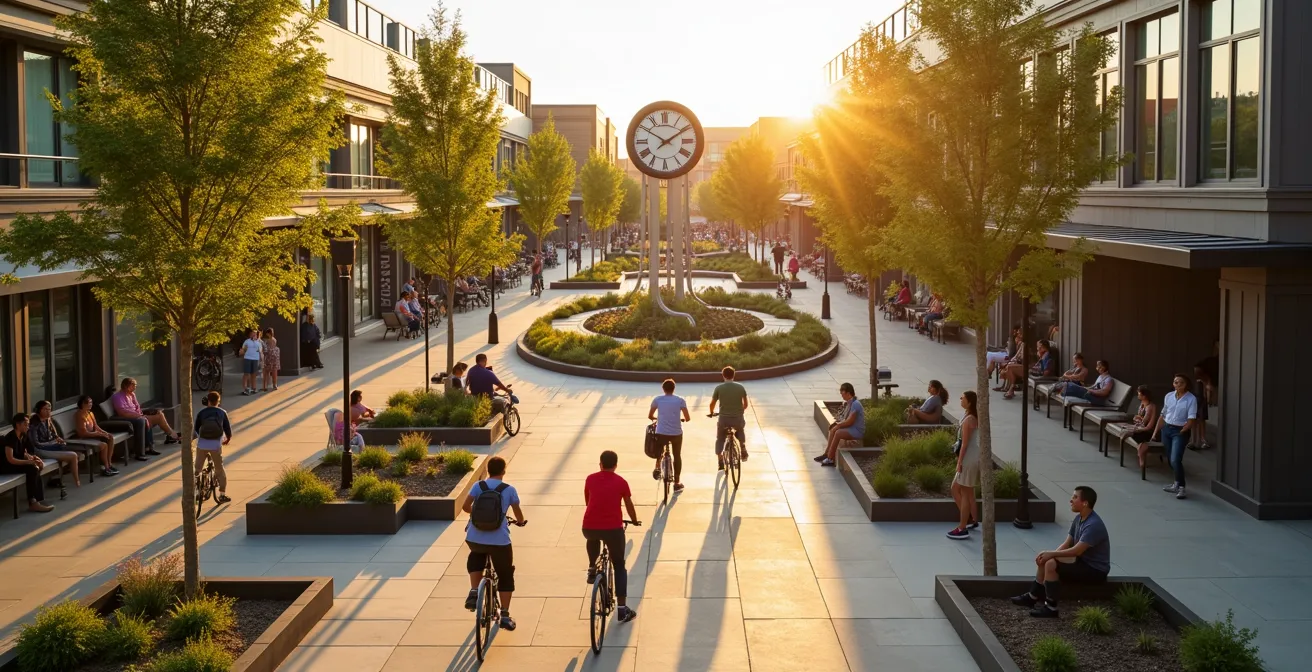
The true value of a 15-minute neighborhood isn’t just convenience; it’s about intentionally designing a ‘network of care’ that gives teenagers independence and parents their time back.
- Modern suburbs often create ‘social dead zones’ that isolate families and increase reliance on cars for every activity.
- Successful models prioritize creating safe ‘third places’ for teens and community hubs with dynamic scheduling for all ages.
Recommendation: Instead of focusing only on property, evaluate a potential neighborhood on its ‘independence infrastructure’—the safe paths, public spaces, and community programs that allow your family to thrive without a car.
The hum of the engine, the endless loop of the same pop songs on the radio, the rearview mirror filled with the faces of children being ferried from one activity to another. For many parents in sprawling suburbs, this is the soundtrack of their lives. We’ve become full-time chauffeurs, and our cars have become mobile waiting rooms. We bought into the dream of a big yard and a quiet street, only to find ourselves trapped by the very distance we sought. Our weekends are consumed by logistics, and the promise of quality family time evaporates on the asphalt between soccer practice and the nearest decent grocery store.
The common solution offered is to ‘manage your time better’ or to carpool, but these are just bandages on a wound inflicted by poor urban design. The problem isn’t our schedule; it’s our geography. But what if we could redesign our suburban life? The 15-minute city concept offers a compelling alternative. It’s not about cramming skyscrapers into quiet neighborhoods. It’s about rediscovering the self-sufficient village model, where life unfolds within a walkable, bikeable radius. This article moves beyond the simple idea of ‘having shops nearby’. We will explore how this model rebuilds the social fabric, creating a network of care that solves critical family challenges, from healthcare deserts to teenage isolation.
In this guide, we’ll deconstruct the key elements that transform a car-dependent suburb into a thriving, walkable community. We will examine the real-world challenges and tangible solutions that empower parents and give children the freedom they need to grow. This is the roadmap to reclaiming your time and rebuilding your village.
Summary: The Path to a Walkable Family Life
- The Pediatrician Gap That Plagues 60% of New Suburban Developments
- How to Start a Neighborhood Watch Without Creating Paranoia?
- Gated Community or Open Suburb: Which Holds Value Better During a Recession?
- The Urban Design Flaw That Keeps Teenagers Indoors
- When to Visit the Community Center to Avoid the “Stroller Jam”?
- Why Your E-Scooter Might Be Illegal on UK Public Roads?
- Native Wildflowers vs Manicured Lawns: Which Saves Taxpayers More?
- Gated Community or Open Suburb: Which Holds Value Better During a Recession?
The Pediatrician Gap That Plagues 60% of New Suburban Developments
One of the most stressful realities for parents in new suburban developments is the healthcare gap. You have a beautiful new home, but the nearest pediatrician accepting new patients is a 45-minute drive away. This isn’t a minor inconvenience; it’s a critical failure of community planning. These areas, often marketed for their family-friendly appeal, become healthcare deserts where urgent needs create logistical nightmares. In fact, the problem is widespread, as recent GoodRx research reveals that over 30 million Americans live more than half an hour from the nearest hospital, a gap that is often even wider for specialized care like pediatrics.
This challenge, however, isn’t unique to the United States. It’s a global issue with different underlying causes, demanding tailored solutions. A truly resilient 15-minute city must have accessible healthcare woven into its fabric, not as an afterthought. This means advocating for mixed-use zoning that encourages satellite clinics, investing in community health centers, and leveraging technology like telehealth to bridge the distance.
The following table illustrates how different countries are tackling similar barriers to healthcare access, offering a glimpse into the creative solutions that can transform a healthcare desert into a connected health ecosystem.
| Country | Main Challenge | Solution Approach |
|---|---|---|
| USA | Insurance networks & distance | Telehealth expansion |
| Canada | GP shortage accepting new patients | Training rural physicians |
| UK | NHS catchment area restrictions | Community health centers |
| China | Urban concentration of hospitals | Mobile clinics & digital health |
Ultimately, a neighborhood isn’t truly family-friendly until a sick child doesn’t automatically mean half a day lost in traffic. Solving this is the first step in building a genuinely supportive environment.
How to Start a Neighborhood Watch Without Creating Paranoia?
The term “neighborhood watch” often conjures images of suspicion, curtains twitching, and an atmosphere of low-grade paranoia. It’s a model based on surveillance, not community. For families looking to build a supportive environment, this approach is counterproductive. The 15-minute city philosophy offers a powerful alternative: shifting the focus from a “neighborhood watch” to a “neighborhood care network.” The goal is not to watch each other, but to watch out for each other. This is about building the trust and organic connections that make a community inherently safer.
It’s about creating a web of support where parents feel comfortable asking a neighbor to watch their kids for ten minutes, where older residents are checked on during a heatwave, and where children have a network of trusted adults beyond their own front door. This is how we transform sterile suburban streets from “social dead zones” into vibrant, interactive spaces. The image of neighbors connecting naturally, as seen in a community garden, is the ultimate goal—a far cry from a security camera.

Building this network doesn’t require complex technology or a significant budget. It begins with small, intentional actions that foster trust and mutual reliance. The focus is on positive engagement and shared responsibility, creating a system where everyone contributes and everyone benefits. This is the true foundation of a safe and thriving family neighborhood.
Your Action Plan: Building a Neighborhood Care Network
- Reframe from ‘watch’ to ‘care’: Shift the focus from surveillance and incident reporting to mutual support, like meal trains for new parents or wellness checks for elderly neighbors.
- Organize a “Walking School Bus”: Map out a route and create a rotating schedule of parent volunteers to walk groups of children to and from school, building community and safety in numbers.
- Create a “Safe Haven” directory: Identify local shops, libraries, or trusted homes that agree to be designated safe spots where a child can go if they feel lost, scared, or need help.
- Establish teen check-in networks: For older kids, create a system for evening activities where groups of parents are aware of their general plans and have a designated contact for the night.
- Use community apps for positive engagement: Utilize platforms like WhatsApp or Facebook Groups to organize playdates, tool-sharing, and community events rather than just reporting suspicious activity.
By taking these concrete steps, we replace a culture of fear with a culture of connection, making our communities safer and more resilient from the inside out.
Gated Community or Open Suburb: Which Holds Value Better During a Recession?
For decades, the gate was a symbol of security and exclusivity, a promise of protected property values. However, as we rethink what makes a community truly valuable, this logic is being turned on its head. During an economic downturn, the resilience of a neighborhood is tested. It’s here that the open, connected, 15-minute suburb reveals its true economic strength. Why? Because its value is not just in the property itself, but in the cost-saving infrastructure it provides to its residents.
When household budgets tighten, the ability to live without a second car—or even a first—is not a lifestyle choice; it’s a massive financial relief. The walkability, access to public transit, and proximity of essential services in a 15-minute community directly translate into thousands of dollars saved annually. An economic analysis shows that an average New York family saves $14,501 annually in these neighborhoods. This built-in affordability acts as a powerful buffer during a recession, making these homes more attractive and helping them retain value better than their car-dependent, gated counterparts.
The experts at Stellarix Urban Planning Research underscore this fundamental shift in their “15 Minute City: The Sustainable Neighborhoods Report,” highlighting the core economic advantage.
The 15-minute city model resolves several basic problems related to urban life. Modest-income families can relieve car ownership pressure as everything is within walking or biking distance.
– Stellarix Urban Planning Research, 15 Minute City: The Sustainable Neighborhoods Report
In contrast, a gated community often doubles down on car dependency. The very gates that promise security also enforce isolation, ensuring every trip for milk, school, or work requires a car. This adds a significant and inflexible cost to a family’s budget, making such properties more vulnerable in a recession. The perceived security of the gate is an illusion when faced with the real-world economic pressure of mandatory transportation costs.
Ultimately, the most secure investment is not a home behind a gate, but a home within a resilient, cost-saving, and connected community.
The Urban Design Flaw That Keeps Teenagers Indoors
There’s a common complaint among suburban parents: “My teenager never leaves their room.” We blame screens and social media, but often, the real culprit is our own neighborhood’s design. Traditional suburbs are designed for two places: the home and the school. There is no “third place” for teenagers—no safe, accessible, and unsupervised space where they can simply hang out. The park is for little kids, the mall requires a car ride, and just “hanging around” on the street is often seen as loitering. This design flaw effectively grounds them, forcing them into digital worlds because the physical one is unwelcoming.
A successful 15-minute community actively designs for teenage independence. This means creating a teenage independence infrastructure—a network of spaces and paths that allows them to have a social life without relying on parents as chauffeurs. This could be multi-use sports courts, outdoor seating with Wi-Fi and charging stations, or designated walls for street art. It’s about trusting them with spaces of their own, which in turn fosters responsibility and genuine social connection.
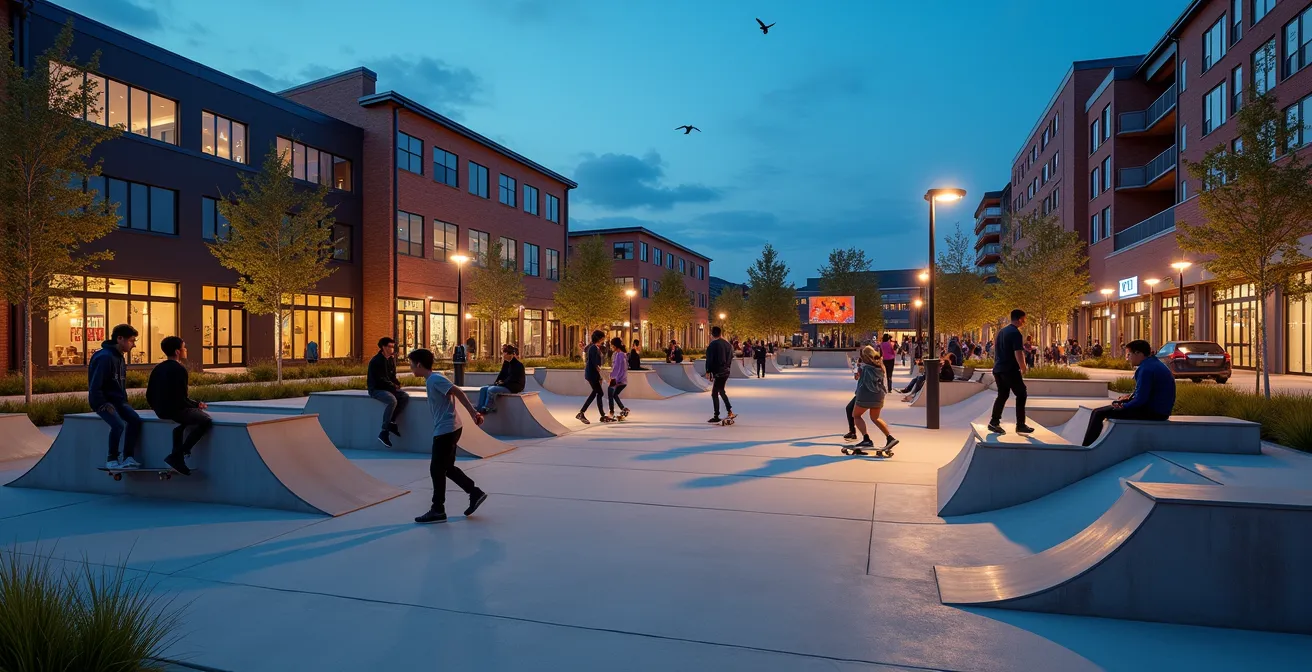
Cities around the world are already proving this concept works, transforming underused urban areas into vibrant hubs for young people. This isn’t just about building a skate park; it’s about seeing teenagers as valid citizens of public space and designing for their needs.
Case Study: Barcelona’s Teen-Friendly Superblocks
Barcelona’s innovative ‘super-block’ system is a prime example of reclaiming urban space for people, including teenagers. By closing off grids of streets to through-traffic, the city creates large, car-free pedestrian zones where teenagers can safely gather, socialize, and play. These spaces are not explicitly ‘teen zones’ but become so organically because they are safe, accessible, and free of charge. As noted in a report on the 15-minute city concept, this approach and others like it in London and Tokyo display hallmarks of teen-friendly design by creating dedicated youth spaces and prioritizing pedestrian freedom.
By providing these spaces, we don’t just get teenagers out of the house; we give them the opportunity to build the real-world social skills and independence they need to thrive.
When to Visit the Community Center to Avoid the “Stroller Jam”?
The community center should be the vibrant heart of a neighborhood, but it often becomes a source of frustration. One minute it’s a serene co-working space for remote workers; the next, it’s a chaotic “stroller jam” during a toddler music class, making it unusable for anyone else. This conflict over shared space is a classic suburban problem. The solution lies not in building more, bigger centers, but in smarter management: what can be called “choreographed proximity.” It’s the art of scheduling a single space to serve different community needs at different times.
This approach recognizes that the “community” is not a monolith. It’s composed of remote workers, stay-at-home parents, teenagers, and seniors, all with different needs and daily rhythms. Dynamic programming maximizes the value of a shared asset by creating designated times for each group, turning a single room into a multi-functional hub that fosters connection rather than conflict. As the father of the 15-minute city concept, Carlos Moreno, explains, the entire model is built on this idea of smart, needs-based proximity.
The 15-minute city model operates on the profound idea that residents should be able to meet most, if not all, of their needs within a short walk or bike ride from their homes.
– Carlos Moreno, 15-Minute City Implementation Guide
A well-choreographed community center embodies this principle perfectly. By scheduling its use throughout the day, it can cater to a wide range of residents, ensuring everyone feels welcome and has a place. The key is to see the space not as a static hall, but as a dynamic stage for community life, with a schedule designed to match the rhythm of the neighborhood.
The following schedule provides a simple yet effective model for how a single community space can be programmed to serve multiple generations throughout the day, avoiding the dreaded “stroller jam” and maximizing its value for everyone.
| Time Slot | Primary Users | Activities | Space Configuration |
|---|---|---|---|
| 9am-12pm | Remote Workers | Quiet Co-working | Open floor with desks |
| 1pm-3pm | Parents & Toddlers | Toddler Takeover | Play mats & soft zones |
| 4pm-6pm | Teenagers | Teen Tech Hub | Gaming & study areas |
| 7pm-9pm | Adults | Evening Workshops | Classroom setup |
This thoughtful scheduling transforms a simple building into a truly responsive community asset, making life easier and more connected for every resident.
Why Your E-Scooter Might Be Illegal on UK Public Roads?
The rise of micro-mobility—e-scooters, e-bikes, and cargo bikes—is a cornerstone of the 15-minute city, promising to liberate families from their cars for short trips. For parents, a cargo e-bike can replace an SUV for the school run, and for a teenager, an e-scooter represents a newfound sphere of freedom. However, this revolution in personal transport is currently tangled in a messy and inconsistent web of regulations. What is perfectly legal in one city might get you a hefty fine in another, creating confusion and risk for families who are trying to do the right thing.
The situation in the United Kingdom is a prime example of this legislative lag. While many European and US cities have integrated e-scooters into their transport networks, the UK government has been much more cautious. As of now, it remains illegal to use a privately owned e-scooter on public roads, pavements, or cycle lanes. They are restricted to private land only. The only legal e-scooters on public roads are those available through government-approved rental trials in specific cities. This creates a confusing paradox where you can rent one but not own and ride one.
This regulatory uncertainty is not just a UK problem. Across North America, rules regarding age limits, helmet laws, speed caps, and where you can ride vary dramatically from state to state and even city to city. For the 15-minute city model to truly succeed, we need clear, consistent, and common-sense legislation that supports safe micro-mobility for all ages. Without it, the promise of a car-free life remains frustratingly out of reach for many families.
Advocating for clear government guidance and dedicated infrastructure, like protected lanes and secure parking, is a critical step for communities wanting to fully embrace these transformative technologies.
Native Wildflowers vs Manicured Lawns: Which Saves Taxpayers More?
The perfect, manicured lawn is a symbol of suburban pride, but it’s also a voracious consumer of resources: water, fertilizer, gasoline for mowing, and, most importantly, time. For busy parents, an hour spent mowing the lawn every weekend is an hour not spent with family. For municipalities, it’s a significant drain on the budget. A growing movement towards suburban rewilding—replacing sterile turfgrass with native wildflowers and plants—offers a powerful solution that is better for our wallets, our environment, and our well-being.
The economic case is surprisingly strong. By converting just a portion of public green spaces from high-maintenance lawns to self-sustaining native meadows, municipalities can slash costs. A municipal budget analysis demonstrates a saving of about half an hour of mowing time per acre for each conversion. Scale that across a suburb’s parks and roadsides, and the savings in labor, fuel, and equipment are substantial. For homeowners, the benefit is more direct: less time working on the yard and more time enjoying it.

Beyond the direct savings, rewilding brings our local ecosystems back to life. These native meadows become critical habitats for pollinators like bees and butterflies, which are essential for a healthy environment. The UK’s “No Mow May” campaign is a fantastic example of this principle in action, showing how a simple change in landscaping habits can have a profound ecological impact.
Case Study: The UK’s Rewilding Movement
The United Kingdom has lost a staggering 97% of its wild meadows since the 1930s, devastating local biodiversity. In response, rewilding initiatives like the “No Mow May” campaign encourage residents and councils to let lawns grow wild to support hundreds of species of wildflowers and the wildlife that depends on them. These revitalized green spaces not only become essential habitats but also act as natural carbon stores, contributing to climate goals while restoring the natural beauty of the landscape.
By embracing the beauty of a wildflower meadow over the monotony of a green lawn, we make a choice that is both economically savvy and environmentally responsible.
Key Takeaways
- True community safety is built on a “network of care,” not surveillance.
- Designing “third places” for teenagers is crucial for their independence and social well-being.
- Open, walkable neighborhoods offer greater financial resilience during a recession than isolated, gated communities.
Gated Community or Open Suburb: Which Holds Value Better During a Recession?
We’ve explored how the 15-minute city model builds social connection, fosters independence, and enhances our local environment. Now, let’s circle back to the foundational question for any family making a long-term investment: what is the most secure financial choice? As we’ve seen, the answer defies old logic. The true, lasting value of a community is not found behind a gate but in its inherent connectivity and the lifestyle it enables. It’s the culmination of all these other factors—the care network, the teen-friendly spaces, the walkable access to services—that creates unshakable economic resilience.
A home in a well-designed 15-minute suburb is more than just property; it’s an integrated system for a better, more affordable life. The financial benefits are interwoven with the social ones. The ‘walking school bus’ saves gas money. The local pediatrician saves time, which is money. The teenage ‘third place’ means fewer expensive, chauffeured trips to the mall. These aren’t just minor perks; they are structural savings that make a home more affordable to run month after month, year after year.
This is why, during a recession, these neighborhoods hold their value. Their appeal broadens precisely when budgets tighten. The ability to live a full, rich life with reduced transportation costs becomes a primary selling point. The very design that makes the community more livable also makes it a more stable and desirable investment. The choice is no longer just about the number of bedrooms, but about the number of hours you get back in your week.
To put these ideas into practice, the next logical step is to evaluate potential neighborhoods not just on curb appeal, but on their built-in potential to support a connected, car-light family life.
Frequently Asked Questions on Why the 15-Minute City Model Saves Families 10 Hours of Commuting Weekly?
Can teenagers legally ride e-scooters in residential areas?
Regulations vary significantly: the UK restricts private e-scooters to private land only, while many US states allow them on bike paths with age restrictions (typically 16+). It’s crucial to check your local city and state/provincial ordinances.
What helmet laws apply to children on cargo e-bikes?
Most jurisdictions, including states in the US and provinces in Canada, require helmets for all minors riding bicycles, including as passengers on cargo e-bikes. Specific requirements for helmet type and age can vary by country and region.
How can parent groups advocate for micro-mobility infrastructure?
Parent groups can be powerful advocates. Start by petitioning your local council or municipality for pilot programs for e-scooters or protected bike lanes. Demand clear government guidance on usage rules and push for the inclusion of dedicated parking and charging infrastructure as part of any new 15-minute neighborhood or community development plans.