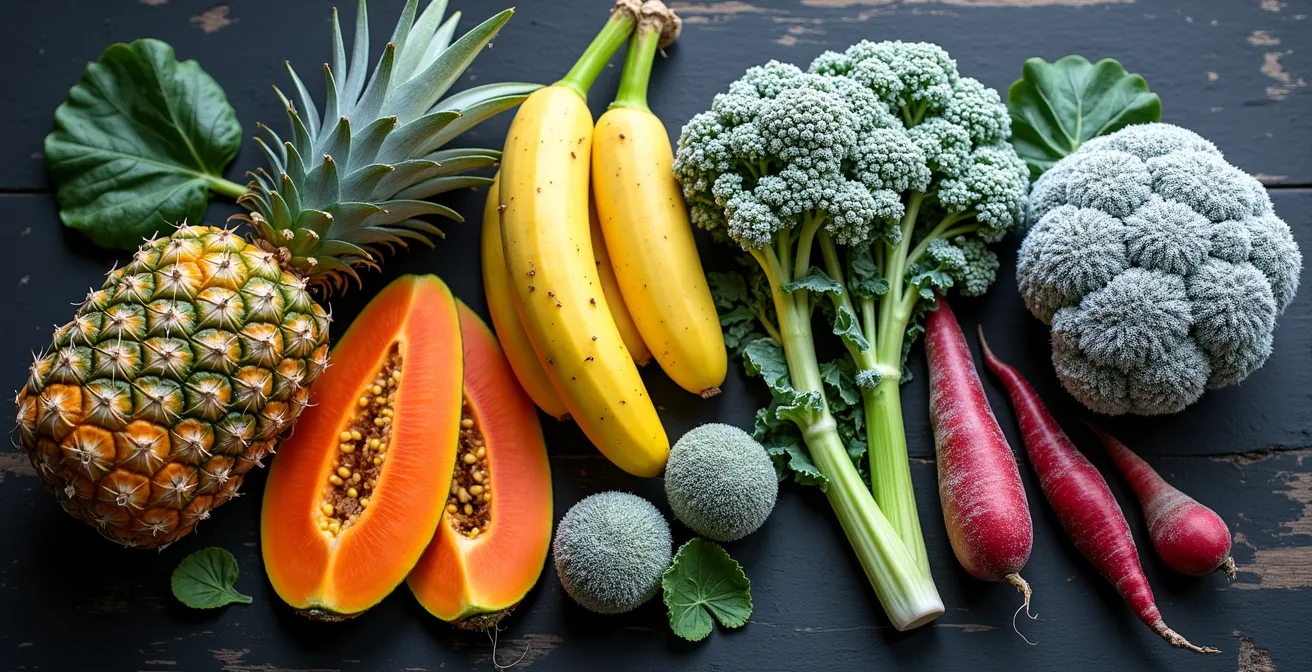
Contrary to the belief that all fruit is good for immunity, eating tropical fruits in winter can actively weaken your body’s defenses by creating an internal “thermal shock.”
- Your body’s “metabolic fire” needs warming, cooked foods in winter to maintain core temperature and digestive efficiency.
- Cooling foods like mangoes and pineapples force your system to expend precious energy, creating a state of “internal dampness” that compromises immunity.
Recommendation: Sync your diet with the season by choosing local, warming foods like root vegetables and spices to build true resilience from within.
As the days grow shorter and a chill settles in the air, the annual quest for immune resilience begins. We’re told to arm ourselves with Vitamin C, and the supermarket aisles, brimming with vibrant mangoes, pineapples, and kiwis, seem to offer a delicious solution. The common wisdom suggests that any fruit is a good weapon in the fight against winter colds. We diligently blend them into smoothies and add them to our breakfast bowls, believing we are fortifying our defenses against the inevitable onslaught of germs.
But what if this conventional approach is fundamentally flawed? What if, in our attempt to supercharge our immunity, we are actually sabotaging it? This isn’t about avoiding fruit; it’s about understanding a deeper biological dialogue between our internal environment and the world outside. Ancient healing systems like Traditional Chinese Medicine (TCM) have taught for millennia that our bodies are not isolated machines but microcosms that must harmonize with the macrocosm of the seasons. Modern science is now beginning to validate this age-old wisdom, revealing the intricate ways our metabolism, hydration, and even our genes respond to the food we eat in the context of the season.
The truth is, your body has an innate intelligence. The key to unshakeable winter immunity lies not in overwhelming it with out-of-season tropical sunshine, but in learning to listen to its needs and supporting its natural efforts to stay warm and strong. This article will explore the powerful, and often counter-intuitive, principles of seasonal eating. We will deconstruct why that “healthy” tropical fruit smoothie might be your immune system’s worst enemy in January and reveal how to truly align your nutrition with the environment to build a resilient, energetic, and vibrant you, all winter long.
To guide you through this paradigm shift in winter wellness, we will explore the science and wisdom behind seasonal nutrition. This article breaks down the core principles for building a robust “metabolic fire” that will keep you strong until spring.
Summary: Why Eating Tropical Fruit in Winter Might Weaken Your Immunity?
- Ginger vs Chili: Which Heat Source Best Stimulates Circulation?
- The Spring Detox Mistake That Shocks Your Metabolism
- Slow Cooking vs Boiling: Which Method Retains More Vitamins in Root Vegetables?
- Why You Are Dehydrated in January Despite Drinking 2 Liters a Day?
- Imported Asparagus vs Local Kale: Is the Nutrient Density Worth the Carbon Footprint?
- Why Eating Raw Salads in Winter Damages Your “Qi”
- When to Wrap Pots: The Frost Date Mistake That Cracks Ceramic
- Acupuncture for Migraines: Placebo Effect or Proven Pain Relief?
Ginger vs Chili: Which Heat Source Best Stimulates Circulation?
When seeking warmth in winter, we often reach for “hot” spices. But not all heat is created equal. From a holistic perspective, the goal isn’t just to feel a flash of heat, but to kindle a deep, sustainable metabolic fire that supports circulation from the inside out. This is where the crucial difference between chili and ginger becomes clear. Chili peppers contain capsaicin, which creates a fiery, superficial sensation. It’s a fast-acting flame that can induce sweat, which paradoxically can lead to cooling.
Ginger, on the other hand, provides a profound, penetrating warmth. Its active compounds, gingerols and shogaols, work on a much deeper level to stimulate circulation and warm the body’s core. It doesn’t just feel warm; it physiologically supports the body’s thermogenic processes. This is more than just ancient wisdom; modern research shows that after consuming ginger, its pungent compound 6-shogaol is rapidly absorbed, reaching peak concentrations in the blood within 30-60 minutes to exert its effects systemically. Further studies on vascular tissue have shown that ginger extract promotes the relaxation of arteries, enhancing vasoprotection and improving blood flow. This makes it an ideal spice for combating the cold stagnation of winter.
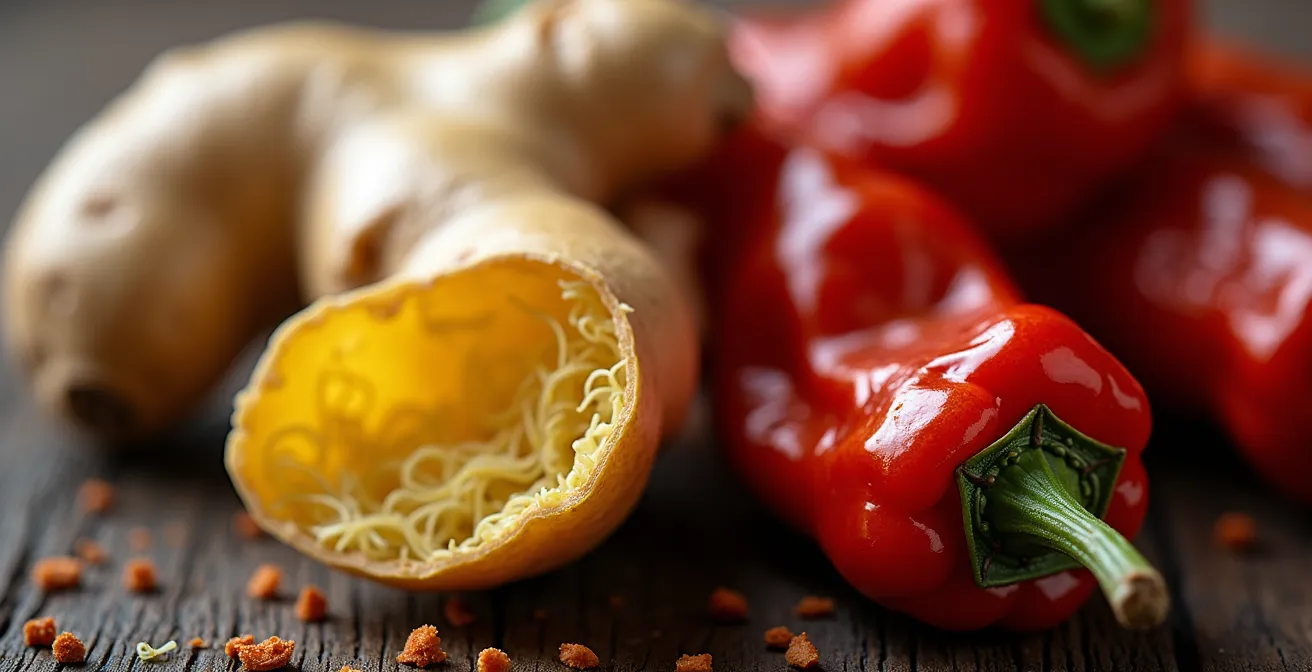
As the image highlights, these two sources of heat have fundamentally different textures and compositions. Think of chili as a quick-burning piece of paper, providing a brief, intense flare-up. Ginger is more like a dense log on the fire, smoldering slowly to provide a lasting, foundational heat that truly supports your body’s digestive integrity and invigorates the flow of warmth to your extremities. For genuine winter resilience, kindling your internal fire with ginger is the superior strategy.
The Spring Detox Mistake That Shocks Your Metabolism
As winter’s grip loosens, the desire for renewal is strong. We are bombarded with messages promoting “spring cleanses” and “detoxes” filled with raw juices and cold salads. While the intention is good, initiating this cooling regimen too early can be a profound shock to a metabolism still calibrated for winter. After months of working to conserve heat and energy, the body’s digestive fire (or “Spleen Qi” in TCM) is not prepared for a sudden influx of raw, cold foods. This premature shift can extinguish the metabolic fire, leading to bloating, fatigue, and ironically, a weakened immune response.
As certified nutritionist Serena Poon notes, “Eating a diet that is full of antioxidant-rich foods, such as vegetables, fruits, and nuts can help protect your body from oxidative stress.” The critical factor, however, is not just *what* you eat, but *when* and *how*. The transition to spring eating must be gradual and aligned with the external environment, not the calendar. Your body provides clear signals when it is ready to shift from winter’s warming, cooked foods to spring’s lighter, fresher fare. Honoring these signals is key to a smooth and energizing transition, preventing the metabolic shock that can set back your health.
Your Body’s Readiness Checklist: 5 Signs You’re Not Ready for a Spring Detox
- Local Climate Reality: Check if your local outdoor temperatures are still consistently below 10°C (50°F). If so, your body is biologically still in winter preservation mode.
- Innate Cravings: Observe your food cravings. If you find yourself still desiring warm soups, stews, and roasted foods over raw salads, your body is signaling its need for warmth.
- Energy Level Monitoring: Pay attention to your energy after a meal. Sudden fatigue or feeling “drained” after starting a regimen of raw juices or smoothies indicates a metabolic shock.
- Digestive Feedback: Track for any new digestive symptoms. Bloating, gas, or loose stools after eating cooling foods suggest your digestive system (“Spleen Qi”) cannot yet handle their energetic nature.
- Wait for Nature’s Cue: Look for the first appearance of local spring greens like wild garlic or dandelions. When nature itself shifts, your body is biologically primed to follow suit.
Ignoring these signs and forcing a detox too early is like throwing a bucket of ice water on a smoldering fire. You don’t just put the fire out; you create a cold, damp environment where pathogens can thrive. A successful spring transition is one that works with your body’s rhythm, not against it.
Slow Cooking vs Boiling: Which Method Retains More Vitamins in Root Vegetables?
In winter, our diet naturally shifts toward grounding, nourishing root vegetables. But how we cook them is just as important as choosing them in the first place. The goal is twofold: maximize nutrient retention and ensure the food is easy for our body to digest and convert into energy. When comparing common cooking methods, slow cooking (like in stews and braises) consistently emerges as the superior choice for winter wellness, far outperforming simple boiling, especially when the water is discarded.
Boiling subjects vegetables to high temperatures and direct contact with large amounts of water, which can leach a significant portion of water-soluble nutrients like Vitamin C and B vitamins. Slow cooking, however, uses lower temperatures over a longer period. This gentle process helps break down tough cellular walls, making nutrients more bioavailable, while the enclosed environment ensures that any nutrients that do escape into the cooking liquid are consumed as part of the delicious, warming broth. This is a principle intuitively understood in traditional cuisines worldwide, from Chinese preparations of winter Daikon radish to hearty European beef stews, which are designed to extract and preserve every ounce of nourishment.
| Method | Vitamin C Retention | B Vitamin Retention | Mineral Retention | Bioavailability |
|---|---|---|---|---|
| Slow Cooking (Stewing) | 60-70% | 75-85% | 90-95% | High – breaks down cell walls |
| Boiling (Water Discarded) | 20-40% | 40-60% | 50-70% | Moderate – nutrients leached |
| Boiling (Soup/Broth Kept) | 70-80% | 80-90% | 95-100% | Highest – nutrients in liquid |
As the data clearly shows, stewing or making soups where the liquid is consumed is the optimal way to retain the full spectrum of nutrients. This method aligns perfectly with the body’s needs in winter, providing food that is not only nutrient-dense but also energetically warming and “pre-digested,” requiring less energy from your system to assimilate. It’s a clear demonstration of how ancient wisdom regarding food preparation is directly supported by modern nutritional science.
Why You Are Dehydrated in January Despite Drinking 2 Liters a Day?
It’s one of winter’s great paradoxes: you diligently drink water all day, yet your skin feels dry, your lips are chapped, and you feel a persistent, low-level fatigue. The culprit is a phenomenon we can call “winter dehydration,” a state driven by a combination of physiological and environmental factors. Firstly, the cold itself blunts our perception of thirst. In fact, research indicates up to a 40% diminished thirst response in cold weather, meaning we simply don’t feel the need to drink even when our body requires fluid.
Secondly, our indoor environments become profoundly dehydrating. As one medical journal on the topic explains, “During the winter months, there is a reduction in relative humidity due to heating the air to a comfortable working temperature, which predisposes an individual to dehydration.” This dry, heated air constantly leaches moisture from our skin and respiratory system with every breath we take. Drinking liters of cold water isn’t the solution. From a TCM perspective, this creates internal dampness—the body becomes water-logged, but the cells remain thirsty because the cold fluid is difficult for the metabolic fire to transform and transport where it’s needed.

True winter hydration is about temperature and form. The solution lies in consuming warm fluids that support, rather than challenge, your core temperature. Think warm herbal teas, savory bone broths, and the nourishing liquid from slow-cooked stews. These hydrating fluids are readily assimilated by the body, effectively replenishing the moisture lost to the dry, heated air of our homes and offices. It’s about hydrating at a cellular level, not just filling your stomach.
Imported Asparagus vs Local Kale: Is the Nutrient Density Worth the Carbon Footprint?
In the dead of winter, a bundle of fresh, green asparagus flown in from Peru can feel like a welcome taste of summer. But beyond the carbon footprint of its journey, there is a deeper, biological reason to choose the humble, locally-grown kale that has weathered the frost. The answer lies in a fascinating scientific concept known as xenohormesis. This is the idea that we, as humans, derive health benefits from eating plants that have experienced a degree of environmental stress.
A plant that has to survive the cold, fluctuating light, and other challenges of a real winter produces a powerful arsenal of protective compounds—polyphenols, antioxidants, and other phytochemicals—to defend itself. When we eat that plant, we absorb these compounds, and they in turn bolster our own resilience. Studies on xenohormesis show that stressed plants can have up to a 10x increase in these protective phytochemicals compared to their counterparts grown in perfect, climate-controlled conditions. The imported asparagus, grown in a perpetual, artificial summer, simply does not possess this stress-induced potency.
This principle directly supports the evolutionary wisdom of seasonal eating. As a study in Discover Magazine points out, our biology is designed to sync with our environment, and consuming local, seasonal food is a primary mechanism for this alignment. The “stressed” winter kale provides precisely the information and compounds our bodies need to thrive in the cold. That imported asparagus, on the other hand, delivers a biological message of “summer” to our cells, creating a confusing and desynchronizing signal that can disrupt our internal clocks and metabolic processes. The choice is clear: the true nutrient density for winter comes from the resilient local greens that have earned their stripes in the cold.
Why Eating Raw Salads in Winter Damages Your “Qi”
In Traditional Chinese Medicine, “Qi” (pronounced “chee”) can be understood as the vital life force or metabolic energy that animates all of our bodily functions. The digestive system, known as the Spleen and Stomach network, is considered the central powerhouse for producing this energy from the food we eat. This system is often described as a “cauldron” that needs a strong “fire” to cook or transform food into Qi and Blood. In winter, this digestive fire is naturally more vulnerable and needs to be protected.
This is precisely why consuming cold and raw foods, like a typical green salad, is discouraged during the colder months. As noted by TCM experts at The Modern Dr, “Cold and raw foods can weaken the digestive system, which is seen as the body’s energy powerhouse in TCM.” When you eat a raw salad, your body must expend a significant amount of its own precious Qi to heat the food up to body temperature before it can even begin to digest it. This effectively drains your metabolic battery and weakens the digestive fire, leading to symptoms of what TCM calls “Spleen Qi Deficiency”—fatigue, bloating, and a feeling of coldness.
This doesn’t mean you must abandon vegetables in winter. The key is to transform them energetically through cooking. Instead of a cold, raw salad, you can:
- Lightly steam or sauté dark leafy greens like kale or chard.
- Add roasted root vegetables such as beets, carrots, and sweet potatoes while they are still warm.
- Incorporate warming proteins like grilled chicken or baked tempeh.
- Create dressings using warming ingredients like ginger, garlic, and gently heated sesame oil.
- Top with toasted nuts and seeds for a warming, nourishing crunch.
By applying warmth and cooking, you are essentially “pre-digesting” the food, making it far easier for your body to extract the vital nutrients without depleting its own energy reserves. You are supporting your Qi, not taxing it.
When to Wrap Pots: The Frost Date Mistake That Cracks Ceramic
In gardening, there’s a critical lesson about thermal shock. If you leave a porous ceramic pot, saturated with moisture, outside during a sudden frost, the water inside its walls will freeze, expand, and crack the pot. The pot, unable to withstand the rapid internal expansion against the cold, rigid exterior, shatters. This powerful image serves as the perfect metaphor for what happens to our digestive system when we make the “frost date mistake” in our diet—consuming energetically cold foods, like tropical fruits, in a cold environment.
Our digestive system is this ceramic pot. In winter, it is working to maintain a constant, warm internal environment (our “metabolic fire”). When we introduce a food that is not only physically cold but also energetically cooling—like a banana or watermelon—we create a violent thermal shock. The system must divert a massive amount of energy to warm this food, a process that “chills” the digestive fire and weakens its function. This shock, repeated over time, creates micro-fissures in our digestive integrity, leading to what TCM calls “dampness”—a condition of poor fluid metabolism, bloating, heaviness, and weakened immunity. Just as different regions have different frost patterns, from the single sharp frosts of a temperate climate to the prolonged deep freeze of a northern one, our bodies require dietary strategies tailored to our specific environment.
Eating a pineapple in Canada in January is the dietary equivalent of leaving a water-logged pot out in an Alberta freeze. It’s a fundamental mismatch between the object’s nature and the environmental conditions. Respecting this principle of thermal harmony is the absolute foundation of maintaining a strong immune system through the winter. We must “wrap our pots” by choosing warming, cooked, and seasonal foods that insulate and support our core, rather than shocking it with an internal frost.
Key Takeaways
- Align Diet with Season: Your body’s needs change with the environment. Choose local, seasonal foods to provide the right biological signals for resilience.
- Prioritize Warmth: In winter, focus on cooked and warming foods (soups, stews, roasted vegetables, spices like ginger) to support your “metabolic fire” and digestive energy.
- Rethink Hydration: True hydration in winter comes from warm fluids like broths and herbal teas, not cold water or cooling fruits, which can create “internal dampness.”
Acupuncture for Migraines: Placebo Effect or Proven Pain Relief?
While diet is the foundation of winter wellness, other holistic practices can powerfully reinforce our efforts to maintain a strong internal fire. Acupuncture, a cornerstone of Traditional Chinese Medicine, offers a targeted way to bolster the body’s energy and immunity. Though often discussed in the context of pain relief for conditions like migraines, its benefits are far more systemic. In TCM, migraines are often seen as a result of “stagnation”—a blockage in the flow of Qi and Blood. Acupuncture works by inserting fine needles at specific points to clear these blockages and restore smooth circulation.
This principle of promoting flow is precisely what’s needed during winter, a season prone to stagnation from cold and inactivity. As experts at the TCM Healing Center state, “Acupuncture offers a powerful, targeted method to ‘warm the channels’ and invigorate the flow of ‘Qi and Blood’, a core principle for winter wellness.” This isn’t just an energetic concept; it has measurable physiological effects. Beyond its well-documented effects on pain, studies demonstrate that acupuncture can lead to increased white blood cell counts and antibody levels, providing a direct boost to the body’s defensive capabilities.
Therefore, viewing acupuncture solely through the lens of pain relief or placebo misses its profound role in preventative health. It acts as a partner to a seasonal diet. While warming foods fuel the metabolic fire from within, acupuncture works from the outside to ensure that the warmth and energy you’re creating circulate freely throughout the body, strengthening your defenses and preventing the internal cold and stagnation that leave you vulnerable to illness. It is a proactive strategy to keep your internal ecosystem balanced, flowing, and resilient against the external challenges of winter.
By embracing these principles of seasonal alignment—choosing warming foods, cooking them appropriately, and supporting your body’s energy flow—you can move beyond simply fighting off colds and begin to cultivate a deep, unshakable vitality that lasts all winter long.