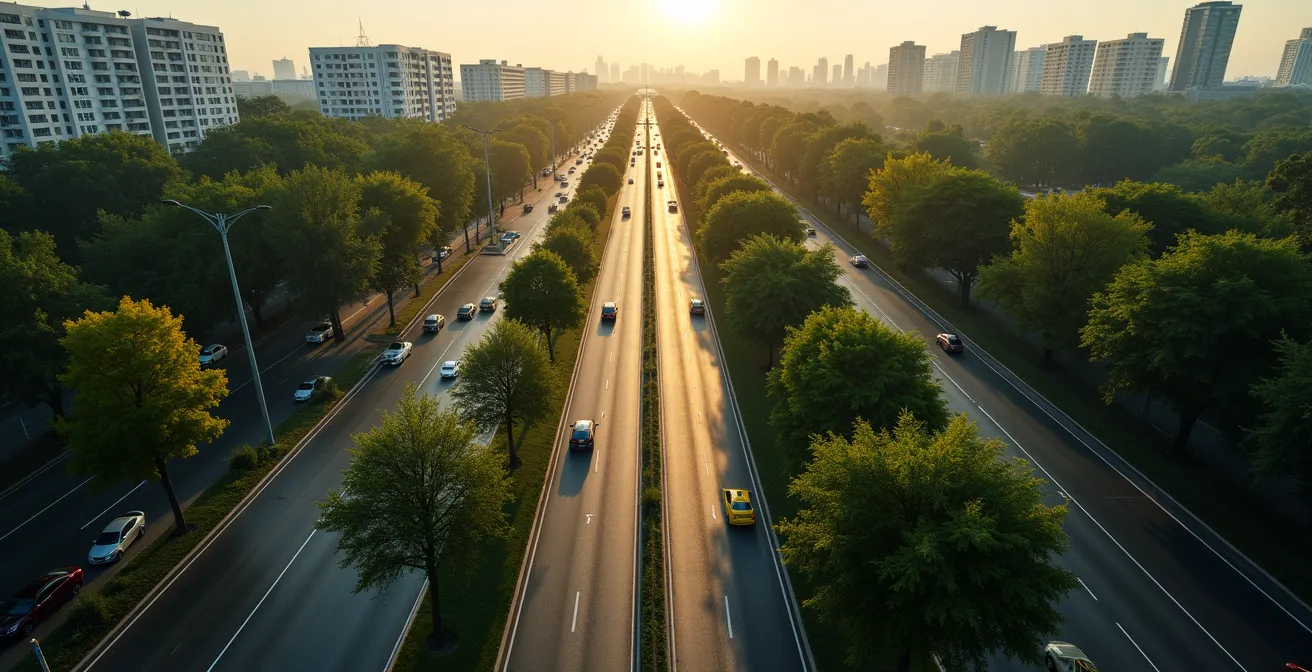
In summary:
- The intense heat on your street isn’t just from sunlight; it’s a systemic failure of how cities manage heat and water.
- Hard, dark surfaces like asphalt act as a massive “thermal mass,” absorbing and radiating heat long after sunset.
- Strategic green infrastructure—more than just trees—functions as an “evapotranspiration engine” to actively cool the air.
- Reconnecting the urban landscape to its natural water cycle with permeable surfaces is critical for both cooling and flood prevention.
- By engineering our green spaces with a focus on function, we can directly improve public health, save money, and build resilient cities.
You feel it every summer: the refreshing coolness of a park, followed by a blast of heat the moment you step back onto a paved street. That temperature difference, which can easily be 5°C or more, is not just a minor discomfort. It is the tangible result of the Urban Heat Island (UHI) effect, a phenomenon turning our cities into ovens. For decades, the conventional wisdom has been to simply “plant more trees” or paint surfaces white. While not incorrect, these solutions barely scratch the surface of a much deeper engineering problem.
The reality is that urban heat is a symptom of systemic failure. Our cities are designed with a profound hydrological disconnect; they are built to shed water as quickly as possible, eliminating the natural cooling that comes from evaporation. The vast expanses of concrete and asphalt act as a giant thermal mass, absorbing solar radiation all day and releasing it all night, preventing any real relief. To truly address this, we must stop thinking like gardeners and start thinking like climate adaptation engineers. The key is not just adding green decoration, but redesigning our urban fabric as an integrated system of energy and water management.
This article will deconstruct the science behind urban heat islands from an engineering perspective. We will move beyond the platitudes to explore how targeted interventions—from the species of wildflowers we plant to the type of pavement under our feet—can systematically dismantle these heat traps. We’ll examine the data-driven connections between green infrastructure and public health, the surprising economic arguments for rewilding urban spaces, and the critical design choices that determine whether a green space cools a city or creates new problems.
To understand the physiological stress caused by this excess urban heat, the following video explores what happens to the human body in extreme temperature conditions, highlighting why mitigating the UHI effect is a critical public health priority.
To navigate these interconnected solutions, this guide breaks down the core challenges and opportunities. The following sections explore the specific, evidence-based strategies that can transform our sweltering streets into cooler, healthier, and more resilient environments.
Summary: Re-Engineering the Urban Landscape to Combat Excess Heat
- Can a Green Corridor Really Lower Local Asthma Rates?
- Native Wildflowers vs Manicured Lawns: Which Saves Taxpayers More?
- The Paving Mistake That Floods Basements During Summer Storms
- Foxes and Coyotes: How to Design Green Spaces That Don’t Invite Pests?
- When to Plant Urban Trees: The Seasonal Window for 90% Survival Rates
- Why 40% of Grant Applications for Home Energy Retrofits Get Rejected?
- Reverse Osmosis vs Carbon: Which Filter Removes Microplastics Best?
- Can a Green Corridor Really Lower Local Asthma Rates?
Can a Green Corridor Really Lower Local Asthma Rates?
The link between green spaces and respiratory health is far more direct than a simple feeling of “fresh air.” It’s a matter of particle physics and atmospheric chemistry. Urban environments are saturated with harmful pollutants like fine particulate matter (PM2.5) from vehicle exhaust and nitrogen dioxide (NO2). These microscopic particles penetrate deep into the lungs, triggering and exacerbating respiratory conditions like asthma. Green corridors—continuous networks of vegetation—act as large-scale, biological air filters. The complex surfaces of leaves and stems effectively capture and remove these airborne particles from the local atmosphere.
The quantitative impact is significant. A comprehensive 2024 global study found that well-designed green corridors can reduce PM2.5 concentrations by up to 27% within their immediate vicinity. This isn’t just a theoretical benefit. The city of London provides a powerful real-world example. Between 2016 and 2023, targeted policies including the expansion of its Ultra Low Emission Zone led to a 50% reduction in NO2 levels. In 2023, the city achieved its lowest-ever recorded PM2.5 concentrations, meeting WHO interim targets for the first time. This directly translates to public health outcomes, especially for the most vulnerable populations.
The correlation is so strong that it can be measured in terms of childhood health. As experts at the Mercator Research Institute noted in a report for the World Economic Forum, the implementation of these clean air policies has a profound, measurable effect:
A 13% reduction in asthma in children born in urban low-emission zones
– Mercator Research Institute, World Economic Forum Clean Air Report 2024
This demonstrates that a green corridor is not just an aesthetic amenity; it is a critical piece of public health infrastructure. By engineering these natural systems into our cities, we can actively reduce the environmental triggers for chronic respiratory diseases, creating a healthier populace as a direct result of improved urban design.
Native Wildflowers vs Manicured Lawns: Which Saves Taxpayers More?
The traditional manicured lawn is an ecological and economic fallacy. It represents a resource-intensive monoculture that demands constant inputs: mowing (labor and fuel), irrigation (water), and chemical treatments (fertilizers and pesticides). From a systems engineering perspective, it’s a high-maintenance, low-return asset. In contrast, a native wildflower meadow, once established, functions as a largely self-sustaining ecosystem that provides immense value with minimal ongoing cost. These meadows support pollinators, improve soil health, and require a fraction of the resources demanded by turfgrass.
The long-term economic argument is overwhelmingly in favor of native plantings. By transitioning from manicured lawns to wildflower meadows, municipalities can achieve staggering cost reductions in public space management. This isn’t just about saving a few dollars; it’s about reallocating significant public funds from costly, repetitive maintenance to more valuable services. The initial setup cost for a meadow may be slightly higher due to soil preparation and seeding, but this is quickly offset by a drastic drop in recurring expenses.

As the photograph above illustrates, these spaces are not unkempt wastelands but vibrant, complex ecosystems. The financial data below solidifies the argument, presenting a clear picture of the systemic ROI that can be achieved. An analysis of municipal costs over a ten-year period shows that the savings are not marginal but transformative. For every acre converted, the savings can approach six figures.
This comparative analysis from the U.S. Environmental Protection Agency (EPA) breaks down the costs, revealing the stark economic difference between these two approaches to urban green space.
| Cost Category | Traditional Lawn (per acre/10 years) | Native Wildflower Meadow (per acre/10 years) | Savings |
|---|---|---|---|
| Mowing Labor | $45,000 | $3,000 | $42,000 |
| Water Usage | $28,000 | $2,000 | $26,000 |
| Fertilizers/Pesticides | $15,000 | $0 | $15,000 |
| Equipment/Fuel | $12,000 | $1,500 | $10,500 |
| Initial Setup | $5,000 | $8,000 | -$3,000 |
| Total 10-Year Cost | $105,000 | $14,500 | $90,500 |
The Paving Mistake That Floods Basements During Summer Storms
The most common paving mistake in urban development is treating the ground as an impermeable seal. Traditional asphalt and concrete are designed to shed water as fast as possible into stormwater systems. This creates a “hydrological disconnect,” where rainfall is treated as waste to be disposed of rather than a resource to be managed. During intense summer storms, which are becoming more frequent with climate change, this design philosophy has two dangerous consequences: it overloads municipal sewer systems, causing street-level flooding, and it concentrates massive volumes of water directly against building foundations, leading to basement flooding.
The engineering solution is to shift our perspective across the permeability spectrum. Instead of fighting water, we must design surfaces that work with it. Permeable pavements—such as pervious concrete, porous asphalt, and interlocking pavers—allow rainwater to infiltrate the ground directly beneath them. This re-establishes the natural water cycle, recharging groundwater and reducing runoff volume to a manageable trickle. Critically, this also provides a significant cooling benefit. As trapped water evaporates from these surfaces, it creates a powerful cooling effect, with studies showing a 2-9°F surface temperature reduction compared to conventional pavement.
Proper implementation requires more than just choosing a new material; it demands careful attention to grading and site design. Water must still be directed away from foundations before it has a chance to infiltrate. A poorly designed permeable driveway can become a liability, channeling water toward the very structure it’s meant to protect. Therefore, a holistic approach that combines permeable materials with intelligent landscape grading is essential for both flood prevention and urban cooling.
Critical Grading and Drainage Checklist for Homeowners
- Verify that the ground slopes away from your foundation by a minimum of 2% for the first 10 feet to ensure positive drainage.
- When installing permeable pavers, ensure a deep, 6-inch gravel base is used to provide an adequate reservoir for water infiltration.
- Design and place rain gardens at least 10 feet away from the foundation to safely capture roof runoff and other concentrated flows.
- For driveways and patios, consider pervious concrete, which can absorb 3-8 gallons of water per minute per square foot, drastically reducing runoff.
- Before beginning a project, check your local municipal stormwater codes, as many have specific regulations regarding concentrated flow and liability.
Foxes and Coyotes: How to Design Green Spaces That Don’t Invite Pests?
As green corridors and urban wilds expand, encounters with wildlife like foxes and coyotes become more common. This is not inherently a problem; it is a sign of ecological restoration. However, conflict arises when green space design inadvertently invites these adaptable animals into residential areas, creating nuisance issues or perceived threats. The engineering challenge is not to eliminate wildlife, but to design landscapes that encourage coexistence by creating clear, defensible boundaries and removing unintentional attractants. This is a matter of strategic planting and habitat management, not extermination.
The primary attractants for urban canids are food and shelter. Open compost piles, fallen fruit from ornamental trees, and pet food left outdoors are powerful invitations. Similarly, dense, unmanaged shrubbery directly adjacent to homes provides ideal denning sites for foxes, while overgrown lots offer cover for coyotes. The solution lies in creating a landscape that is less accommodating. This involves choosing plant species strategically—using thorny or prickly shrubs as natural barriers rather than dense, soft hedges—and maintaining a “clean edge” between human-used spaces and wilder greenways.
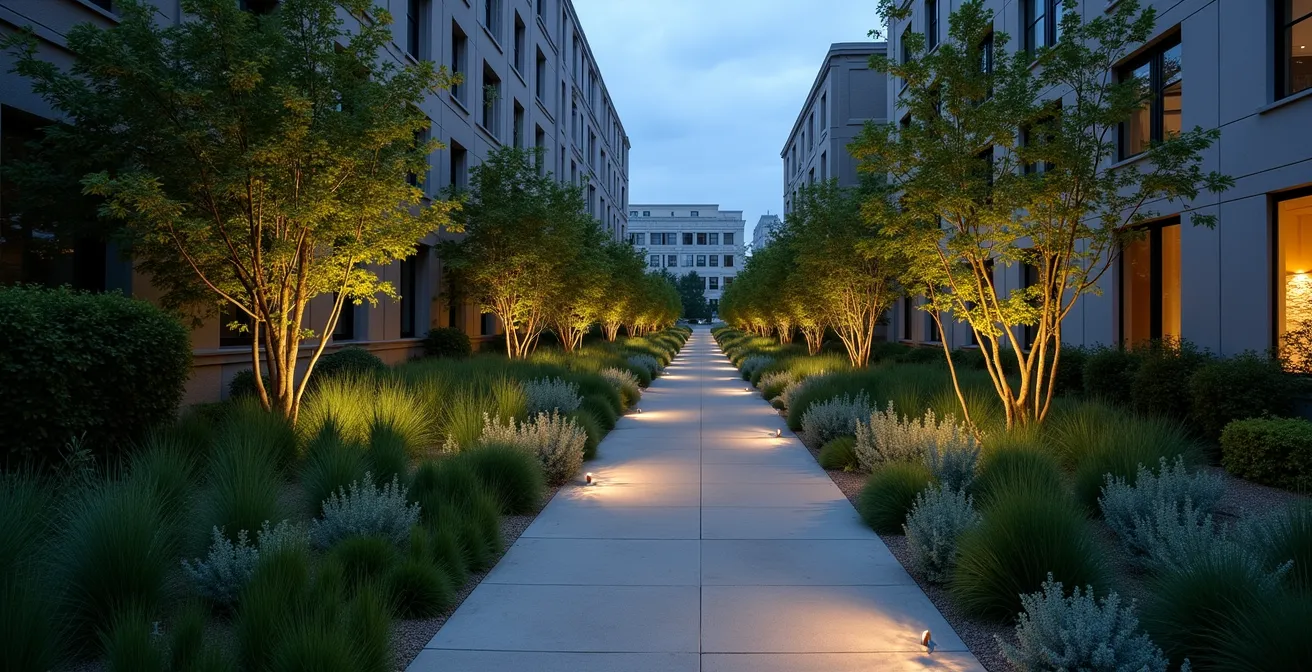
Effective design, as depicted in the image, uses layered plantings to create a gradual transition from wild to domestic. A buffer zone of low-growing groundcover between a forest edge and a children’s play area, for example, removes the element of surprise and makes the space less appealing for predators. Coexistence is not a passive outcome; it is the result of deliberate, informed landscape architecture that respects the needs of both humans and wildlife.
Urban Wildlife Coexistence Design Checklist
- In the UK: Avoid planting dense shrubs like forsythia near homes to deter fox dens. Instead, use prickly holly hedges as natural, impenetrable barriers.
- In the USA/Canada: Install motion-activated sprinklers as a harmless deterrent for coyotes and raccoons. Remove all fallen fruit from trees within 24 hours.
- Plant native thorny species such as hawthorn or blackthorn along property edges at least 3 meters from buildings to create a natural, wildlife-resistant fence.
- Maintain a 50-foot buffer zone of mown or low-growing groundcover between dense wilderness areas and residential yards or play areas.
- In urban areas of China: Focus on fully enclosed composting systems to eliminate food sources. Select bird-deterrent plant species if nuisance birds are a secondary concern.
When to Plant Urban Trees: The Seasonal Window for 90% Survival Rates
Planting a tree is an investment in future infrastructure. However, a significant portion of this investment is lost when trees fail to establish, a frequent outcome of improper timing. A tree’s ability to survive the shock of transplantation is almost entirely dependent on planting it during its dormant season. During this period, the tree’s metabolic activity is low, allowing it to focus all its energy on root development without the stress of supporting a full canopy of leaves. Planting “in season,” when the tree is actively growing, forces it to divide its resources, dramatically reducing its chances of survival.
The optimal planting window is therefore a non-negotiable parameter dictated by regional climate and tree type. In colder regions like Canada or the northern USA, this window typically falls in the autumn, after leaves have dropped but before the ground freezes solid, or in early spring, after the ground has thawed but before buds break. In warmer regions like the southern UK or southern USA, the longer, milder winters provide a more extended planting season. Ignoring these biological calendars is the primary reason for the failure of many urban forestry initiatives, wasting both money and time.
When done correctly, the return on investment from urban trees is immense. They are a cornerstone of the “evapotranspiration engine,” actively cooling the air, reducing building energy consumption, managing stormwater, and improving air quality. An assessment of the urban forest in Louisville, Kentucky, revealed that its tree canopy provides an astonishing $389 million in annual economic benefits. Achieving this kind of systemic ROI requires treating tree planting not as a weekend hobby, but as a precise, scheduled engineering task.
The following calendar, based on EPA guidelines and best practices, provides a region-specific framework for maximizing tree survival rates.
| Region | Tree Type | Optimal Window | Critical Care Period |
|---|---|---|---|
| Canada | Bare-root | Sept 15 – Oct 31 | 24 months post-planting |
| UK | All types | Nov 1 – Feb 28 | First 2 growing seasons |
| USA (Northern) | Container | April 15 – May 31 | Weekly 25L water/2 years |
| USA (Southern) | B&B trees | Oct 15 – Dec 15 | Bi-weekly deep watering |
| China (Northern) | Bare-root | March 15 – April 30 | Daily monitoring Year 1 |
Why 40% of Grant Applications for Home Energy Retrofits Get Rejected?
A high percentage of grant applications for home energy retrofits are rejected for a simple reason: they present an incomplete cost-benefit analysis. Most applications focus exclusively on active measures like new insulation, high-efficiency windows, or upgraded HVAC systems. They fail to include the significant, quantifiable energy savings provided by passive cooling strategies, namely strategic landscaping. Grant reviewers are looking for the highest possible return on investment, and by omitting the energy-saving impact of green infrastructure, applicants are artificially deflating their project’s ROI.
Strategic landscaping is not merely decorative; it’s a passive cooling system. A large deciduous tree planted to the west of a house can reduce afternoon solar heat gain in the summer by over 20%, directly lowering the load on an air conditioning unit. A green roof can reduce a roof’s surface temperature by up to 40°C, leading to a 25% decrease in cooling demand. These are hard, quantifiable metrics that must be included in any serious energy retrofit proposal. When insulation savings are combined with the documented effects of strategic landscaping, the project’s cost-benefit ratio can improve by as much as 40%, making it a far more attractive candidate for funding.
Case Study: Medellín’s Passive Cooling Corridors
Medellín, Colombia, provides a city-scale example of this principle. By implementing 30 “green corridors” with strategic tree planting along roads and waterways, the city achieved a local temperature reduction of up to 2°C (3.6°F). This passive cooling approach demonstrates how well-documented landscaping can reduce HVAC loads by an estimated 15-30%. For a grant application, citing such a precedent and applying its principles—supported by local heat island data—transforms landscaping from a “nice-to-have” into a core component of the energy efficiency strategy.
To succeed, an application must tell the full story. It must demonstrate an understanding that a building’s energy performance is an integrated system, influenced by both its internal components and its external environment. By quantifying the role of passive cooling, applicants can turn a borderline proposal into a clear winner.
Grant Application Success Strategies: Integrating Landscaping
- Include local heat island data from official sources, showing the 5-20°F temperature variations in your specific neighborhood to establish a baseline need.
- Quantify the impact of shade trees with established metrics, e.g., “The addition of three west-facing deciduous trees is projected to reduce air conditioning use by 23%.”
- Document the benefits of green roofs or walls, citing figures like “a 40°C surface temperature reduction, which corresponds to an estimated 25% cooling load decrease.”
- Reference specific eligible programs that recognize landscaping, such as Canada’s Greener Homes Grant, which includes landscaping as an eligible expense for improving energy efficiency.
- Calculate a combined ROI, showing how the synergy between insulation and strategic landscaping leads to a superior cost-benefit ratio compared to active measures alone.
Reverse Osmosis vs Carbon: Which Filter Removes Microplastics Best?
When considering water purity at home, the debate often centers on technological solutions like reverse osmosis (RO) versus activated carbon filters for removing contaminants like microplastics. Both have their merits in a point-of-use context. However, this focus on a final, in-home barrier overlooks a much larger, more effective filtration system: the landscape itself. What if the most powerful filter wasn’t in your kitchen, but engineered into the very fabric of your street and neighborhood?
A huge source of microplastics in urban water runoff is tire wear. As vehicles drive, their tires shed tiny plastic particles that are then washed into our stormwater systems during rain events. From there, they enter our rivers, lakes, and eventually, our drinking water sources. While an RO system can remove these particles at the tap, it does nothing to stop the environmental contamination. A more systemic solution is to capture these pollutants at the source using green infrastructure. This is where bioswales—vegetated, mulched, and engineered drainage courses—become critical components of urban water management.
Bioswales are designed to slow down and filter stormwater runoff. As the water percolates through layers of vegetation, mulch, and soil, pollutants are trapped and broken down. The effectiveness of this natural filtration is remarkable. Recent research on urban green spaces demonstrates that bioswales can trap up to 85% of microplastics originating from tire wear. By integrating these features into road medians, parking lots, and residential streets, we are essentially building a distributed, city-wide water treatment plant that cleanses runoff before it ever reaches our waterways. This approach represents a fundamental shift from remedial action at the tap to preventative filtration at the landscape scale.
Key Takeaways
- Urban heat is an engineering failure of energy and water management, not just a lack of shade.
- Green infrastructure acts as an “evapotranspiration engine,” using the natural water cycle to provide active cooling far beyond simple shading.
- Designing for permeability with materials like pervious concrete is crucial for both cooling and flood prevention, reconnecting the city to its water table.
Can a Green Corridor Really Lower Local Asthma Rates?
While the first analysis focused on the filtration of inorganic pollutants like PM2.5, a second, equally important mechanism links green corridors to respiratory health: the management of biogenic pollutants, namely pollen. A poorly designed green space can, paradoxically, worsen conditions for asthma and allergy sufferers. This occurs when urban forestry programs favor the planting of dioecious male trees (like male ash, poplar, or mulberry), which produce vast quantities of airborne pollen, while avoiding female trees, which produce seeds or fruit and trap pollen.
This widespread planting bias creates “pollen bombs” in our cities. Because female trees can be perceived as “messy,” municipal planners have for decades overwhelmingly selected male cultivars. The result is a massive increase in the concentration of allergenic pollen in the very places designed to be green refuges. An asthmatic individual seeking relief in a park may instead find themselves in an environment saturated with the specific triggers for their condition. The solution, from an engineering and public health perspective, is to design with pollen in mind, using a carefully selected planting list.
A well-engineered green corridor prioritizes monoecious species (which have both male and female flowers on the same plant, limiting large-scale pollen release) or ensures a balanced planting of female dioecious trees. It favors species known for low allergenicity and leverages the landscape to trap pollen. For example, planting a dense hedge of low-pollen shrubs can act as a natural barrier, capturing pollen drifting from other areas. Therefore, the question is not just *if* a green corridor can lower asthma rates, but *how* it is designed. By moving beyond a simple “more trees” approach to a sophisticated, species-aware planting strategy, we can ensure our green infrastructure actively reduces both chemical and biological respiratory triggers, maximizing its public health ROI.
By applying these engineering principles, urban residents and planners can systematically dismantle the heat island effect. The next logical step is to move from understanding to action, advocating for and implementing these evidence-based landscaping strategies in your own community to build a cooler, healthier, and more resilient future.