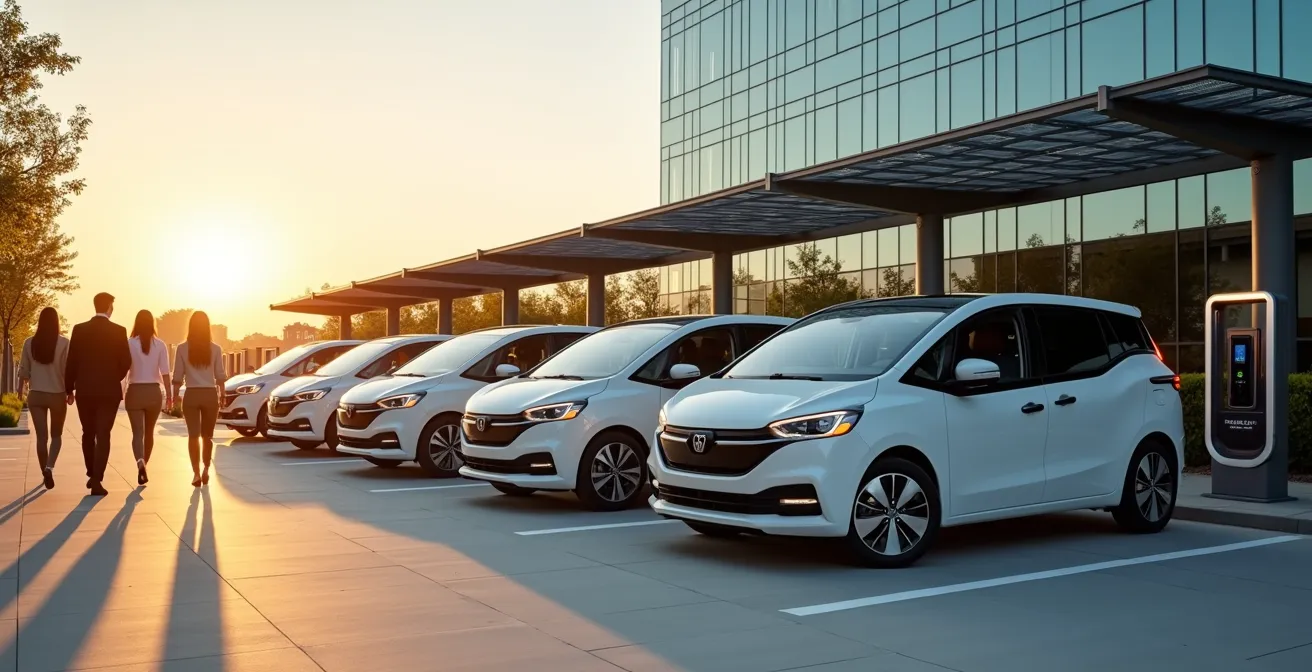
Transitioning to an electric shuttle fleet is no longer just an environmental statement; it’s a strategic business decision that delivers a multifaceted return on investment by transforming the employee commute into a competitive advantage.
- The financial ROI extends beyond fuel savings, factoring in lower maintenance, higher productivity, and improved talent retention.
- Operational success hinges on intelligent charging strategies and inclusive design, not just vehicle acquisition.
Recommendation: Shift the focus from viewing shuttles as a cost center to leveraging them as a strategic asset for enhancing employee well-being, productivity, and corporate brand value.
For HR directors and facility managers, the pressure to attract and retain top talent while meeting aggressive sustainability targets is immense. The traditional company car, once a status symbol, now represents a significant carbon liability and logistical headache. Many organizations consider corporate shuttles as a solution, but often stop at the surface-level benefit of “going green.” They see it as a simple substitution: swap diesel buses for electric ones. This approach misses the fundamental opportunity.
The true value of an electric shuttle program lies not in the vehicles themselves, but in the sophisticated operational choreography that underpins them. It’s about transforming a stressful, unproductive daily commute into a seamless, connected, and even productive part of the workday. The conversation must evolve beyond simple carbon reduction to a more strategic discussion about boosting productivity, ensuring equity and accessibility, and creating a tangible benefit that makes your company a more desirable place to work.
This article moves beyond the generic sales pitch. We will dissect the critical operational questions you need to answer to build a truly successful program: from calculating a holistic ROI and mastering charging logistics to designing an experience that employees actually value. It’s time to stop thinking about shuttles as just a green initiative and start seeing them as a powerful tool for strategic corporate and campus connectivity.
To navigate this complex but rewarding transition, we will explore the key operational and strategic pillars. This guide breaks down the essential considerations, from financial viability to the nuanced details of employee experience, providing a clear roadmap for implementation.
Summary: Why Corporate EV Shuttles Are Replacing Company Cars for Top Talent?
- Diesel vs Electric Shuttle: How Long Until the ROI Becomes Positive?
- How to Schedule Charging Loops Without Disrupting Peak Hour Service?
- Wi-Fi or Silence: What Do Employees Actually Want on the Commute Bus?
- The Design Flaw That Makes Self-Driving Pods Unusable for Wheelchair Users
- When to Install On-Site Superchargers: The Grid Capacity Check
- 100-80-100 Model: Does Less Time Actually Equal Same Output?
- Can a Green Corridor Really Lower Local Asthma Rates?
- Diesel vs Electric Shuttle: How Long Until the ROI Becomes Positive?
Diesel vs Electric Shuttle: How Long Until the ROI Becomes Positive?
The initial capital outlay for electric shuttles is undeniably higher than for their diesel counterparts. This often becomes the primary obstacle for decision-makers. However, a narrow focus on purchase price ignores the complete financial picture. The real metric is the Total Cost of Ownership (TCO), which dramatically shifts the economic argument in favor of electrification over the vehicle’s lifespan. TCO accounts for reduced fuel costs, significantly lower maintenance expenses due to fewer moving parts, and potential government incentives.
A comprehensive TCO analysis reveals that a fleet of just 10 electric vehicles can yield substantial returns. For instance, one model shows that for a fleet of electric pickup trucks, there are $677,815 in total savings over 10 years. While shuttle bus figures will differ, the principle remains the same: operational savings accumulate to overcome the initial investment, often reaching a positive ROI within 5-7 years, depending on usage intensity and local energy costs.
Beyond direct financial returns, the ROI includes powerful indirect benefits. These “soft” returns are critical for building a complete business case. As demonstrated by Columbia University’s successful transition, shifting to an electric fleet can achieve a 70% reduction in greenhouse gas emissions, improving air quality for passengers and the community. This enhances brand reputation, helps meet ESG (Environmental, Social, and Governance) goals, and serves as a tangible recruiting tool for environmentally-conscious talent. The ROI is not just a number on a spreadsheet; it’s a strategic investment in your company’s financial, environmental, and human capital health.
How to Schedule Charging Loops Without Disrupting Peak Hour Service?
The fear of a shuttle running out of battery during morning or evening peak hours is a legitimate concern for any facility manager. The solution isn’t just about buying buses with the longest range; it’s about implementing an intelligent operational choreography for charging. Simply plugging in the entire fleet overnight is inefficient and fails to address the dynamic needs of a full day’s service. The most effective approach is a combination of depot charging and “opportunity charging” during operational lulls.
This is often achieved with a split-fleet strategy. Instead of having the entire fleet in service all day, a portion of the vehicles operates while the other portion charges. This rotation ensures that there are always fully-charged shuttles ready for deployment, eliminating range anxiety and guaranteeing service continuity during critical rush hours. This strategy turns the depot into a dynamic hub of activity rather than a static parking lot.
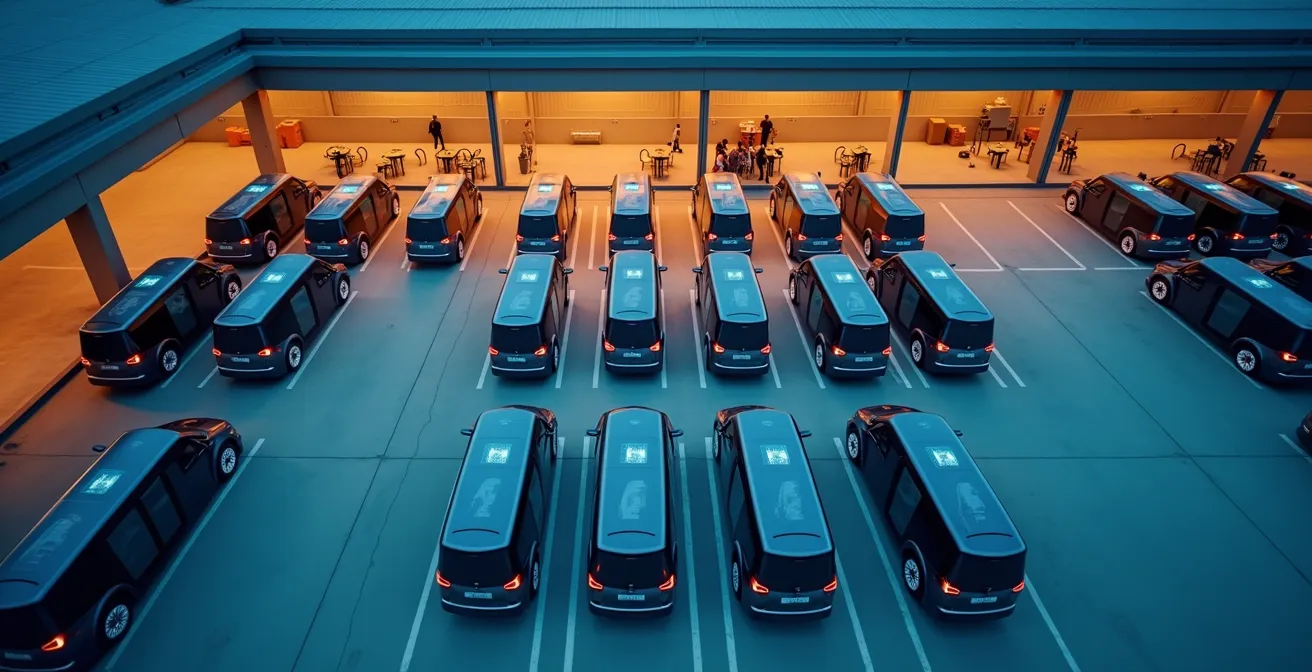
Successfully implementing this model requires careful planning and the right technology. It’s a system built on data analysis of your specific fleet’s duty cycles to identify natural downtime, typically during mid-day off-peak hours. From there, it’s about creating a robust process supported by the right infrastructure and software.
Action Plan: Implementing an Opportunity Charging Strategy
- Analyze fleet duty cycles to identify 10 AM-2 PM off-peak windows for opportunity charging.
- Install high-power DC fast chargers (400kW+) at strategic depot locations to minimize charging time.
- Implement a split-fleet rotation where 50% of vehicles charge during the identified off-peak lulls.
- Deploy charge management software to optimize charging schedules based on real-time energy costs and service demand.
- Monitor battery health metrics to balance the speed of fast charging with the long-term longevity of the batteries.
Wi-Fi or Silence: What Do Employees Actually Want on the Commute Bus?
A corporate shuttle is more than just transportation; it’s an extension of the workplace. The amenities provided during the commute can make the difference between a frustrating journey and a valuable perk. While preferences vary, a consistent theme emerges from employee feedback: the desire to reclaim time. Research shows that American employees spend over 100 daily minutes and a significant portion of their income on their commute, often arriving at work already stressed. A well-equipped shuttle transforms this “dead time” into a productive or restful period.
For many, particularly in tech and professional services, the single most valued amenity is reliable, high-speed Wi-Fi. This turns the shuttle into a “productivity conduit,” allowing employees to clear their inbox, prepare for the day’s meetings, or collaborate with colleagues. This not only boosts overall output but also allows employees to disconnect more fully once they get home, improving work-life balance.
The value of a productive commute is best expressed by those who experience it daily. As one employee at a Silicon Valley company noted about their shuttle service, it’s a game-changer for their daily routine. This sentiment is captured in feedback on leading shuttle services.
…excellent service…It is actually a joy to commute and be able to be productive while on my way to work without stressing.
– Felix A., Employee at a Silicon Valley company
However, productivity isn’t the only goal. Offering a “quiet zone” or “silent car” section of the shuttle caters to those who prefer to decompress, read, or simply rest. The ideal strategy involves creating a flexible environment that accommodates both needs. By providing options, you empower employees to choose how they use their commute time, dramatically increasing the perceived value of the service and turning it into a powerful tool for employee satisfaction and retention.
The Design Flaw That Makes Self-Driving Pods Unusable for Wheelchair Users
The push towards futuristic, autonomous transport pods is exciting, but in the race for innovation, a critical element is often treated as an afterthought: accessibility. Many sleek, self-driving pod designs prioritize minimalist aesthetics over inclusive functionality, resulting in narrow doorways, fixed seating, and a complete lack of space for wheelchair users. This isn’t just a compliance issue under the Americans with Disabilities Act (ADA); it’s a fundamental design failure that excludes a segment of your workforce.
True inclusive mobility means designing for accessibility from the ground up, not “bolting on” a ramp as an option. This requires a shift towards Universal Design principles, where the goal is to create an environment that is usable by all people, to the greatest extent possible, without the need for adaptation or specialized design. For a corporate shuttle, this means wide aisles, level-boarding capabilities or reliable ramps/lifts, and flexible interior layouts that can securely accommodate wheelchairs without sacrificing comfort for other passengers.

Building an accessible fleet goes beyond physical accommodations. It also means considering employees with visual, auditory, or neurodivergent needs. A truly universal approach ensures that every employee feels respected and can use the service with dignity and independence. Here are the core principles to integrate:
- Standardize Accessibility: Ensure ADA-compliant wheelchair lifts and ramps are standard features on every vehicle, not optional add-ons.
- Flexible Layouts: Design flexible seating configurations that can be easily adjusted to accommodate multiple wheelchair positions or other mobility devices.
- Multi-Sensory Cues: Implement high-contrast visual signage and clear, automated auditory announcements for stops and other important information to assist visually impaired users.
- Sensory-Friendly Zones: Create designated areas with reduced noise and lower lighting to provide a more comfortable environment for neurodivergent employees or those with sensory sensitivities.
- Community Partnership: Engage with local disability advocacy groups during the vehicle selection and service design phase to gather firsthand feedback and ensure the solution truly meets user needs.
When to Install On-Site Superchargers: The Grid Capacity Check
Deciding to go electric is the first step. The second, more complex step is determining the right charging infrastructure. The temptation is to install the fastest chargers available, but “bigger is not always better.” The choice between Level 2 AC chargers, DC Fast Chargers, and emerging Megawatt Charging Systems depends entirely on your operational model and, most critically, your facility’s existing electrical grid capacity. A premature investment in high-power chargers without a proper grid assessment can lead to costly, and sometimes prohibitive, infrastructure upgrades.
The key is to match the charger type to the use case. For a fleet that can charge overnight for 8-10 hours, Level 2 AC chargers are often sufficient, cost-effective, and place minimal strain on the grid. However, if you are implementing a split-fleet strategy with mid-day opportunity charging, more powerful DC Fast Chargers become essential to minimize downtime. This is where a grid capacity check becomes non-negotiable. Partnering with your local utility provider early in the process is crucial to understand what your site can handle and what upgrades might be required.
The following table, based on data from national energy analyses, breaks down the typical power requirements and grid impact of different charging levels. As a report from the Department of Energy highlights, the move to higher-power charging for medium and heavy-duty vehicles requires substantial planning for its impact on local grid infrastructure.
| Charger Type | Power Level | Typical Use Case | Grid Impact |
|---|---|---|---|
| Level 2 AC | 7-19 kW | Overnight depot charging | Low – manageable with existing infrastructure |
| DC Fast Charger | 50-350 kW | Opportunity charging | Medium – may require grid upgrades |
| Megawatt Charging | 1000+ kW | Heavy-duty rapid charging | High – requires substantial grid infrastructure |
Ultimately, the decision requires a strategic balance. You need enough power to support your operational choreography without incurring unnecessary grid upgrade costs. An energy audit and a phased implementation plan are the most prudent paths forward, ensuring your infrastructure can scale with your fleet.
100-80-100 Model: Does Less Time Actually Equal Same Output?
The conversation around the 4-day work week, often based on the “100% pay, 80% time, 100% output” model, is gaining traction. For this to be feasible, companies must find ways to maximize employee focus and efficiency. A corporate shuttle service can be a surprisingly powerful enabler of this model. By eliminating the stress and cognitive load of driving in traffic, employees arrive at work more focused and ready to be productive from the moment they walk in the door. As authorities on commute solutions emphasize, this is a key differentiator in a competitive labor market.
The shuttle enables employers to help their employees make the first or last mile commute to their workplace or transit station. Participating in the Commute.org shuttle program helps employers attract and retain employees.
– Commute.org, San Mateo County Transportation Authority Report
The link becomes even more direct when the commute itself is transformed into productive time. A Wi-Fi-equipped shuttle doesn’t just reduce stress; it effectively extends the productive workday without infringing on personal time. This concept is proven by companies that have successfully integrated shuttles into their operational fabric.
Case Study: The First Productive Hour
A study of companies using DPV Transportation’s WiFi-equipped shuttles revealed a significant shift in work patterns. Employees began using the morning commute as their ‘first productive hour’ for focused tasks like responding to emails and planning their day. This meant they arrived at the office having already accomplished deep work, directly supporting compressed work week goals by maximizing cognitive resources before the official workday even began. This demonstrates how a shuttle service can be a strategic tool to facilitate modern, flexible work models, as noted in their analysis of streamlined employee commuting.
By providing a structured environment for work or rest, the corporate shuttle helps preserve the precious cognitive energy that is often depleted by a frustrating commute. This makes employees more effective during their core work hours, making the goal of achieving 100% output in 80% of the time a more realistic and sustainable objective.
Can a Green Corridor Really Lower Local Asthma Rates?
The corporate responsibility of a large campus extends beyond its property lines. A fleet of diesel shuttles contributes to local air pollution, particularly with emissions of particulate matter (PM2.5) and nitrogen oxides (NOx), which are known triggers for asthma and other respiratory illnesses. Transitioning to an all-electric fleet creates a “green corridor” along its routes, directly improving the air quality for the surrounding community. This isn’t a theoretical benefit; it’s a measurable public health outcome.
The impact is most significant in dense urban or suburban areas where shuttle routes pass through residential neighborhoods, parks, and school zones. By eliminating tailpipe emissions, a company actively reduces the environmental health burden it places on its neighbors. Environmental health studies demonstrate a clear link, showing a 70% reduction in PM2.5 and NOx emissions along electric shuttle routes compared to their diesel predecessors. This creates a healthier environment for everyone, including an organization’s own employees and their families who live nearby.

This positive externality becomes a powerful part of the corporate narrative. It transforms the company from a passive occupant into an active community steward. This commitment to local health can strengthen relationships with municipal governments, improve public perception, and provide a compelling story that resonates far more deeply than abstract carbon offset numbers. It demonstrates in a very tangible way that the company’s sustainability goals are not just about internal metrics, but about creating real-world, positive change in the community it calls home.
Key Takeaways
- A holistic ROI for EV shuttles must include financial TCO, employee productivity gains, and community health benefits.
- Successful implementation depends on an intelligent “operational choreography” of split-fleet charging, not just vehicle purchase.
- Designing for the employee experience, with amenities like Wi-Fi and a commitment to universal accessibility, is what transforms the shuttle from a utility into a strategic retention tool.
Redefining the ROI: A Holistic View on a Strategic Asset
We began by asking when an electric shuttle’s ROI becomes positive. The traditional answer focuses on the break-even point where fuel and maintenance savings eclipse the initial capital cost. But as we’ve explored, that answer is dangerously incomplete. A truly strategic assessment requires a holistic ROI model that integrates the financial, human, and social returns into a single, comprehensive business case.
The financial return is the foundation, built on a rigorous TCO analysis. The human capital return is layered on top, quantified through increased productivity (the “first productive hour”), improved employee satisfaction, and lower turnover costs as the shuttle becomes a key differentiator in talent retention. Finally, the social return is realized through enhanced brand reputation, progress towards ESG targets, and measurable improvements in community health by creating green corridors. Each component reinforces the others, creating a powerful value proposition.
This modern definition of ROI reframes the electric shuttle from a simple cost-saving measure into a strategic, multi-faceted asset. It becomes a tool for building a more productive, equitable, and sustainable corporate ecosystem. For HR and facility leaders, the ability to articulate this complete picture is what will secure executive buy-in and unlock the full potential of transforming your campus connectivity.
To put these principles into practice, the next logical step is to conduct a feasibility study for your own organization, starting with a detailed TCO analysis and an audit of your site’s grid capacity. Begin assembling the data to build your business case for a smarter, greener, and more productive commute.