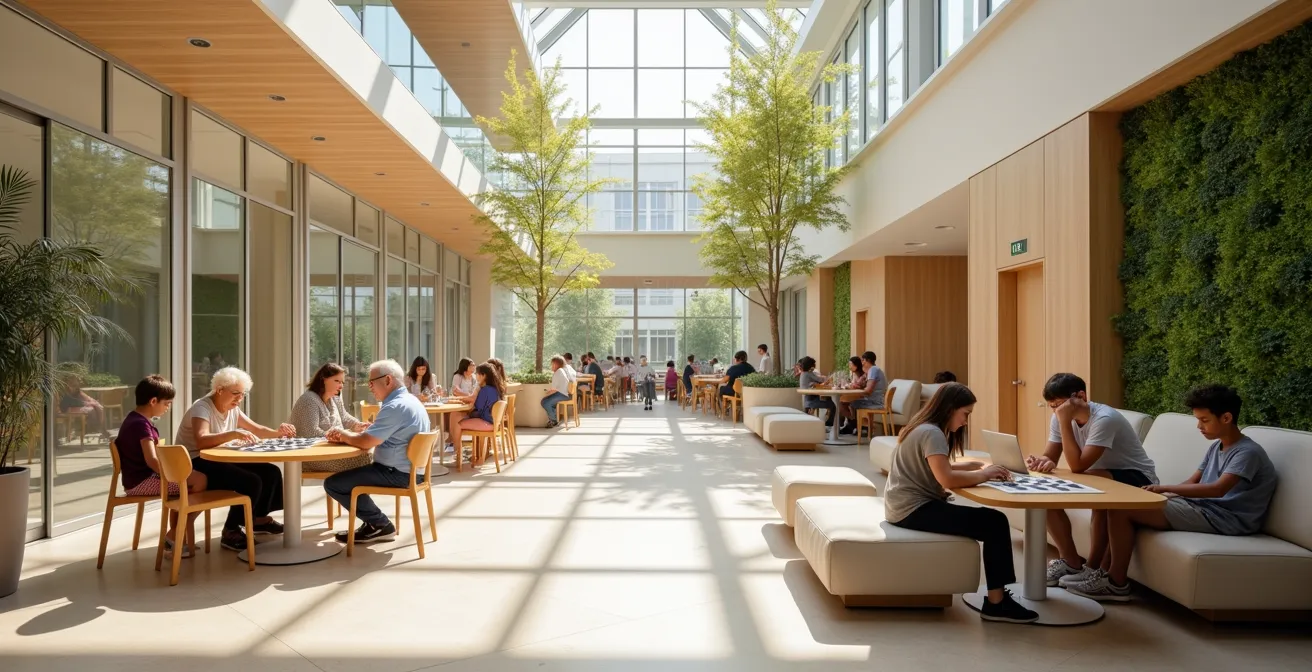
Far from being obsolete, the community center is emerging as the most critical piece of social infrastructure for the health of our digital-first cities.
- They are not just buildings, but “social gymnasiums” designed to foster interactions that online platforms cannot replicate.
- Success is now measured not by attendance, but by quantifiable metrics of “belonging” and proven social impact.
Recommendation: Local leaders must shift their view from seeing centers as a cost to seeing them as a strategic investment in civic resilience and public health.
In our hyper-connected, yet deeply isolated world, a quiet revolution is taking place. We were promised a global village through our screens, but for many, the result has been a lonelier neighborhood. The ambient chatter of a shared physical space has been replaced by the curated silence of a Zoom waiting room. For local councils and residents alike, the realization is dawning: digital platforms, for all their utility, cannot replace the fundamental human need for tangible, unstructured, and meaningful connection. The narrative that community centers are relics of a bygone era is collapsing under the weight of this collective longing.
The common response is to see them simply as places that offer services or host events. This view misses the profound shift that is occurring. The comeback of the community center isn’t about nostalgia; it’s about a radical reimagining. It’s about a move from passive space to active social architecture. The true challenge isn’t just to keep the lights on, but to answer a much deeper question: how do we intentionally design spaces that rebuild the very social muscles our digital lives have allowed to atrophy? This is the new frontier of placemaking.
This article moves beyond the platitudes of “building community” to explore the strategic nuts and bolts of this revival. We will not just talk about what a community center is, but what it *does*. We will dissect the programmatic and financial models that create vibrant, intergenerational hubs. We will explore how to retain the human capital—the volunteers—that bring these spaces to life and how to measure the seemingly unmeasurable concept of “belonging.” This is a guide for community architects—for anyone passionate about engineering the antidote to modern loneliness, one repurposed hall and one shared skill at a time.
To fully grasp the mechanics behind this powerful transformation, this guide breaks down the essential strategies for creating, funding, and sustaining a modern community hub. We’ll explore everything from programming that bridges generational divides to the metrics that prove a center’s value to city hall.
Summary: The Blueprint for a Modern Community Hub
- Bingo vs Esports: How to Program a Space That Attracts Boomers and Gen Z?
- Grant or Membership: Which Funding Model Keeps Community Centers Open?
- The Onboarding Mistake That Causes 50% of Volunteers to Quit in Month One
- Library or Coworking: How to Repurpose Old Halls for Remote Workers?
- How to Quantify “Belonging” to Justify Municipal Budget Requests?
- When to Join Expat Clubs: The Timing Strategy for Faster Integration
- Coding or Carpentry: Which Skill Best Suits a 10-Year-Old’s Motor Skills?
- Bingo vs Esports: How to Program a Space That Attracts Boomers and Gen Z?
Bingo vs Esports: How to Program a Space That Attracts Boomers and Gen Z?
The most common failure of community programming is designing *for* demographics instead of designing *for connection between* them. A truly vibrant center isn’t a silo of separate activities; it’s a space of engineered serendipity where a retired accountant and a teenage gamer might actually cross paths. The goal is not simply to offer bingo for seniors and an esports league for youth, but to create a shared environment where these activities can coexist and even overlap, sparking unexpected conversations and mentorship.
This is achieved through a principle I call “Parallel Play & Purpose.” It involves creating zones where different age groups can engage in adjacent but connected activities. Imagine a “tech cafe” where seniors are learning to use tablets next to a corner where students are coding. The shared resource—high-speed internet and comfortable seating—becomes the bridge. The UK’s successful Men’s Sheds movement is a brilliant example, creating purpose-driven spaces for skill-sharing that naturally attract an older demographic while being open to all.
The key is to think of technology not as a generational divider but as a potential bridge. Programs where younger members teach digital skills to older ones through a shared, fun experience—like using VR headsets for virtual travel to places on their bucket lists—transform the dynamic from a clinical class into a shared adventure. This is social architecture in action: designing the program to create the desired social outcome.
- Implement ‘Parallel Play & Purpose’ zones where different age groups engage in adjacent but connected activities, allowing natural mentorship opportunities.
- Create ‘Tech as Bridge’ programs where younger members teach digital skills to seniors through shared experiences like virtual travel.
- Establish a ‘Skill-Swap Marketplace’ with structured peer-to-peer micro-classes crossing generational divides, from bread-making to podcasting.
Ultimately, successful intergenerational programming is less about the specific activities and more about creating a permissive, welcoming environment where curiosity can flourish across age lines.
Grant or Membership: Which Funding Model Keeps Community Centers Open?
The debate between grant dependency and membership models presents a false choice. A resilient community center in the 21st century cannot survive on a single funding stream. The most sustainable model is a hybrid one, blending municipal support, targeted grants, and, most importantly, self-generated social enterprise revenue. This diversification not only ensures financial stability but also deepens community investment. When a center generates its own income, it shifts from being a line item in a city budget to a proactive, contributing partner in the local economy.
Social enterprise is the engine of this new model. This means building revenue-generating activities directly into the center’s mission. Think of a community cafe that employs local youth, a tool-lending library with a modest subscription fee, or renting out sound-proof pods to remote workers. These aren’t just fundraisers; they are services that meet community needs while creating a consistent income stream. In fact, an analysis of successful US social enterprise centers showed they can achieve over 70% self-funding, drastically reducing their reliance on volatile grant cycles.
This is precisely how the Highland Community Center in New York transformed an old warehouse into a thriving hub. By integrating green power and a range of programs that the community was willing to pay for, they created a powerful cycle of support and innovation. The visual of a bustling community cafe next to a well-organized tool library isn’t just a sign of activity; it’s the physical manifestation of a smart, diversified funding strategy that ensures the center’s long-term health and independence.

As the image illustrates, diverse revenue streams like a cafe and a tool library are not just amenities; they are the financial bedrock of the modern community hub. This approach transforms the center from a cost center into a value-generating asset for the entire neighborhood.
By adopting this entrepreneurial mindset, community centers can secure their future and prove their indispensable role as engines of local life, not just recipients of public funds.
The Onboarding Mistake That Causes 50% of Volunteers to Quit in Month One
The lifeblood of any community center is its volunteers, yet most centers treat their onboarding process as an administrative afterthought. The single biggest mistake is a failure to provide a sense of immediate impact and a clear path for growth. New volunteers are often given vague, low-value tasks with no connection to the center’s mission and no vision for their future involvement. This lack of purpose is demoralizing and is the primary reason so many passionate individuals quietly disengage within weeks. An engaged member base is the ultimate metric of success, and volunteers are its most powerful drivers.
Professionals in the field understand this; a recent survey found that 57% of community professionals believe an active and engaged member base is the key measure of a community’s success. To build this base, we must architect a volunteer journey that is as intentional as the building’s physical design. This begins with scrapping the old “start at the bottom” mentality and implementing what I call “First Impact” roles. These are small, high-visibility projects that can be completed in one or two sessions, giving the volunteer an immediate and tangible sense of contribution and ownership.
Beyond the first day, a “Volunteer Journey Map” is essential. This visualizes a clear progression, showing how a role like “Event Helper” can lead to “Program Assistant” and eventually “Program Lead.” It matches their skills to strategic needs, transforming their involvement from “just helping out” to being a critical part of the center’s success. This approach stops the volunteer bleed and builds a committed, long-term team.
Your Volunteer Retention Audit: A 5-Point Action Plan
- Points of Contact: List all channels where potential volunteers first interact with your center (e.g., website form, reception desk, event signage). Are these channels welcoming and clear about the next steps?
- Collect & Inventory: Gather all existing onboarding materials (handbooks, welcome emails, first-day task lists). Do they offer “First Impact” roles or generic, uninspiring tasks?
- Coherence Check: Confront every volunteer role with your center’s core mission. Can a volunteer in that role clearly articulate how their work contributes to the bigger picture?
- Journey & Emotion Audit: Map out the potential volunteer journey from their first shift to their first year. Does it offer a clear path for growth and skill development, or is it a flat line?
- Integration Plan: Identify the biggest gaps. Prioritize creating at least two “First Impact” roles and a simple, visual “Volunteer Journey Map” to share during onboarding.
Investing in a structured, inspiring onboarding process is not an operational cost; it is the most crucial investment you can make in the human capital that will define your center’s future.
Library or Coworking: How to Repurpose Old Halls for Remote Workers?
The rise of remote work presents an unprecedented opportunity for community centers to reclaim their role as the neighborhood’s “third place.” However, simply putting desks and Wi-Fi in an old hall is a recipe for failure. Remote workers don’t just need a place to work; they need a place that combats the isolation of the home office. The solution lies not in choosing between a traditional library (too quiet) or a pure coworking space (too transactional), but in creating a hybrid “Zoned Hub Model.” This social architecture approach repurposes a single large space into multiple zones with distinct functions and acoustic properties.
This model allows a center to cater to the full spectrum of community needs simultaneously. It means designing a silent “deep work” zone with bookable pods, a collaborative area for team meetings, and a social cafe for casual conversations and networking. This intentional design is what separates a thriving hub from an empty room. The Creekside Community Recreation Centre in Vancouver, a stunning facility repurposed after the 2010 Winter Olympics, exemplifies this commitment to high-quality, multi-functional design by achieving a LEED Platinum rating while serving a diverse community on the waterfront.
The Zoned Hub Model fundamentally expands the center’s user base. It attracts not just remote workers, but students, parents needing childcare, and anyone seeking a change of scenery. It becomes a place of dynamic energy, where professional needs and social needs are met under one roof.
This table, based on an analysis of modern community spaces, clearly illustrates the superiority of the zoned model.
| Feature | Traditional Library | Pure Coworking | Zoned Hub Model |
|---|---|---|---|
| Noise Levels | Silent only | Open conversation | Multiple zones (silent/collaborative/social) |
| Amenities | Books, reading spaces | Desks, wifi | Sound-proof pods, meeting rooms, cafe, childcare |
| Target Users | Readers, students | Remote workers | All community members |
| Community Integration | Limited | Professional only | Full spectrum engagement |
By adopting this zoned approach, community centers can become the indispensable daytime heart of the neighborhood, serving a new generation of workers while strengthening the social fabric for everyone.
How to Quantify “Belonging” to Justify Municipal Budget Requests?
For decades, community centers have justified their existence with “soft” metrics: attendance numbers, program variety, and anecdotal success stories. In an era of data-driven municipal budgeting, this is no longer enough. To secure funding and prove their vital role in public health, centers must learn to quantify the seemingly unquantifiable: the sense of belonging. This requires shifting from measuring activity to measuring impact. It means building a dashboard of hard metrics that translate social connection into a language that city councils understand: economic value and preventative health.
This isn’t about soulless datafication; it’s about making the invisible, visible. The first step is Social Network Analysis (SNA). This involves tracking the increase in new, unique member-to-member interactions over time. Are people who met at the center now collaborating on projects or meeting for coffee? This demonstrates the center’s role as a social catalyst. Another powerful tool is measuring the Local Economic Multiplier. By partnering with local businesses to offer member discounts, centers can track redemption rates and demonstrate how their activities directly drive revenue to neighborhood shops, proving their role as an economic engine.
Perhaps the most compelling metric is in preventative health. By working with local health authorities, it’s possible to correlate center attendance with a reduction in GP visits for issues related to social isolation and loneliness. This reframes the center’s budget not as a community expense, but as a direct investment in public health with a measurable return. This data-backed storytelling is what turns a budget request from a plea into a strategic proposition.

Visualizing these metrics on a dashboard, as suggested above, makes the center’s impact undeniable. It translates the warm feeling of community into the cold, hard data that influences policy and unlocks funding.
Here are three key metrics to begin measuring, as outlined by a study on building social capital:
- Social Network Analysis (SNA): Track the increase in new unique member-to-member interactions per quarter.
- Local Economic Multiplier: Measure revenue driven to local businesses through member discount redemption rates.
- Preventative Health Metric: Correlate center attendance with a reduction in GP visits for social-isolation issues.
By adopting this new language of impact, community centers can finally prove what they’ve always known: they are not a luxury, but essential infrastructure for a healthy, connected city.
When to Join Expat Clubs: The Timing Strategy for Faster Integration
For expatriates, the community center serves a unique and critical function as an “integration bridge.” However, the timing of engagement is everything. Relying too heavily on expat-only groups can create a comfortable bubble that ultimately hinders true integration, while diving headfirst into local-only settings can be overwhelming. The strategic use of a community center lies in its ability to be a “third place”—a neutral, welcoming ground that facilitates a phased transition from outsider to local.
The concept of the “third place,” as brilliantly articulated by sociologist Ray Oldenburg, is central here. As described in an analysis by the Project for Public Spaces, these are locations where conversation is the main activity, status is leveled, and strangers are welcome. For an expat, the community center is the perfect third place. It’s not home (first place) or work (second place), but a low-pressure environment to observe local customs, practice the language, and build social bridges without the formal structure of an “expat club.”
The journey should be strategic. In the first few months, online expat forums are invaluable for practical survival tips. But from months four to nine, the community center becomes the crucial next step. It offers mixed settings—a pottery class, a public lecture, a community garden—where expats and locals can interact around a shared interest. This is the “bridge” phase. After this, around the ten-month mark, the expat is ready to “graduate” to niche, local-first hobby groups (a hiking club, a book circle) discovered *through* connections made at the center, completing their integration journey.
This phased approach, using the community center as a managed stepping stone, transforms the daunting process of integration into a structured and achievable path toward genuine belonging.
Coding or Carpentry: Which Skill Best Suits a 10-Year-Old’s Motor Skills?
The question of whether to offer a coding class or a carpentry workshop for children isn’t a simple “either/or.” It’s a question of developmental philosophy. While both are valuable, a truly holistic approach to child development within a community center recognizes that pitting digital skills against manual skills is a false dichotomy. The most powerful programming combines both, fostering a full spectrum of cognitive and motor development.
Let locals design the programs. So instead of some city planner deciding ‘we need a coding class,’ it’s the neighborhood teens saying, ‘We want a recording studio,’ and the center making it happen. That’s how you get buy-in.
– Oakland Community Center Program Director, Community Center Impact Study
As this insight from a seasoned director suggests, the best programs are born from community demand, not top-down planning. A 10-year-old’s world shouldn’t be confined to a screen or a workbench; it should fluidly move between them. Coding develops abstract logic and resilience through iterative debugging. Carpentry builds spatial reasoning and an understanding of irreversible decisions. A program that teaches kids to design an object on a computer and then fabricate it with power tools does not just teach two skills; it teaches an entire problem-solving process that is adaptable, resilient, and relevant to any future economy.
This integrated approach offers a more complete development path. It honors both the fine motor skills of typing and the gross motor coordination required for woodworking. It builds a versatile skill set that prepares a child not just for a specific job in a tech hub or a manufacturing sector, but for a future where adaptability is the most valuable currency.
The following table, adapted from a comparison of developmental skills, highlights the benefits of a combined approach.
| Aspect | Coding | Carpentry | Combined Approach |
|---|---|---|---|
| Cognitive Development | Abstract logic, problem-solving | Spatial reasoning, planning | Full spectrum thinking |
| Resilience Type | Iterative debugging, persistence | Careful planning, irreversible decisions | Adaptable problem-solving |
| Motor Skills | Fine motor (typing, clicking) | Gross and fine motor coordination | Complete motor development |
| Future Economy Relevance | Tech hubs (Austin, Waterloo) | Manufacturing sectors (UK Midlands) | Versatile skill set |
Ultimately, the community center’s role is not to churn out coders or carpenters, but to cultivate curious, capable, and well-rounded human beings.
Key Takeaways
- The modern community center must be intentionally designed as a “social gymnasium” to combat digital isolation.
- Financial sustainability depends on a hybrid model that blends public funding with self-generated social enterprise revenue.
- Measuring impact through hard metrics like Social Network Analysis and preventative health data is crucial for justifying budgets.
Bingo vs Esports: How to Program a Space That Attracts Boomers and Gen Z?
We return to this core question, but with a deeper understanding. The solution is not a checklist of activities but a fundamental shift in philosophy. It’s about moving from being a service provider to being a master of social architecture. The goal isn’t just to fill a room; it’s to lower the social barriers that prevent a retired nurse and a graphic design student from discovering a shared love for gardening or local history. This is the art of programming for connection.
This philosophy rests on creating “programmatic friction”—intentional, positive overlaps between different groups. It means scheduling a “repair cafe” staffed by skilled seniors right next to the youth robotics club. The shared need for tools and workspace creates a natural point of interaction. It means transforming a simple cooking class into a “grandma’s recipes” event where elders share family traditions with younger members eager to learn authentic skills. Every program becomes an opportunity to weave the social fabric a little tighter.
This is the ultimate purpose of the community center’s comeback. It is not to compete with the digital world, but to offer what the digital world cannot: a physical space for messy, uncurated, and beautiful human interaction. It’s a place where shared purpose and engineered serendipity come together to build not just skills, but relationships. This is how we build neighborhoods that are not just digital-first, but human-first.
Your role as a community architect, whether you are a council member, a center director, or a local resident, is to champion this vision. Begin today by identifying one opportunity in your community to create positive friction and engineer a moment of connection.
Frequently Asked Questions on Community Centers and Integration
When should I rely primarily on expat forums?
Months 1-3: Use expat forums for immediate practical needs like visa info and housing tips. This is your survival phase, focused on logistics.
How do community centers help integration?
Months 4-9: Community centers serve as bridges between expat support and local integration. Engage in their interest-based classes (like cooking or language exchange) to meet locals in a low-pressure, structured setting.
When to transition to local-only groups?
Month 10+: Once you’ve built some confidence and a few local connections at the community center, it’s time to graduate. Use those connections to join niche, local-first hobby groups (e.g., a specific hiking club or book circle) for deep community integration.