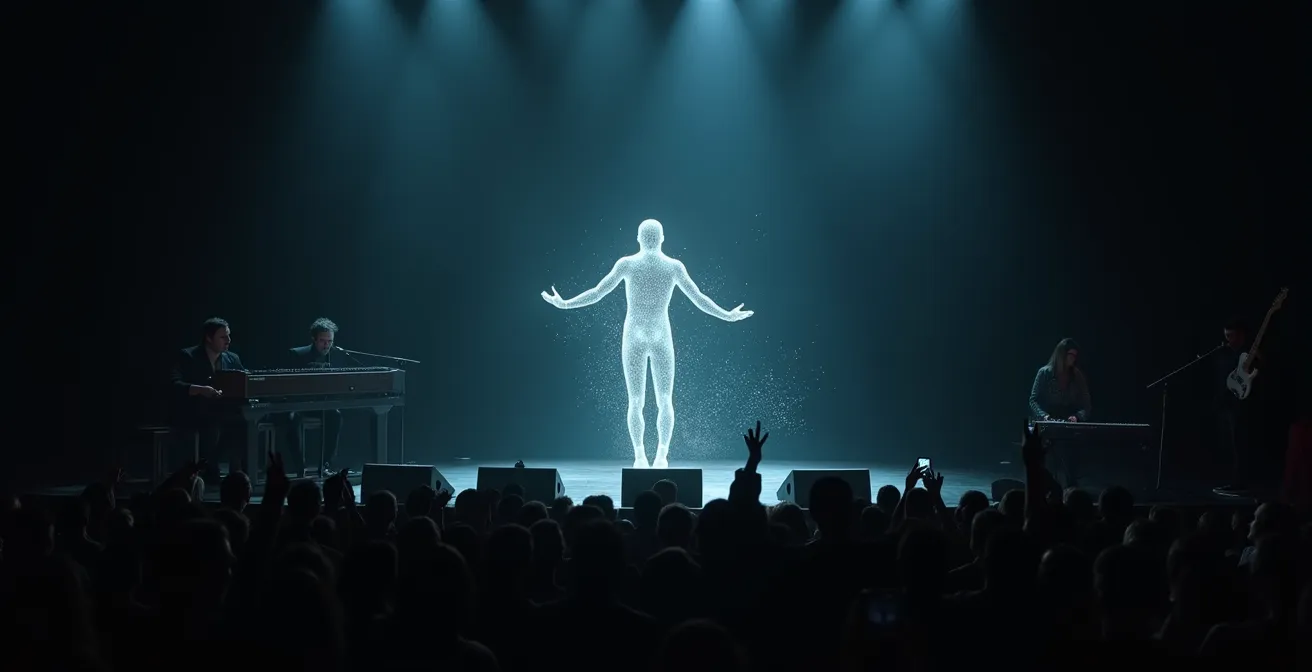
Buying a ticket to a hologram concert is not just a consumer choice; it is an ethical vote on the future of memory and legacy.
- The technology is not true holography but a 19th-century illusion, creating a “digital marionette” with no artistic agency.
- Legal rights to a deceased artist’s likeness vary dramatically across countries like the USA, UK, Canada, and China, creating a complex ethical minefield for estates.
Recommendation: Before attending, question whether the performance genuinely extends the artist’s legacy or merely commodifies their likeness, turning memory into a product.
The lights dim. A familiar silhouette appears on stage, bathed in an ethereal glow. The voice is unmistakable, the moves iconic. But the artist, whether it’s Whitney Houston, Tupac Shakur, or Roy Orbison, has been gone for years. For the price of a ticket, we are offered a miracle: a resurrection. As fans, the pull is immense—a chance to relive a cherished memory or experience a legend we never got to see. The immediate justification is that it’s a tribute, a way to honor an artist’s enduring impact. But is it? Or is it something else entirely?
This experience, powered by sophisticated technology, forces us to move beyond simple questions of entertainment. It pushes us into a profound ethical inquiry. If the artist cannot consent, if their performance is a pre-programmed sequence, are we witnessing an homage or a high-tech séance that exploits a legacy for profit? The core issue is not whether the technology is impressive, but whether it crosses an invisible line. The moment we start debating this, we are no longer just fans; we are ethicists grappling with the very nature of identity, authenticity, and what we owe the dead. This article does not seek to give a simple yes or no answer. Instead, it aims to deconstruct the phenomenon, exploring the technology, the laws, the psychology, and the artistry to equip you with a framework for your own moral judgment.
For those who prefer a visual introduction, the following trailer for the Whitney Houston hologram tour captures the commercial and emotional appeal of these posthumous performances, setting the stage for the questions we are about to explore.
To navigate this complex topic, we will dissect the illusion itself, question the legal ownership of a digital ghost, and explore the psychological impact on us, the audience. By examining every facet of this emerging art form, we can begin to form a more considered opinion on what it truly means to bring a star back from the dead.
Summary: Decoding the Digital Afterlife of Pop Stars
- Not Actually a Hologram: How the 2D Trick Fools Your Brain?
- Who Owns the Face: The Legal Battle Over Dead Celebrity Rights?
- The “Uncanny Valley” Effect: Why Holograms Feel Soulless After 10 Minutes?
- Keynote from Afar: Is Beaming the CEO worth the $50k Cost?
- Star Wars Dreams: When Will We Have Real-Time 3D Calls on Phones?
- Spectacle vs Substance: Are Light Shows Valid Artistic Expression?
- What Happens to Your Instagram Portfolio When You Die?
- Immersive Theater vs Traditional Stage: Is the $100 Ticket Worth the Hype?
Not Actually a Hologram: How the 2D Trick Fools Your Brain?
The first ethical question begins with an act of demystification. The term “hologram concert” is a powerful marketing tool, evoking sci-fi fantasies of three-dimensional light sculptures. However, the technology used for these performances is far older and simpler. What we are seeing is a modern, high-definition version of a 19th-century stage illusion known as Pepper’s Ghost. It involves projecting an image onto a transparent, angled screen on the stage. To the audience, this 2D reflection appears to be a free-floating, 3D figure interacting with the live environment. It’s a masterful trick of light and perspective, not a true volumetric projection.
Why does this distinction matter from a philosophical standpoint? Because the term “hologram” implies a level of technological and ontological substance that isn’t present. As scientist Craig James clarifies, “The term ‘holography’ was originally coined to describe a particular technique to record images that would also provide different perspectives from multiple viewing angles.” The stage illusion does not do this; it’s a flat image, albeit a very convincing one. Realizing this transforms the entity on stage from a resurrected presence into a digital marionette—a sophisticated puppet whose every move is pre-determined and broadcast with projectors that, according to technical specifications, require over 5,000+ lumens of brightness to cut through stage lighting.
The success of this illusion in capturing the public imagination is undeniable. Digital Domain’s creation of the Tupac Shakur projection for Coachella in 2012, which involved four months of studio work and a body double, resulted in a performance that garnered over 60 million YouTube views. This demonstrates a collective willingness to suspend our disbelief. The ethical question then becomes: are we complicit in a deception, and does that deception cheapen the authenticity of the memory we claim to be honoring?
By calling it a hologram, we grant it a futuristic mystique. By understanding it as Pepper’s Ghost, we see it for what it is: an old trick, brilliantly executed, that raises very new questions.
Who Owns the Face: The Legal Battle Over Dead Celebrity Rights?
Once an artist dies, who has the right to reanimate their image and put it back to work? This is not a philosophical question but a complex legal one, with different answers depending on where you are in the world. The core concept at play is the right of publicity, which governs the commercial use of a person’s name, likeness, and other aspects of their identity. In the United States, this right is a patchwork of state-specific laws. Some states, like California, have robust posthumous rights that allow an estate to control and profit from a celebrity’s likeness for decades after their death. Other states offer little to no such protection.
This legal fragmentation creates an ethical minefield. The decision to mount a posthumous tour may have less to do with artistic integrity and more with jurisdictional opportunity. The situation becomes even more complicated when viewed globally, as the very concept of a “right of publicity” is not universal. The United Kingdom, for instance, relies on “passing off” laws, which primarily protect against misrepresentation that damages a business’s goodwill. Meanwhile, Canada’s framework is largely determined by provincial estate laws, with Quebec’s Civil Code offering specific provisions on personality rights. In China, the “Right of Portrait” (肖像权) under its Civil Code provides another distinct set of protections for image rights.
This global legal disparity is critical for fans to understand. The “approval” of an estate is not a monolithic ethical seal; it’s a legal transaction that varies in meaning and scope worldwide. Below is a comparison of these frameworks, which highlights how the digital ghost of an artist is subject to vastly different rules of ownership.
As this comparative legal analysis shows, the question of ownership is far from settled.
| Country | Legal Framework | Key Considerations |
|---|---|---|
| USA | Right of Publicity | State-specific laws governing personality rights |
| UK | Passing Off Laws | Common law protection against misrepresentation |
| Canada | Provincial Estate Laws | Quebec Civil Code provisions on personality rights |
| China | Right of Portrait (肖像权) | Civil Code protections for image rights |
Does the estate act as a faithful steward of a legacy, or as a rights-holder maximizing an asset? The answer is often uncomfortable, and it is written not in stone, but in the shifting sands of international law.
The “Uncanny Valley” Effect: Why Holograms Feel Soulless After 10 Minutes?
The initial awe of seeing a deceased star on stage is a powerful emotional experience. But for many, that wonder quickly gives way to a subtle sense of unease. This feeling is known as the “uncanny valley,” a concept from robotics and aesthetics. It describes the point at which a humanoid figure appears almost, but not perfectly, like a real human, causing a response of revulsion or strangeness. The digital resurrection of a performer often falls directly into this valley. The likeness is there, but the micro-expressions, the spontaneity, the spark of life—the very soul of a performance—is absent. The figure moves, but it has no agency. It sings, but it cannot truly feel.
This creates a cognitive dissonance for the audience. We are here to celebrate an artist known for their unique charisma and connection, yet we are watching a flawless but lifeless facsimile. After the initial novelty wears off, the audience is left with the stark reality of the illusion. The digital marionette can repeat the choreography perfectly, but it cannot improvise, react to the crowd’s energy, or make a mistake. It is this predictability, this perfect soullessness, that can leave a performance feeling hollow after just a few songs. Our brains, finely tuned to detect authenticity in human interaction, sense that something is fundamentally wrong.
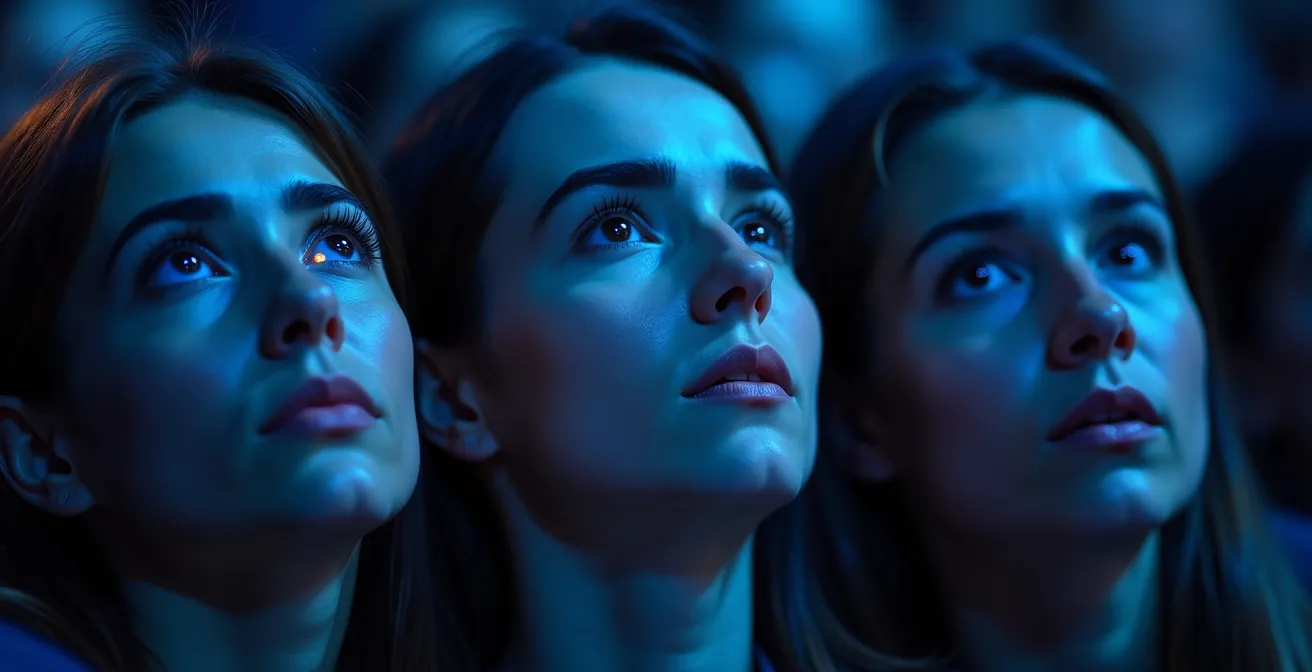
However, the experience is not universally negative. Some argue that the uncanny feeling is secondary to the collective experience of the event. Alyssa Michaud, a professor who studies music and fandom, observed of one such concert, “I think the thing that surprised me most was how powerful that sense of communal fandom was on the floor.” For many, the concert is less about the figure on stage and more about being in a room with hundreds of other people who share a deep connection to the artist’s music. The “hologram” becomes a focal point for a shared ritual of remembrance and celebration. The performance is not on the stage, but in the crowd.
Your Ethical Audit Checklist: Before You Buy the Ticket
- Points of contact: Identify all the ways the artist is being represented—the performance, merchandise, marketing. Is it consistent with their original persona?
- Collecte: Inventory the existing posthumous material. Is this performance a respectful addition or a cash-in on a saturated market?
- Cohérence: Confront the performance with the artist’s known values. Would they have approved of this technology, this presentation of their work?
- Mémorabilité/émotion: Does the prospect of the show evoke excitement for the music and community, or a morbid curiosity about the technology?
- Plan d’intégration: How does this fit into your own relationship with the artist? Will it enhance your memory of them or potentially tarnish it?
Ultimately, the question is whether the power of communal joy can overcome the inherent strangeness of the digital ghost. Is the shared experience of fandom enough to bridge the authenticity threshold and give the soulless figure a temporary soul?
Keynote from Afar: Is Beaming the CEO worth the $50k Cost?
The conversation around digital resurrection technology often centers on deceased celebrities, but its application extends far beyond the concert stage. The corporate world has embraced a similar form of telepresence, “beaming” living executives into conferences and events across the globe. Instead of resurrecting the dead, it’s about projecting the living, offering a more engaging and high-impact alternative to a standard video call. But does this futuristic presentation justify its astronomical price tag?
The cost is significant. While a one-off event might be less, projects involving this technology can be substantial investments. According to industry sources, comparable holographic presentation projects typically cost between $100,000 to $400,000, depending on the complexity and scale. For that price, a company gets more than just a video feed; they get “presence.” The CEO appears on stage as a life-sized, seemingly 3D figure, capable of interacting with a host and the audience in real-time. This creates a “wow factor” that a Zoom call simply cannot match, potentially making a keynote more memorable and impactful.
This very use case has been pioneered by companies specializing in holographic communication technology, turning what was once a novelty into a viable business tool.
Case Study: ARHT Media’s Corporate Hologram Solutions
Toronto-based ARHT Media, which patented their first capture and display technology in 2017, has been a key player in expanding this technology into the corporate events industry. The company provides solutions for beaming executives into conferences, offering an alternative to traditional video conferencing with more presence and engagement. While the effect is powerful, it comes at significantly higher costs than standard telepresence solutions, forcing organizations to weigh the novelty and engagement benefits against the substantial financial outlay.
From an ethical perspective, this application is less fraught than posthumous performance, as the subject is alive and consenting. However, it raises questions about value and authenticity in a different context. Is the goal genuine communication, or is it to use technological spectacle as a proxy for corporate power and innovation? The beamed CEO is, in essence, a high-cost symbol.
Star Wars Dreams: When Will We Have Real-Time 3D Calls on Phones?
For decades, films like *Star Wars* have planted a clear image in our collective imagination: small, personal devices projecting fully three-dimensional, real-time holographic communications. Seeing a life-sized CEO beamed onto a stage feels like a step in that direction, but why is this technology still confined to expensive, large-scale events and not yet in our pockets? The answer lies in a confluence of immense technical challenges that go far beyond the processing power of a single device.
The primary blockers are not just about creating the image, but about capturing, transmitting, and displaying it in real-time on a massive scale. According to one industry analysis, “The primary blockers are not just processing power, but standardization and bandwidth.” For a true 3D call to work, there needs to be a universal standard for how the data is captured and displayed, similar to how JPEG is a standard for images. Furthermore, the amount of data required to transmit a moving, three-dimensional image is exponentially greater than for a 2D video stream, placing enormous strain on current network infrastructure.
Despite these hurdles, true volumetric communication is not pure science fiction; it is already being deployed in specialized, high-value industrial and entertainment settings. For instance, real-time 3D visualization is being used for remote surgical assistance in some Canadian hospitals, while UK engineering firms use holographic projections for complex machinery repair guidance. In China’s real estate market, volumetric displays help clients visualize architectural spaces. Even entertainers like MrBeast have used holobox technology to appear in multiple locations simultaneously. These niche applications are the proving grounds for the technology, solving critical problems in controlled environments before they are ready for mass consumer adoption.
So, while the “Help me, Obi-Wan Kenobi” moment on your smartphone is likely still years away, the underlying technology is slowly maturing, moving from the realm of spectacle to practical, world-changing utility.
Spectacle vs Substance: Are Light Shows Valid Artistic Expression?
When an artist is no longer present to create, can a performance engineered by others still be considered a valid extension of their art? This is the central debate surrounding posthumous concerts, particularly exemplified by the groundbreaking “ABBA Voyage” show in London. Unlike the Pepper’s Ghost projections of deceased artists, ABBA’s members were alive and deeply involved in its creation. They didn’t just license their likeness; they performed their entire concert in motion-capture suits for five weeks, creating a library of authentic movements and expressions. This data then drives their digital “ABBAtars.”
The sheer scale of this endeavor highlights the immense human artistry involved. The production used 160 cameras over 5 weeks to capture the band’s every nuance. The result is not a simple re-creation but a new, hybrid art form—part live concert, part film, part technological marvel. Here, the technology is not a gimmick to replace a missing performer but a medium to present a new work of art, one that could not exist in any other form. It blurs the line between spectacle and substance, arguing that the spectacle *is* the substance.
The ultimate goal of such artistic endeavors is to make the technology disappear, leaving only the emotional impact. As Andrew McGuinness, a creator in the immersive entertainment space, eloquently states, “What I dream about is for people to forget about the technology in its entirety.” This is the holy grail for any tech-infused art: to transcend the medium and deliver a pure, unmediated experience. In the case of ABBA Voyage, many fans report that after a few minutes of awe at the technology, they simply accept the ABBAtars as the band and become lost in the music and the communal energy of the concert.
Perhaps the question isn’t whether a digital performance is “real,” but whether it is “true”—true to the artist’s intent, true to the spirit of the music, and true to the emotional needs of the audience. When the artist themselves shepherds their digital ghost into existence, the ethical concerns about consent and exploitation largely evaporate, leaving only the question of its artistic merit.
What Happens to Your Instagram Portfolio When You Die?
The ethical dilemmas of digital resurrection are not limited to the rich and famous. In an age where our lives are meticulously documented on social media, each of us is curating a vast digital portfolio—a collection of images, thoughts, and connections that forms a significant part of our identity. What happens to this digital self after we die? This question moves the debate from the concert hall to our own homes, forcing us to consider our own digital legacy.
Unlike a celebrity estate with teams of lawyers, the average person’s digital assets are often left in a state of legal and emotional limbo. Platforms like Meta and Google have “memorialization” policies, but they are often reactive and place the burden on grieving family members to provide proof of death and navigate complex procedures. The concept of a “digital executor”—a person legally designated to manage your online accounts—is emerging, but it is not yet a standard part of estate planning for most people.
This lack of planning opens the door to new and unsettling possibilities. The same data that powers our social feeds can be used to create simulations of us after we’re gone. Companies are already offering services to create AI chatbots trained on a deceased person’s digital footprint, allowing loved ones to “talk” to them. This practice, a form of algorithmic grief, raises profound ethical questions. Is this a healthy way to process loss, or does it create a digital ghost that prevents the living from moving on? Who has the right to create such a bot? Your spouse? Your children? A tech company to whom you unwittingly granted rights in a terms-of-service agreement?
The conversation about celebrity holograms is merely the most visible manifestation of a much larger societal question. In the 21st century, planning for your death must include planning for your data. Otherwise, the digital ghost you leave behind may not be one you would recognize.
Key Takeaways
- The term “hologram concert” is a misnomer; the technology is a 2D illusion called Pepper’s Ghost, which creates a “digital marionette” rather than a true 3D resurrection.
- The legality of posthumous performances is a global patchwork, with rights varying significantly between the USA (Right of Publicity), UK (Passing Off), Canada (Provincial Laws), and China (Right of Portrait).
- While the technology can feel soulless due to the “uncanny valley” effect, the communal experience of fandom can sometimes override this, creating a different kind of value for attendees.
Immersive Theater vs Traditional Stage: Is the $100 Ticket Worth the Hype?
Ultimately, for a music fan, the decision to attend a hologram concert comes down to a value judgment. Is this unique experience worth the often-premium ticket price? To answer this, it’s useful to compare it not to a traditional concert, but to another popular form of high-cost entertainment: immersive theater. Productions like “Sleep No More” in New York or the works of Punchdrunk in London have redefined the relationship between audience and performance, and they often command similar ticket prices.
Fans have shown they are willing to pay for novel experiences. For some immersive shows, fans are willing to pay up to $125 USD or more for a ticket. What they are buying is not just a seat with a view, but an active role in a sprawling, multi-sensory world. The value proposition is agency, exploration, and a story that feels personal because you physically walk through it. A hologram concert offers a different kind of value: not agency, but access. It’s access to a moment in time, to a shared cultural memory, and to a community of fellow fans.
The global rise of both these art forms shows a clear audience appetite for non-traditional performances. From the established large-scale productions in London and New York to the more experimental approaches in Toronto and the tech-infused shows of Shanghai, audiences are voting with their wallets for experiences that break the fourth wall, either physically or technologically.
| City | Notable Productions | Characteristics |
|---|---|---|
| London | Punchdrunk productions | Established large-scale productions |
| New York | Sleep No More | Long-running commercial success |
| Toronto | Emerging scene | More experimental approaches |
| Shanghai | Tech-infused productions | Integration of digital elements |
The question, then, is not simply “Is the hologram worth $100?” but “What kind of experience am I seeking?” If you seek passive viewing of a perfected memory, the digital resurrection may deliver. If you seek active participation and unpredictable moments, perhaps your money is better spent elsewhere. The ticket buys you a seat at one of the strangest and most compelling intersections of technology, memory, and art.
Frequently Asked Questions on The Ethics of Digital Resurrection
What is a digital executor?
A person designated to manage your online accounts and digital assets after death, with legal authority varying by jurisdiction.
How do platform memorialization policies work?
Major platforms like Meta and Google offer options to memorialize or delete accounts, with each having different requirements for proof of death.
Can AI recreate someone from their social media data?
Companies are already offering services to create AI chatbots trained on deceased persons’ social media data, raising ethical concerns.