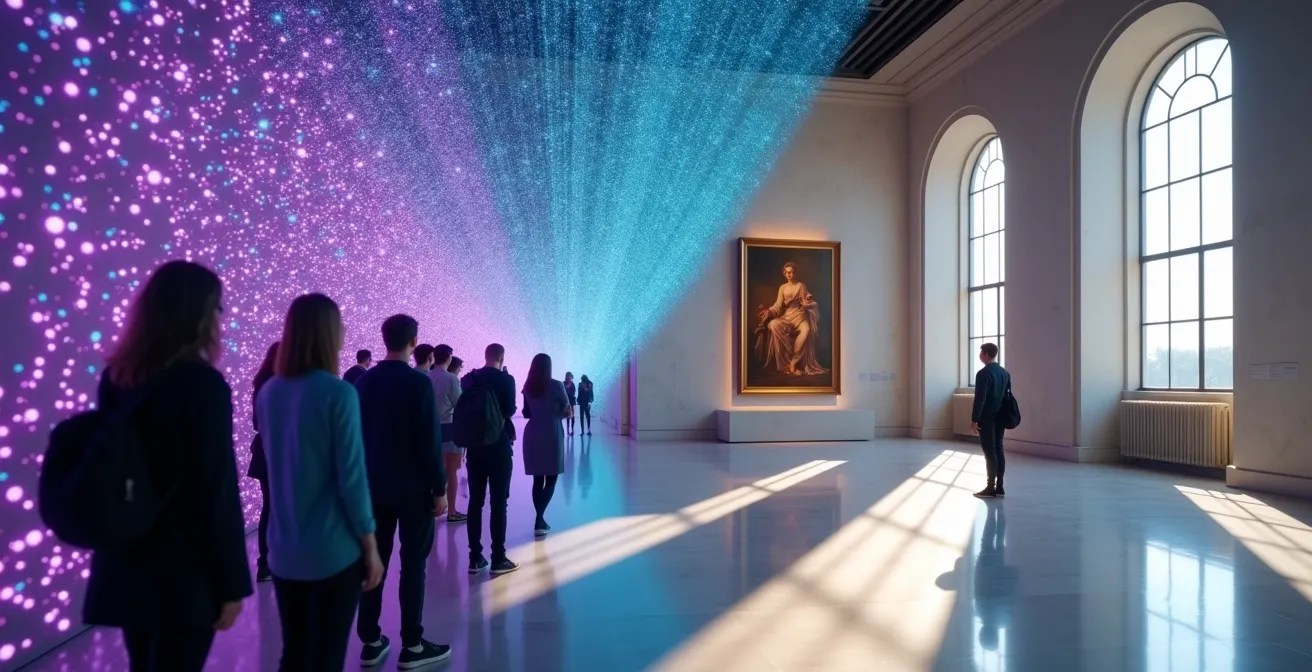
The rise of immersive exhibits isn’t just an artistic trend; it’s the success of a fundamentally different economic model built on active participation, not passive observation.
- Immersive venues generate over 60% of their revenue from high-margin ticket sales, compared to 35-40% for traditional museums.
- The experience is designed as a “narrative journey” where visitor interaction (co-creation) becomes part of the product, justifying premium pricing.
- This model turns visitors into marketers, using “Instagrammable” moments as powerful, cost-effective organic promotion.
Recommendation: When choosing, decide if you’re seeking to contemplate a collection of objects or to purchase a role in a multi-sensory story.
The modern cultural tourist faces a new dilemma. On one hand, there is the hallowed hall of a traditional museum, a quiet space to contemplate masterpieces. On the other, a pulsing, glowing world of light and sound, promising an “experience.” It’s a choice between the tangible history of a painting at MoMA and the ephemeral, Instagram-famous light show of a TeamLab exhibit. Many dismiss this as a simple contest between substance and spectacle, or a generational shift towards digital entertainment. This view misses the real story.
The success of immersive art isn’t accidental or superficial. It represents a powerful pivot in cultural consumption, a shift from an object-based economy to an experiential one. These new venues are not just showing art differently; they are operating as a completely different type of business. They have re-engineered the visitor’s role, transforming them from a passive observer into an active participant whose very presence and interaction are monetized. This is not just a new chapter in art history; it’s a case study in a new experiential economy.
This analysis will deconstruct the economic and psychological engine behind the immersive phenomenon. We will explore how set design becomes a narrative tool, break down the justification for a $50 ticket, and examine the crucial, often-overlooked, challenges of accessibility and artistic validation. By understanding this model, we can see why it’s not a fleeting trend, but a formidable new force in the cultural landscape.
This article delves into the key strategic and operational differences that define this new wave of cultural institutions. The following sections break down the components of their success, from storytelling and pricing to technology and accessibility.
Summary: An Economic Breakdown of the Immersive Art Phenomenon
- Storytelling in 3D: How Set Design Transforms an Exhibit into a Journey?
- The $50 Ticket: Why Are Immersive Experiences So Much More Expensive?
- Sensory Overload: Is Immersive Art Excluding Neurodivergent Visitors?
- How to Sell a Smell-Based Art Installation on Instagram?
- Spectacle vs Substance: Are Light Shows Valid Artistic Expression?
- Not Actually a Hologram: How the 2D Trick Fools Your Brain?
- How Do Van Gogh Exhibits Project on 30ft Walls Without Pixelation?
- Headset Headache: How to Enjoy VR Art Without Motion Sickness?
Storytelling in 3D: How Set Design Transforms an Exhibit into a Journey?
A traditional museum presents a collection of objects, often arranged chronologically or thematically. The visitor moves from one static point to the next, reading panels and observing. An immersive exhibit, by contrast, sells a narrative journey. The space itself is the primary medium, and the set design is the plot. Visitors are not just looking at art; they are moving through a story with a beginning, middle, and end. This fundamental shift in purpose explains the massive appeal, with TeamLab Borderless in Tokyo drawing a record-breaking 2.3 million visitors in a single year before its relocation.
This approach transforms the visitor from a consumer to a character. Their path through the exhibit is their personal story arc. Experiences like those created by Meow Wolf, which began as an underground art collective, are explicitly built around participant-driven storytelling. There is no single correct path; exploration and discovery are the goals. This sense of agency and personal narrative creates a much deeper level of engagement than simply viewing a painting on a wall.
The value proposition is no longer the art object itself, but the visitor’s unique journey through it. This concept of co-creation is central. As one analysis of TeamLab’s work notes, the art is designed to be incomplete without the visitor’s presence.
The artworks react to human presence and interaction, whether it’s through touch, movement, or proximity. This co-creation aspect makes visitors feel like active participants rather than mere observers.
– TeamLab Museum Analysis, Wonderful Museums
By designing the exhibit as an explorable world rather than a curated gallery, these venues create an experience that is unique to each person. This justifies a different value calculation and forms the foundation of their distinct economic model.
The $50 Ticket: Why Are Immersive Experiences So Much More Expensive?
The sticker shock of a $50 ticket for an immersive show, compared to a $25 entrance fee for a major traditional museum, is a common reaction. This price difference isn’t arbitrary; it reflects a fundamentally different business model built on a high-cost, high-margin experiential product. While traditional museums rely on a mix of ticketing, donations, and endowments, immersive venues are primarily commercial enterprises where the ticket is the main event. In fact, industry analysis shows that average ticket yields exceed USD 35 globally, with premium locations easily reaching $50 or more.
The justification for this price point lies in the participation-based revenue model. The cost covers not just entry but access to an all-encompassing sensory environment. This requires immense investment in technology, real estate with high ceilings, and constant operational upkeep. Unlike a painting that can hang on a wall for decades with minimal cost, a digital exhibit requires continuous power, maintenance, and technical staff. The revenue structure must support this high operational expenditure.

As the visual above suggests, the tactile and interactive nature of the experience is what customers are paying for. This direct engagement also fuels a secondary, highly profitable revenue stream: merchandise. The emotional high of the experience makes visitors more inclined to purchase ancillary products. A comparative financial breakdown reveals just how different the models are.
| Revenue Type | Immersive Museums | Traditional Museums |
|---|---|---|
| Ticket Sales | 62.45% of revenue | 35-40% of revenue |
| Ancillary Merchandise | 25% of gross receipts | 10-15% of gross receipts |
| Average Price Point | $25-50 | $15-25 |
This data, highlighted in an analysis by ARTnews, shows that immersive venues are far more effective at converting the experience directly into revenue, both at the door and in the gift shop. The high ticket price is not just an entry fee; it’s the purchase of a comprehensive entertainment product.
Sensory Overload: Is Immersive Art Excluding Neurodivergent Visitors?
The very asset that makes immersive exhibits so compelling—their appeal to sensory capital—is also their greatest liability. These spaces are intentionally designed to be overwhelming, with pulsing lights, all-encompassing soundscapes, and sometimes even engineered scents. While thrilling for many, this environment can be exclusionary and distressing for neurodivergent individuals, including those with autism, sensory processing disorders, PTSD, or anxiety. The intense stimulation can trigger sensory overload, making the experience unbearable rather than enjoyable.
The scale of this sensory input is significant. For context, many immersive exhibitions feature dramatic audio at approximately 85-90 decibels, a level comparable to a noisy restaurant or heavy city traffic. When combined with disorienting visuals like infinite mirror rooms or rapidly changing projections, the cognitive and sensory load can be immense. This raises critical questions about accessibility that go beyond physical accommodations like ramps and elevators.
Recognizing this challenge, some of the more forward-thinking institutions are beginning to implement strategies to mitigate these issues. They are not abandoning their core model but are providing tools and designated spaces to allow a wider range of visitors to participate. These accommodations demonstrate an evolving understanding that true accessibility in an experiential economy must account for sensory and neurological diversity. The following checklist outlines some of the best practices currently being adopted.
Your Action Plan: Verifying Sensory Accessibility Features
- Tools at Entry: Check if the venue offers noise-dampening headphones or other sensory tools upon request at the entrance.
- Designated Quiet Zones: Identify if the floor plan includes dedicated, clearly marked quiet rooms or low-stimulation areas for sensory breaks.
- Advance Warnings: Look for clear notices on the website or at the entrance regarding flashing lights, strong scents (especially floral), or disorienting effects.
- Visitor Guidance: Note if the staff or signage provides practical advice, such as focusing on a single point to reduce disorientation or suggesting specific clothing (like all white) to minimize visual distraction.
- Phased Experiences: Inquire about special “low-sensory” hours or days, where audio volumes are reduced and lighting effects are toned down for a more controlled experience.
While these measures are a step in the right direction, the inherent conflict between maximalist sensory engagement and inclusive design remains a central challenge for the immersive art industry.
How to Sell a Smell-Based Art Installation on Instagram?
One of the biggest challenges for the experiential economy is marketing an intangible product. How do you convey a feeling, a journey, or a scent through a purely visual medium like Instagram or TikTok? The answer lies in shifting the focus from the art object to the human reaction. You don’t sell the smell; you sell the look of wonder on someone’s face as they experience it. This strategy is core to the organic marketing engine that has propelled immersive art to viral fame.
Unlike a traditional museum that might post a high-resolution image of a painting, an immersive venue’s social media is filled with pictures of people *inside* the art. The visitor becomes the subject. The “Instagrammability” of venues like TeamLab is not a byproduct of their design; it is a central feature. Every mirrored room and field of interactive lights is a perfectly crafted photo opportunity. This turns every visitor with a smartphone into a potential marketer, creating a powerful, self-sustaining loop of user-generated content that serves as free, authentic advertising.
This marketing approach is especially crucial for experiences that are not purely visual. For an installation based on sound or smell, showing the artwork itself is impossible. The solution, as one marketing analysis points out, is to focus on the audience’s response.
The most effective marketing isn’t trying to show the smell, but showing the human reaction to it. Use video testimonials, reaction shots, and interviews with visitors describing their unique sensory journey.
– Marketing Strategy Analysis, Original analysis based on museum practices
By showcasing the emotional impact on past visitors, these venues create a powerful sense of FOMO (Fear Of Missing Out). Prospective customers see authentic joy, surprise, and contemplation, and they want to experience that feeling for themselves. This focus on human reaction is how the intangible is made desirable and, ultimately, marketable.
Spectacle vs Substance: Are Light Shows Valid Artistic Expression?
The most persistent criticism leveled against immersive art is that it is “spectacle, not substance.” Critics argue that these experiences prioritize shallow entertainment over deep artistic or intellectual engagement, reducing art to a series of dazzling photo backdrops. They question whether a digitally projected Van Gogh can ever carry the same weight as the artist’s original, textured brushstrokes. This debate, however, often overlooks the vast economic and popular validation these experiences have received. For instance, last year’s data shows approximately $60 million in ticket sales for TeamLab Planets in Tokyo alone—a figure that demands the phenomenon be taken seriously.

The image of a lone figure contemplating an infinite, mirrored cosmos challenges the simplistic notion that these spaces are only for group selfies. For many, they offer profound, personal moments of awe and introspection. The “substance” may not lie in a physical object but in the visitor’s internal, emotional, and psychological response to the engineered environment. The art is the feeling it provokes.
Furthermore, the line between “traditional” and “experiential” is becoming increasingly blurred. Many established institutions are incorporating interactive and digital elements into their exhibits. As Aziz Isham, Executive Director of the Museum of the Moving Image, astutely observes, the landscape is not a simple binary.
Museums exist on a spectrum. While there are still quite a few that have a ‘look at object / read a panel’ approach, there are many that are experiential. Most are a hybrid.
– Aziz Isham, Executive Director, Museum of the Moving Image
Ultimately, visitor choice is the deciding factor. The millions who willingly pay for these experiences are voting with their wallets, confirming that they find value, meaning, and yes, substance, in these spectacular worlds. The market has declared them a valid—and highly successful—form of cultural expression, whether or not they fit traditional definitions of art.
Not Actually a Hologram: How the 2D Trick Fools Your Brain?
Many visitors leave immersive exhibits wondering about the “holograms” they just walked through. In reality, very few of these experiences use true holographic technology. The magic is often a clever and large-scale application of a much older illusion: projection. Specifically, these venues rely on sophisticated digital projection systems to create the illusion of three-dimensional, interactive worlds. It’s a 2D trick that masterfully exploits human perception.
The technical backbone for many of these exhibits, including those by the renowned art collective teamLab, involves a network of high-powered projectors and sensors. As a technical analysis explains, teamLab exhibitions specifically use EPSON digital technology, which works through a series of touch-reactive areas and pre-coded animations. When a visitor touches a wall, they are interrupting a light sensor, which triggers a pre-programmed visual response. The “artwork” isn’t magically creating itself; it’s executing a command.
The true genius of this model lies not in the technology itself, but in its psychological application. The installations are designed to create a state of cognitive dissonance, where the rational mind knows it’s an illusion, but the senses experience it as real. This tension is what fosters a deep connection.
Case Study: The Psychology of Digital Illusions
The dynamic and reactive nature of teamLab’s art means that no two visits are exactly alike. The artworks react to the specific movements and presence of the people in the room at that moment. This creates a powerful psychological effect: visitors feel a sense of ownership and agency over their experience. They are not just witnessing a projection; they are actively co-creating it. This perceived influence, even while knowing it is a programmed illusion, deepens the emotional impact and makes the memory of the experience intensely personal and unique.
This is why the experience feels so magical. The technology is simply a tool to manipulate perception and create an emotional reality that transcends the technical “trick.” The visitor’s brain is prompted to fill in the gaps, transforming a series of 2D projections into a living, breathing environment.
How Do Van Gogh Exhibits Project on 30ft Walls Without Pixelation?
Scaling a famous painting like Van Gogh’s “The Starry Night” to cover a 30-foot wall without it becoming a blurry, pixelated mess is a significant technical challenge. The solution lies in a technology called projection mapping, which has become the dominant force in the immersive entertainment sector. In fact, this single technology underpins an estimated 38.90% of the immersive market’s 2024 revenue, highlighting its economic and technical importance.
Projection mapping doesn’t use a single, giant projector. Instead, it involves a synchronized network of multiple high-resolution projectors whose images are digitally “stitched” together. Specialized software maps the projection onto a three-dimensional surface—be it a complex architectural facade or the simple walls of a large room—correcting for distortion, angles, and surface irregularities. This allows a seamless, massive image to be created from many smaller, overlapping ones. The source material itself is also key; the digital versions of the artworks are often of an extremely high resolution to allow for such massive scaling.
This technology has significant infrastructure requirements, which contributes directly to the high operational costs and ticket prices of these venues. Creating an optimal experience is not as simple as renting a warehouse and some projectors. As a technical deep-dive on the subject notes, the physical space is paramount.
Projection Mapping systems use multiple projectors to turn everything into a screen, projecting videos on all types of objects to bring the whole room alive. Quality projection-based art often requires a 10-meter or even higher ceiling with several thousand square meters of floor space for optimal experiential impact.
– Technical Requirements Analysis, Rustic Pathways Magazine
Achieving a crisp, large-scale image is therefore a combination of high-resolution source files, a powerful network of projectors, and sophisticated software running in a purpose-built physical environment. It’s a costly technological ballet that creates the illusion of stepping inside a painting.
Key takeaways
- Immersive art is not just a new genre, but a distinct economic model focused on selling participation in a narrative journey.
- The high ticket price is justified by high operational costs and a value proposition based on co-creation and sensory engagement, leading to higher revenue from both tickets and merchandise.
- The “Instagrammable” nature of these exhibits is a deliberate and highly effective organic marketing strategy that turns every visitor into a promoter.
Headset Headache: How to Enjoy VR Art Without Motion Sickness?
As immersive experiences push further into the digital realm, Virtual Reality (VR) headsets are becoming a more common tool. They offer unparalleled immersion by completely replacing the user’s view of the real world. However, this total immersion comes with a well-known side effect: cybersickness, or VR motion sickness. This feeling of nausea, dizziness, and disorientation occurs when your eyes perceive motion that your inner ear does not, creating a sensory mismatch. This can quickly ruin an otherwise compelling artistic experience.
Fortunately, both creators and users can take steps to mitigate this issue. For visitors, prevention is key. Small adjustments and an awareness of your own limits can make a significant difference in being able to enjoy VR art without discomfort. Here are some practical tips for preventing VR motion sickness:
- Ensure a perfect fit: Before you start, adjust the headset’s IPD (interpupillary distance) setting to match your eyes. A blurry or misaligned image is a major cause of strain and sickness.
- Take preemptive breaks: Don’t wait until you feel sick. Take the headset off for a few minutes every 15-20 minutes, even if you feel fine.
- Choose your movement: Opt for experiences that use “teleportation” (point-and-click) movement instead of “smooth locomotion” (like walking with a joystick), as the latter is a common trigger.
- Find a horizon: If the experience has one, try to keep a static horizon line in your view to give your brain a stable reference point.
- Consider alternatives: If you are particularly sensitive, look for Augmented or Mixed Reality (AR/MR) experiences that overlay digital elements onto the real world, which is often less disorienting.
Despite these challenges, VR is unlikely to replace physical, in-person experiences. Instead, it will act as a powerful complement, offering new avenues for artistic expression and accessibility. As one analysis on museum technology concludes, the human element remains irreplaceable. People still crave real-world interaction and the shared experience of going out. VR will enhance, not substitute, the museum visit.
Ultimately, the choice between a quiet gallery and an interactive light show is a choice between two valid, but fundamentally different, forms of cultural consumption. The next time you plan a visit, consider not just what you want to see, but the kind of economic and sensory experience you wish to join. Your ticket is not just an entry fee; it’s an investment in a particular vision of what art can be.