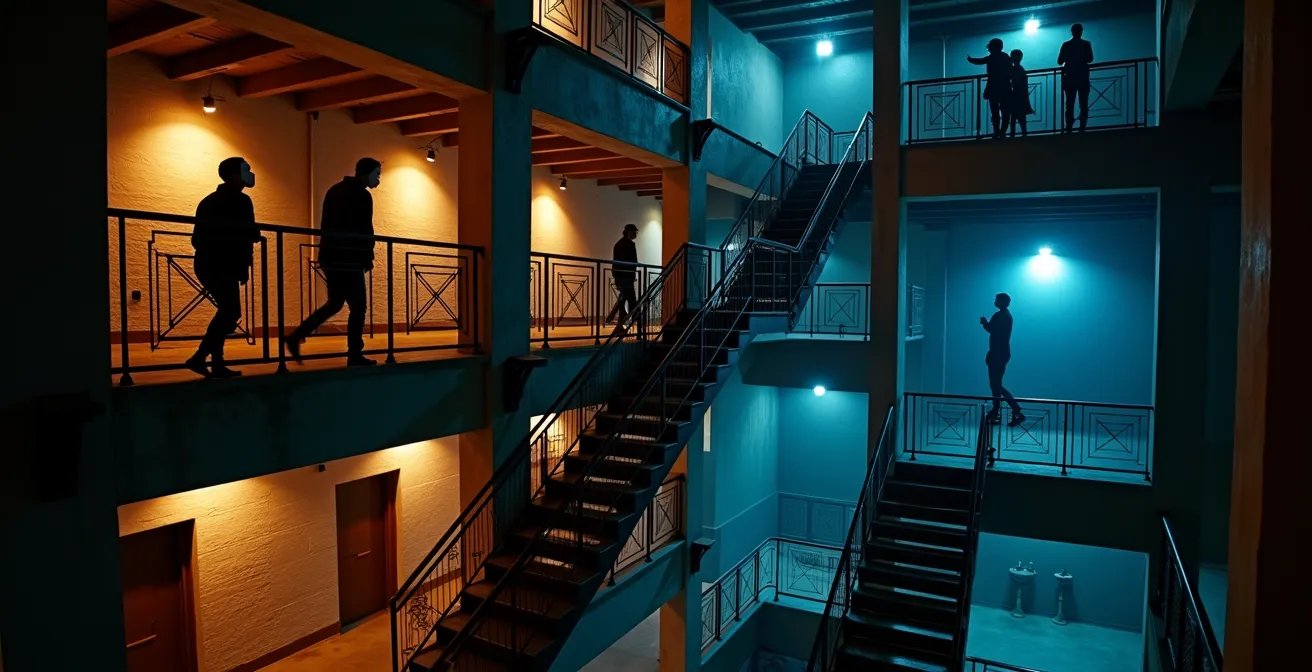
The true value of an immersive ticket lies not in the hype, but in its ‘Artistic ROI’—the measurable ratio of narrative depth to manufactured spectacle.
- Shallow “selfie factories” prioritize aesthetics over story, while high-value experiences build detailed, explorable worlds.
- Effective participation isn’t about being an extrovert; it’s about adopting the critic’s gaze and observing the narrative density of the environment.
Recommendation: Use the frameworks in this guide to evaluate an experience’s substance *before* you book, ensuring your entertainment budget is an investment in genuine art, not just a fleeting trend.
The question looms over every culture seeker’s budget: with tickets often breaking the $100 barrier, is the new wave of immersive art a revolution in storytelling or just an expensive, overhyped trend? In cities like London and New York, you can’t scroll through social media without seeing friends wander through a projected Starry Night or don a mysterious mask in a shadowy, repurposed warehouse. The FOMO is palpable. But so is the skepticism. For every groundbreaking show like Sleep No More, a dozen shallow “selfie factories” seem to pop up, designed more for Instagram feeds than for genuine artistic engagement.
The common advice—”wear comfortable shoes,” “be open to the experience”—is well-meaning but ultimately unhelpful. It doesn’t equip you to make a discerning choice. It fails to address the core anxiety of the savvy consumer: how do I distinguish profound art from a pretty-but-hollow backdrop? How can I be sure my money is funding innovation and not just a clever marketing gimmick? This is not just about entertainment; it’s about the very redefinition of our cultural consumption, a market that demands a more critical eye.
But what if the key isn’t a simple “yes” or “no” answer? What if the real solution is a new way of evaluating these experiences altogether? This guide proposes a different approach: calculating the Artistic Return on Investment (Artistic ROI). It’s a framework for looking past the spectacle to measure the substance. We will not just tell you what to see, but *how* to see—providing the critical tools to analyze narrative density, set design, and your own role as an audience member.
From the technology behind the spectacle to the economics of ticketing, this analysis will empower you to become a more discerning consumer of immersive art. You’ll learn to identify true innovation, navigate these worlds with confidence (even as an introvert), and ultimately decide for yourself if that hundred-dollar ticket is a worthy investment in your cultural life.
Contents: Judging the Value of Immersive Experiences
- How Do Van Gogh Exhibits Project on 30ft Walls Without Pixelation?
- The Introvert’s Guide to Immersive Art: How to Participate Without Panic?
- Museum or Selfie Backdrop: How to Identify Shallow Pop-Up Experiences?
- Rush Tickets vs Membership: The Cheapest Way to See Top Tier Theater
- When to Visit Blockbuster Exhibitions to Avoid the Crowd Crush?
- Storytelling in 3D: How Set Design Transforms an Exhibit into a Journey?
- Quest vs Vive: Which Headset Offers the Best Museum Experience at Home?
- From Technology to Artistry: When Is Projection Worth the Price?
How Do Van Gogh Exhibits Project on 30ft Walls Without Pixelation?
The magic of walking into a room where Van Gogh’s sunflowers bloom across 30-foot walls is undeniable. It’s the “spectacle” component of the immersive promise, and it’s powered by sophisticated technology. The effect isn’t achieved with a single projector, but through a technique called projection mapping. This involves using multiple, high-lumen, 4K or even 8K resolution projectors that are precisely calibrated. Specialized software “stitches” these projections together, a process known as edge blending, creating one massive, seamless canvas. This prevents the pixelation you’d see if you simply blew up a single image.
This technological arms race is fueled by a booming market. The immersive experience economy is not a niche curiosity; it’s a colossal industry. Research estimates the Immersive Entertainment Market at $144.17 billion in 2025, with projections to soar to over $400 billion by 2030. This financial reality explains the proliferation of these shows: the technology is becoming more accessible, and the public appetite seems insatiable. However, the technology itself is neutral. It can be used to create profound artistic statements or, just as easily, expensive digital wallpaper.
Understanding this technical foundation is the first step in becoming a critical consumer. When you see a seamless, vibrant projection, you’re not just seeing art; you’re seeing a significant investment in hardware and software. The crucial question for determining Artistic ROI is what that technology is being used to *do*. Is it simply displaying a famous painting at a large scale, or is it animating it, deconstructing it, and using the 3D space to offer a new perspective on the artist’s work? The spectacle is the hook, but it should never be the entire story.
The Introvert’s Guide to Immersive Art: How to Participate Without Panic?
A common misconception about immersive theatre is that it demands extroverted performance from its audience. The fear of being pulled on stage, handed a prop, or forced into an awkward interaction is a major barrier for many. However, it’s crucial to understand a key distinction highlighted by industry experts: immersive is not always interactive. As a critical starting point, one should remember that “immersive theater and interactive theater are not necessarily synonymous; immersive theater may not have interactive elements in it at all, and interactive theater may not be immersive in the core sense.” An immersive experience surrounds you in a world; an interactive one demands your response.
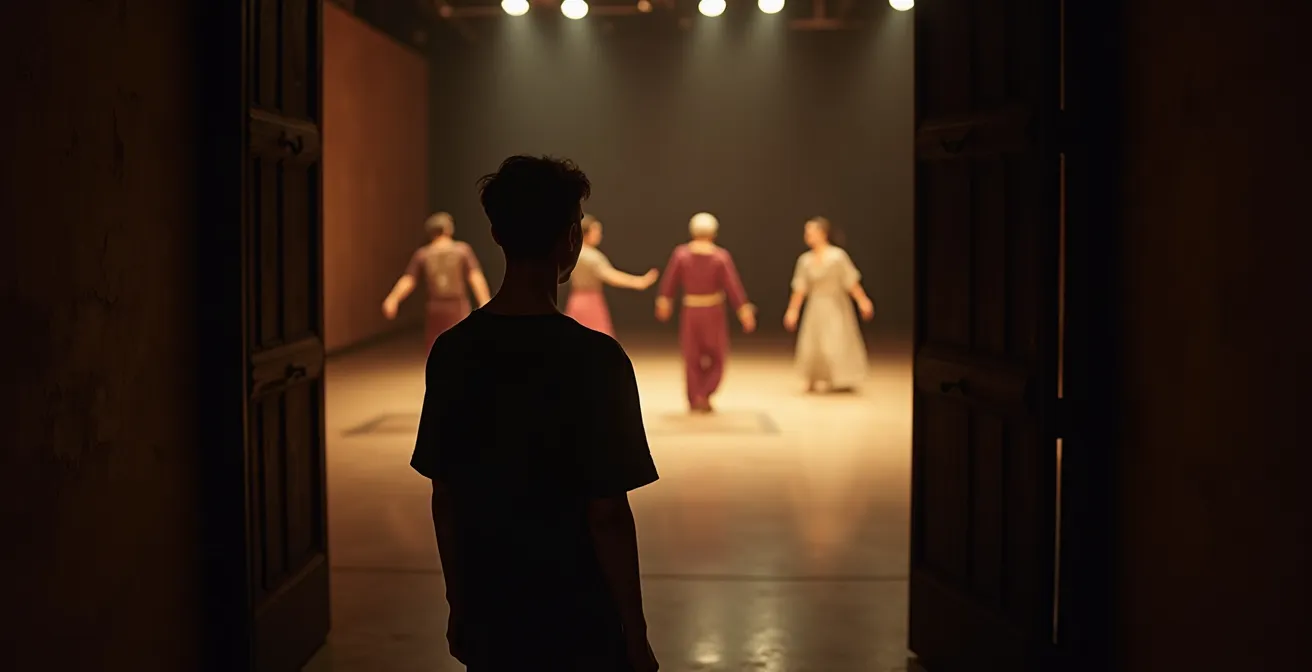
For the introvert, the most powerful mode of engagement is what can be termed the “Introvert’s Gaze”—adopting the role of a silent observer, a ghost in the machine. Your presence is your participation. In mask-based shows like Sleep No More, this is the default state. The mask grants you the freedom of anonymity, allowing you to watch intimate scenes unfold without feeling self-conscious. Instead of panicking about what you’re “supposed” to do, reframe your role. You are not a passive viewer; you are an explorer, a detective piecing together a polychronic narrative from the clues you gather. Your agency lies in where you choose to look and which character you decide to follow.
To master this, let the production’s rules be your guide. They are designed to facilitate the experience, not to test you. If you are meant to be a silent observer, embrace it. If you have the agency to open drawers or read letters, do so at your own pace. The highest Artistic ROI for an introvert comes not from forced interaction, but from the quiet, contemplative moments of discovery—finding a hidden room, catching a subtle glance between two performers, or simply absorbing the rich ‘narrative density’ of the set design. Participation is a spectrum, and observation is one of its most potent forms.
Museum or Selfie Backdrop: How to Identify Shallow Pop-Up Experiences?
The explosion of the immersive market has led to a critical problem for consumers: saturation. With the industry in China alone boasting over 32,000 immersive projects by late 2023, it’s inevitable that quality will vary wildly. The line between a profound art installation and a shallow “selfie factory” has become dangerously blurred. The key to a high Artistic ROI is learning to spot the difference *before* you buy a ticket. A shallow experience offers spectacle without substance; its environment is a backdrop for photos, not a vessel for narrative.
A truly immersive world has high narrative density—every object, sound, and lighting choice serves the story. An interactive experience, in contrast, focuses on its connection with you. The following table breaks down these core differences, providing your first tool for critical evaluation.
| Characteristic | Immersive Theater | Interactive Theater |
|---|---|---|
| Audience Role | You can wander through a grand ballroom, peek behind curtains, or follow whichever character catches your attention. | The actors turn their focus directly on you, might ask you a question, hand you a prop, or respond in real time. |
| Environment | Creates multi-sensory worlds—you might smell food cooking, feel wind from an open window, or hear music from another room. | Focuses less on surrounding you and more on connecting with you. |
| Venue Size | Can be massive, like a multi-story hotel or old warehouse, letting hundreds explore at once. | Often happen in smaller, more contained venues so every audience member can be reached personally. |
| Experience Type | Feels like slipping into another dimension—you’re surrounded but not necessarily spoken to, exploring at your own pace. | Feels like joining a live improv—you’re noticed, spoken to, and sometimes relied on to keep the story moving. |
Beyond this, you need a practical method for vetting a specific show. Look for signs of substance. Does the marketing talk about story, character, and journey, or does it just show beautiful people in beautiful rooms? Are the reviews from theatre critics or from lifestyle influencers? A high-value experience is confident in its story, while a low-value one sells only its aesthetics. Use the following audit to guide your research.
Your Artistic ROI Audit: 5 Points to Verify Before Booking
- Source Material: Does the experience adapt a rich, complex narrative (e.g., Shakespeare, a historical event), or is it based on a purely visual concept (e.g., “The World of Pink”)?
- The “Why”: Can you find interviews or press where the creators explain their artistic intent? Look for discussions of theme and message, not just “creating a fun space.”
- Sensory Engagement: Does the description promise multi-sensory elements beyond the visual? Mentions of sound design, scent, or tactile objects are signs of deeper world-building.
- Critical Reception: Seek out reviews from established arts critics, not just user-generated content. A critic is trained to analyze narrative structure, a key indicator of substance.
- The No-Photo Rule: While not universal, a strict “no photography” policy is often a sign of confidence. The creators want you to live in their world, not document it for social media.
Rush Tickets vs Membership: The Cheapest Way to See Top Tier Theater
For the discerning culture seeker, the financial calculation is as important as the artistic one. With premium tickets often exceeding the cost of a traditional Broadway show, finding value is paramount. The business model of the immersive industry provides clues. An industry analysis reveals that while ticket sales made up 62.45% of 2024 revenues, the real story for savvy consumers is the expected 24.76% growth in subscriptions and memberships. This signals a shift toward cultivating repeat customers, a strategy you can leverage.
Rush tickets, digital lotteries, and off-peak pricing (e.g., weekday matinees) remain the classic tools for the opportunistic theatregoer. They offer a direct discount but require flexibility and luck. However, for those committed to exploring immersive art, a membership or subscription can offer a superior Artistic ROI over the long term. These programs, offered by producers like Punchdrunk or arts venues, often provide not just discounted or priority access but also entry into a curated ecosystem. You are investing in a specific artistic taste, increasing your odds of seeing high-substance work.
The global context also matters. While North America currently dominates the market, the explosive growth in the Asia Pacific region suggests that new, potentially more accessible pricing models may emerge. Paying attention to these global trends can reveal opportunities. Ultimately, the “cheapest” way isn’t just about the lowest price for a single ticket. It’s about the most cost-effective strategy for consistently accessing high-quality experiences. A membership might feel like a larger upfront cost, but if it grants you access to three high-substance shows for the price of two shallow ones, your Artistic ROI is significantly higher.
When to Visit Blockbuster Exhibitions to Avoid the Crowd Crush?
Even the most profound immersive experience can be ruined by one thing: a crowd. The “crowd crush” transforms an explorable world into a frustrating queue, tanking the Artistic ROI. Your ability to connect with the narrative density of the space is directly proportional to your freedom of movement and observation. Therefore, strategic timing isn’t just a matter of comfort; it’s an essential part of curating your own high-quality experience. The goal is to maximize your signal-to-noise ratio, where the “signal” is the art and the “noise” is the distraction of other people.
The most obvious strategy is to avoid peak times: Friday nights, Saturday evenings, and holiday weekends. The best slots are typically the first entry of the day on a weekday (when the space is fresh and least populated) or the last entry on a Sunday or weeknight (when crowds are thinning out). Some productions even offer extended or late-night hours, which often attract a more dedicated, less tourist-heavy audience. Check the booking calendar for variations in ticket prices; cheaper slots almost always correlate with lower demand and fewer people.

Beyond timing, a few tactical choices on-site can drastically improve your experience. Resisting the urge to follow the largest group is paramount. The moment a crowd forms around a performer, peel off and explore an empty room. The narrative in these shows is often cyclical; you will get another chance to see that scene. In the quiet moments, you can absorb the details of the set, read the props, and piece together the story’s deeper layers—the very essence of high narrative density. Remember, the production has invested heavily in these details; the crowd crush prevents you from seeing them.
Storytelling in 3D: How Set Design Transforms an Exhibit into a Journey?
In the best immersive theatre, the environment is not a passive backdrop; it is arguably the main character. As the Immersive Experience Network notes, “These environments are not just backgrounds for the action but integral parts of the narrative, designed to engage the audience’s senses and draw them into the story.” This is the pinnacle of “substance over spectacle.” The set tells a story all on its own. A forgotten letter on a desk, a half-finished meal on a table, the specific scent in a room—these are all narrative devices that build the world and its history, a concept known as environmental storytelling.
The gold standard for this is Punchdrunk’s Sleep No More. The production is a masterclass in transforming a physical space into a psychological journey. According to an analysis by the MIT Media Lab, the show unfolds across a converted warehouse with over 100 cinematically detailed rooms. Audience members are instructed to explore this labyrinthine “McKittrick Hotel.” By opening a drawer in a detective’s office or reading a patient’s file in an abandoned asylum ward, you are actively uncovering layers of the plot. The set design rewards curiosity.
Case Study: The Narrative Density of The McKittrick Hotel
In Sleep No More, a guest might wander into a taxidermist’s workshop. The room is filled with unsettling stuffed birds and meticulous drawings. On its own, it’s an atmospheric space. But for the audience member who has been following the character of Lady Macbeth, and who later finds a single black feather on her vanity, the room gains a profound narrative weight. The set design creates a web of connections that only the observant audience member can piece together. This is peak Artistic ROI: the environment itself provides a deeper, more personal narrative path than the main action.
This is the ultimate test for identifying substance. Does the set fall apart on close inspection, or does it reveal more detail? A “selfie factory” is designed to look good from 10 feet away. A true immersive world is designed to be touched, read, and explored. Its narrative density is a direct measure of its artistic integrity and your potential for a meaningful journey.
Quest vs Vive: Which Headset Offers the Best Museum Experience at Home?
The promise of immersion is no longer confined to physical venues. The at-home virtual reality (VR) market offers a compelling, and often more affordable, alternative. With the VR segment leading the immersive technology market, the question for culture seekers is no longer *if* they should engage with VR, but *how*. Choosing a headset like a Meta Quest or an HTC Vive isn’t just a tech decision; it’s a choice of cultural ecosystem. The “best” headset is the one that provides access to the highest quality artistic content.
The Meta Quest series has democratized VR with its standalone, wireless design and more accessible price point. Its store is filled with a wide array of apps, including virtual museum tours and narrative experiences. The HTC Vive, particularly its Pro series, is often favored by developers and prosumers for its superior tracking and fidelity, typically requiring a powerful PC to run. This often translates to more graphically intense and complex experiences, but at a higher cost and complexity.
However, the hardware is only half the equation. The quality and availability of content are dictated by regional market dynamics and developer focus. A look at technology adoption provides crucial context.
| Region | Market Position 2024 | Growth Forecast | Key Drivers |
|---|---|---|---|
| North America | Leading Market Share | Steady growth | Strong presence of tech giants like Meta and Apple driving platform development. |
| Asia Pacific | Growing rapidly | 23.86% CAGR to 2030 | Explosive growth in location-based experiences, particularly in China. |
| Europe | Substantial pace | High growth expected | Rich cultural heritage driving innovative use in museums and heritage sites. |
As the table from a Polaris Market Research report indicates, North America’s tech-driven market may produce more polished platforms, but Europe’s focus on cultural heritage might yield more artistically significant museum partnerships. Your Artistic ROI calculation here is a trade-off: the Quest offers broad access and convenience, while a PC-based system like the Vive might grant you entry to more niche, high-fidelity artistic projects. The wise choice is to research the exclusive titles and apps for each platform *before* investing in the hardware.
Key Takeaways
- The value of an immersive show is not in its price but its ‘Artistic ROI’—the balance of meaningful narrative against empty spectacle.
- True immersion is built on ‘narrative density,’ where every element of the set design serves the story, rewarding curiosity and exploration.
- Your role as an audience member is a choice; silent, focused observation (‘The Introvert’s Gaze’) is as valid and powerful as active interaction.
From Technology to Artistry: When Is Projection Worth the Price?
We now understand the technology that allows Van Gogh’s paintings to be projected onto vast walls without pixelation. But this brings us back to the central question of our entire investigation: when is that spectacle worth the high ticket price? The technology itself, as we’ve established, is creatively neutral. Its value is determined entirely by its application. The difference between a masterpiece and a gimmick lies in whether the technology serves a compelling artistic vision or simply acts as a high-tech delivery system for a pre-existing image.
The lowest form of Artistic ROI comes from experiences that are purely representational—they show you the art, but bigger. While visually impressive, this offers little more than a high-resolution slideshow. The highest ROI comes from experiences that are transformative. These use projection mapping not just to display, but to deconstruct, animate, and interpret the art, creating a new work that could not exist in any other medium. They use the three-dimensional space to place you *inside* the artist’s psyche, surrounding you with the brushstrokes and movement that define their work.
A prime example of technology serving art with immense success can be seen in theatrical productions that blend projection with live performance. The Shanghai production of Sleep No More, a collaboration between SMG Live and Punchdrunk, has masterfully integrated technology while respecting its core artistic integrity. Over eight years, it has generated over 550 million yuan ($75.35 million) in revenue, demonstrating that audiences are willing to pay a premium for substance. The success shows that when technology is used to deepen a narrative rather than replace it, the financial and artistic returns can be enormous. It proves that spectacle and substance are not mutually exclusive; they can be powerful allies.
The next time you are faced with the choice, don’t just ask if an experience is “cool” or “Instagrammable.” Ask if it has narrative density. Ask what story the set is telling. Use this critical framework to calculate its Artistic ROI, and invest your time and money in the groundbreaking art that is truly redefining cultural consumption.