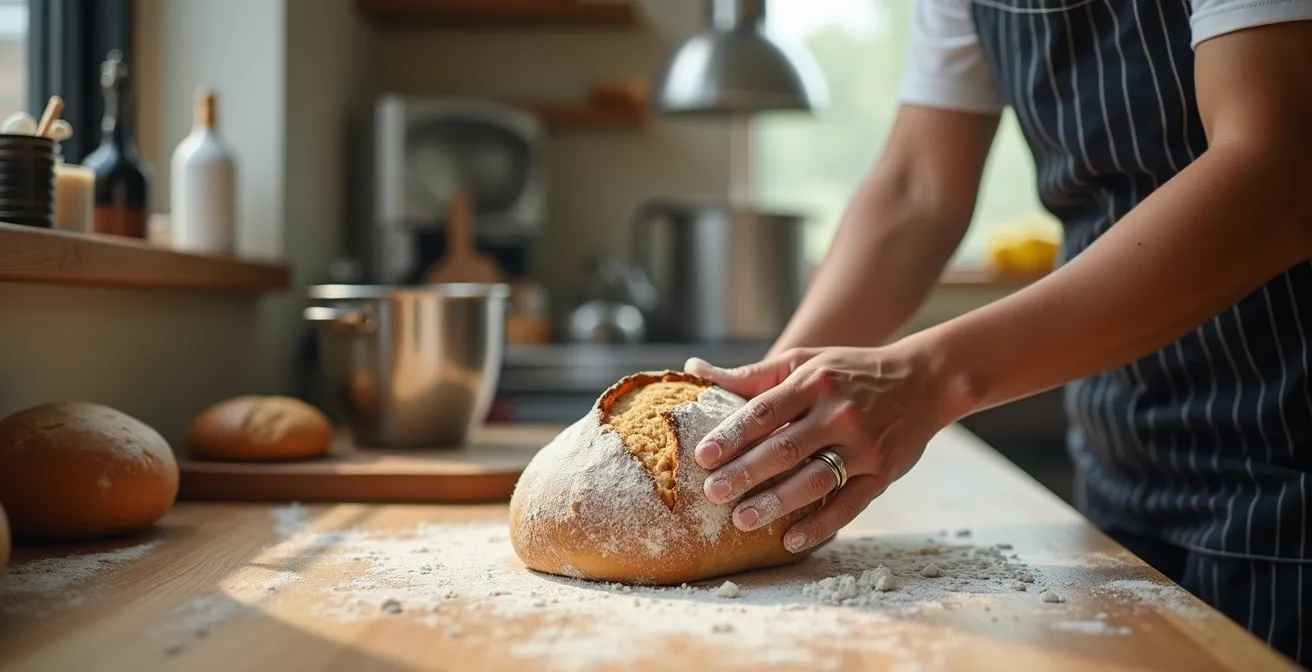
Successfully transitioning from a home baker to a legitimate business hinges on mastering the operational systems—pricing, logistics, and legal compliance—that professionals use.
- Accurate pricing must account for all hidden costs, including labor and insurance, not just ingredients.
- Strategic choices in packaging and sales models (markets vs. subscriptions) directly impact profitability and customer loyalty.
Recommendation: Treat legal requirements like labeling not as hurdles, but as branding opportunities to build customer trust and professional credibility from day one.
The aroma of a freshly baked sourdough loaf cooling on the counter is a reward in itself. For many passionate home bakers, sharing that creation with friends and family is a joy. But then comes the question: “You should sell these!” It’s a flattering thought that quickly collides with a daunting wall of uncertainty. Suddenly, you’re not just thinking about flour and water, but about health inspectors, business licenses, and the dreaded commercial kitchen.
The common advice is to “check your local cottage food laws” or “start small at a farmers market.” While true, this guidance barely scratches the surface. It overlooks the fundamental shift in mindset required to move from a beloved hobby to a viable business. The fear of bureaucracy often paralyzes talented bakers, keeping their passion confined to their own kitchens. This fear stems from viewing regulations and logistics as obstacles rather than as a structured path to success.
But what if the secret to a thriving micro-bakery wasn’t just a better starter, but a better system? The true leap from hobbyist to professional isn’t about passion; it’s about mastering the operational and bureaucratic frameworks that turn flour into profit. These “boring” parts—meticulous pricing, strategic scheduling, and rigorous compliance—are not roadblocks. They are the blueprint for a sustainable and resilient business.
This guide will walk you through these essential systems. We’ll deconstruct the real costs behind a single croissant, explore how packaging choices define your brand, and reveal the scheduling hacks that make small-batch production profitable. By the end, you’ll see legal compliance not as a threat, but as your greatest tool for building a trusted, professional baking business.
Summary: Your Guide to Professional Home Baking
- Flour, Power, and Time: Why You Are Underpricing Your Croissants?
- Paper or Plastic: Which Bag Keeps Crusty Bread from Getting Soft?
- The Scheduling Hack to Bake 20 Loaves in a Domestic Oven
- Farmers Market or Subscription Drop: Which Model Builds Loyal Customers?
- Labeling Requirements: The Fine Print That Can Get You Fined
- Why Relying Solely on Foot Traffic Bankrupts 40% of High Street Shops?
- Discard Crumpets: The Best Way to Use Up Excess Starter?
- Why Your Sourdough Starter Died After 7 Days and How to Revive It?
Flour, Power, and Time: Why You Are Underpricing Your Croissants?
The most common mistake new bakery entrepreneurs make is basing their prices solely on the cost of flour, water, and salt. This approach fundamentally undervalues the true investment behind each loaf. A professional baker understands that “true costing” is the first and most critical step toward building a sustainable business, not just funding a hobby. This means accounting for every single input, visible and invisible.
Hidden costs are the silent profit killers. These include not only premium ingredients, whose prices can fluctuate wildly, but also overhead expenses. Think about utilities like electricity and gas, the depreciation of your oven and mixer, and essential packaging like bags and labels. Furthermore, you must factor in business-specific costs like product liability insurance, which is non-negotiable when selling food to the public. The price of key ingredients can be especially volatile; for instance, some professional bakers report current ingredient costs showing $260 for a 36-pound case of imported European-style butter.
Perhaps the most overlooked cost is your own labor. Even if you’re a one-person operation, your time has value. A professional calculates a fair hourly wage (a minimum of $15-20/hour is a common baseline) and builds it into the price of every item. Failure to do so means you are not running a business; you are subsidizing your customers’ purchases with your free labor. This financial pressure is real, as even established bakeries must adapt; a survey of Bay Area bakeries revealed that in the face of inflation, the price of a butter croissant rose by an average of 20%.
Adopting a “true costing” model is a declaration that you are a professional. It ensures your business has the financial resilience to grow, invest in better equipment, and ultimately, thrive. It’s the difference between breaking even and building an enterprise.
Paper or Plastic: Which Bag Keeps Crusty Bread from Getting Soft?
Packaging for an artisan baker is far more than a simple container; it’s a critical component of your product, brand, and business strategy. The choice between a paper bag and a plastic one is not just about aesthetics—it dictates the customer’s experience, protects your hard-earned crust, and communicates your brand’s values. A soggy crust due to improper packaging can instantly devalue a beautifully crafted loaf.
Paper bags are the classic choice for crusty breads like sourdough. They allow the bread to breathe, which helps maintain a crisp crust for the first day. However, they offer little protection against staling over time. Plastic bags, conversely, are excellent at retaining moisture, keeping bread soft for longer but at the expense of turning a prized crust into a chewy, disappointing skin. This makes plastic suitable for enriched breads like brioche, but a poor choice for rustic loaves. The material you choose sends a powerful message about your brand’s positioning.
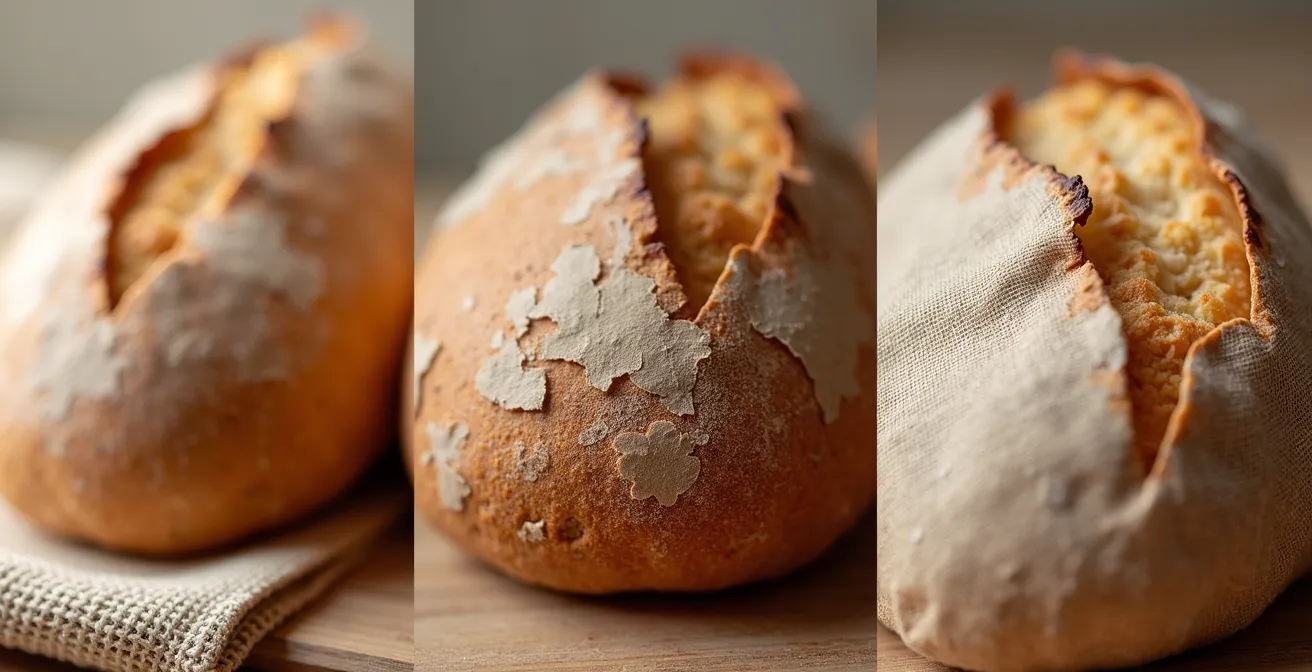
Beyond texture, your packaging choice has significant financial and market implications. A simple stamped paper bag signals an artisanal, fresh-daily product, while a compostable bag appeals to an eco-conscious clientele and can justify a premium price point. Your target market and its local regulations are also a factor; plastic bags are increasingly banned or discouraged in many regions, making eco-friendly options a necessity for compliance and market access.
This table breaks down how different packaging materials influence your costs and how customers perceive your product’s price. An analysis of bakery menu pricing shows a clear link between packaging investment and perceived value in specific markets.
| Package Type | Cost Impact | Price Perception | Best Markets |
|---|---|---|---|
| Stamped Paper Bag | $0.15-0.25/unit | Artisanal/Premium | Vancouver, Portland |
| Compostable Bag | $0.20-0.35/unit | Eco-Premium | California, UK cities |
| Clear Plastic | $0.05-0.10/unit | Mass Market | Limited (bans in many areas) |
| Linen/Cotton Bag | $2-4/unit | Ultra-Premium | Toronto, London luxury |
The Scheduling Hack to Bake 20 Loaves in a Domestic Oven
The single biggest constraint for a home baker scaling up is the domestic oven. With a typical capacity of only two to four Dutch ovens, producing a market-worthy quantity of 20, 30, or even 50 loaves seems impossible. The key to overcoming this is not a bigger oven (at first), but a smarter schedule. Operational headroom is created through meticulous planning, not just brute force.
The solution is a staggered production timeline. Instead of mixing all your dough at once, you create multiple batches, offsetting each one by a few hours. For example, you might mix Batch 1 at 8 AM, Batch 2 at 10 AM, and Batch 3 at 12 PM. This ensures that as one batch is finishing its bake, the next is perfectly proofed and ready to go into the oven. This “pipeline” approach transforms your oven from a single-task device into a continuous production line, maximizing its uptime and your daily output.
To implement this, you must first map your entire baking process with precision. Know exactly how long your starter needs to peak, the duration of your bulk fermentation at a given temperature, and your final proofing time. With this data, you can work backward from your desired bake times to create a detailed timeline. Many bakers use a simple spreadsheet to track each batch’s progress, preventing costly mistakes like over-proofing.
While a domestic oven can handle 4-6 loaves per batch, professional micro-bakers eventually invest in specialized equipment to scale further. A Rofco oven, for example, can bake 12 or more large loaves at once. However, the principle remains the same: efficient scheduling is the engine of production. For those not ready to invest, researching shared commercial kitchens, which can be rented for $15-30 per hour in many cities, offers a flexible way to access larger-capacity ovens and scale production without the upfront cost.
Farmers Market or Subscription Drop: Which Model Builds Loyal Customers?
Once your production is streamlined, the next critical decision is your customer channel strategy. How will you get your bread into the hands of customers? The two most popular models for micro-bakeries are the traditional farmers market and the modern subscription-based drop-off. The choice is not trivial; it defines your business’s cash flow, customer relationships, and potential for growth.
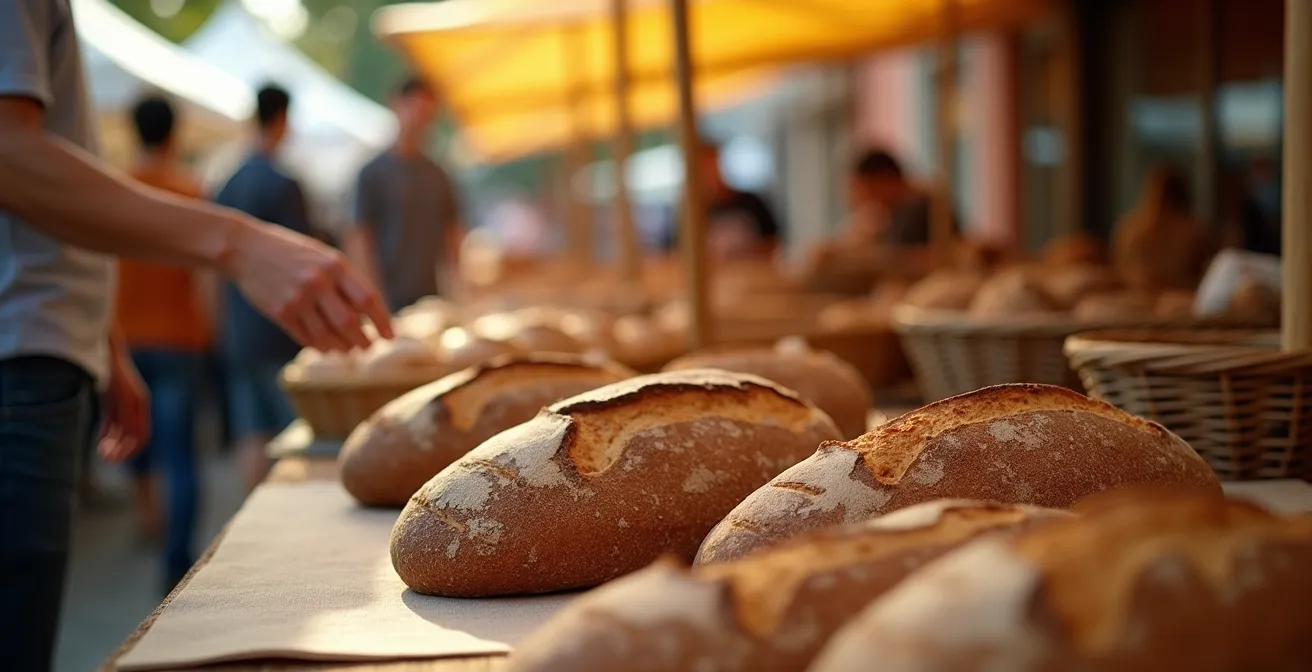
The farmers market is the classic entry point for a reason. It offers unparalleled visibility and direct interaction with customers. Shoppers can see, smell, and sometimes taste your product, creating a powerful sensory connection. This direct feedback is invaluable for refining your offerings. For many, the exposure from a market stall is a game-changer; one cottage bakery owner reported that their baking business quadrupled in its third year primarily due to the visibility gained at a local farmers’ market. The market provides a constant stream of new potential customers, building brand awareness in the local community.
The subscription model, often called a Community Supported Bakery (CSB), offers a different set of advantages. Instead of unpredictable weekly sales, you have predictable, recurring revenue. Customers sign up and pay in advance for a weekly or bi-weekly loaf, which they pick up from a designated location. This model dramatically reduces waste, as you bake exactly to order. It also fosters a deeply loyal customer base, creating a community around your bakery. However, it requires more upfront marketing effort to build that initial subscriber list, often relying on a strong social media presence to attract and retain members.
Ultimately, the best model depends on your goals. The farmers market is ideal for rapid brand exposure and gathering customer feedback. The subscription model is superior for creating predictable income and operational efficiency. Some successful bakeries even use a hybrid approach, using the market to attract new customers and then converting them into long-term subscribers.
Labeling Requirements: The Fine Print That Can Get You Fined
For many home bakers, the topic of labeling is where the dream of selling bread meets the hard reality of regulation. This is the fine print that separates the hobbyist from the professional. While it may seem like a bureaucratic chore, proper labeling is a non-negotiable legal requirement and a powerful tool for building customer trust. A clear, compliant label signals professionalism and a commitment to your customers’ safety, turning a regulatory burden into a brand asset.
Cottage food laws, which govern the sale of homemade goods, vary significantly between states in the US, and have distinct counterparts in Canada and the UK. However, some core principles are universal. At a minimum, most jurisdictions require your label to include the name and address of your business, the common name of the product, and a statement that the food was made in a home kitchen not inspected by the health department. The most critical component, however, is the ingredient and allergen list.
Ingredient lists must be in descending order by weight. More importantly, you must clearly declare all major allergens. The US requires labeling for nine major allergens, while the UK lists fourteen. Failure to do so can result in significant fines and, more seriously, pose a health risk to your customers. It’s also forbidden to use protected terms like “organic” or “gluten-free” without official certification. For bakers in regions like Quebec, Canada, bilingual labeling in both French and English is also mandatory. Mastering these details is a hallmark of a serious business owner.
To navigate this crucial aspect of your business, a systematic approach is essential. This checklist provides a framework for ensuring your products are compliant and your business is protected.
Your Essential Labeling Compliance Checklist
- Ingredient Declaration: List all ingredients in descending order by weight on every single package.
- Allergen Warnings: Include a clear and conspicuous warning for all major allergens relevant to your country (e.g., the 9 in the US or 14 in the UK).
- Contact Information: Display your business name and contact information (address or phone number) as required by your local cottage food laws.
- Certified Claims: Absolutely avoid using terms like “organic,” “non-GMO,” or specific health claims unless you have the official certification to back them up.
- Jurisdictional Nuances: Verify specific local rules, such as bilingual labeling requirements in Quebec or specific “made in a home kitchen” disclaimers.
Why Relying Solely on Foot Traffic Bankrupts 40% of High Street Shops?
In the digital age, a physical presence at a farmers market is no longer enough. The idea that “if you bake it, they will come” is a dangerous myth. Relying solely on foot traffic is like building a shop on a street with no signs. To build a resilient micro-bakery, you must create an audience before you create the product. This means building a digital footprint that generates demand and de-risks your launch.
Social media platforms like Instagram are powerful tools for this. They allow you to share your story, showcase your process, and build a community of followers who are invested in your brand long before they can buy their first loaf. A well-curated feed showing your starter bubbling, the lamination of your croissant dough, or the perfect “ear” on a sourdough loaf acts as a powerful marketing engine. It transforms you from an anonymous baker into a trusted local artisan.
Consider the strategy of bakers like Kristen Dennis of Full Proof Baking. By creating high-quality, educational content on platforms like YouTube, she established herself as an expert in the field. She built a massive, engaged following of fellow bakers who trusted her advice and were eager to support her work. This “audience-first” approach means that when you are ready to sell, you are not launching to an empty room. You are opening the doors to a crowd of eager customers who already know, like, and trust you.
This digital presence also serves as your primary communication channel. You can announce market attendance, share your weekly menu, and take pre-orders, which helps manage production and reduce waste. It provides a direct line to your customers, allowing you to build relationships that go beyond a simple transaction at a market stall. Ignoring this digital foundation is one of the biggest strategic errors a modern micro-baker can make.
Discard Crumpets: The Best Way to Use Up Excess Starter?
As you scale your production, you’ll inevitably face a new challenge: a growing mountain of sourdough starter discard. For a hobbyist, this is a minor annoyance. For a professional, it’s a significant stream of wasted ingredients and money. The entrepreneurial mindset sees this not as waste, but as a raw material for a new, profitable product line. Monetizing discard is a sign of a mature and efficient business.
The most successful strategy is to create a separate range of products where the discard is the star ingredient. Items like crackers, waffles, crumpets, and pancakes have a dual advantage. First, their other ingredient costs are often lower than those for bread, leading to a higher profit margin. Second, they can be marketed as a “zero-waste” or sustainable option, which appeals strongly to environmentally conscious consumers and can command a premium price.
Another clever approach is to sell the starter itself. Dehydrated starter flakes can be packaged into “Sourdough Starter Kits” and sold for $10-15. This not only creates a new revenue stream but also positions you as an expert, empowering others to start their own baking journey. It’s an excellent way to build your brand and community beyond just selling finished loaves.
Before launching a discard product line, it is crucial to check your local cottage food laws again. Some regulations may have different rules for cooked products (like waffles) versus baked goods (like crackers). Understanding these nuances ensures you remain compliant. By transforming a byproduct into a valuable asset, you optimize your ingredient spend, increase your revenue, and strengthen your brand’s commitment to sustainability.
Key Takeaways
- True costing is non-negotiable: Always factor in hidden costs like insurance, utilities, and your own labor to ensure profitability.
- Compliance builds trust: View legal requirements like allergen labeling not as a burden, but as a way to prove your professionalism and care for customers.
- Your sales model dictates growth: Deliberately choose between farmers markets (for visibility) and subscriptions (for predictability) based on your business goals.
Why Your Sourdough Starter Died After 7 Days and How to Revive It?
A dead starter means lost production, cancelled orders, and reputational damage.
– Tom Cucuzza, The Sourdough Journey
A sourdough starter is the living heart of your bakery. Its health and predictability are a direct reflection of the health and predictability of your business. When a starter dies, it’s not just a baking inconvenience; it’s a catastrophic system failure. This final piece of the puzzle—maintaining a robust starter—serves as a powerful metaphor for running a professional operation. It requires consistency, attention to detail, and an understanding of external variables.
A starter’s failure is rarely a mystery; it’s a result of an environmental imbalance. The most common culprits are feeding schedules, temperature, and water quality. A professional baker doesn’t leave these to chance. They maintain a strict feeding schedule, use a proofer or a warm spot to ensure a consistent temperature (ideally around 75-80°F), and, critically, they understand their water.
Water chemistry has a profound impact on yeast and bacterial activity. As an in-depth look at microbakery operations reveals, regional water variations can make or break a starter. The table below illustrates how different water types can affect your starter’s health and what professional bakers do to mitigate these issues.
| Region | Water Type | Common Issue | Solution |
|---|---|---|---|
| London, UK | Hard water (high minerals) | Slow fermentation | Use filtered or bottled water |
| Texas, USA | Chlorinated municipal | Yeast inhibition | Let water stand 24hrs before use |
| Canadian winters | Cold tap water | Sluggish activity | Warm water to 75-80°F |
| California, USA | Variable pH levels | Inconsistent rise | Test and adjust pH if needed |
Just as you would test and control the water for your starter, a professional baker systematically controls every variable in their business. They don’t guess at prices; they calculate them. They don’t hope for customers; they build an audience. They don’t ignore regulations; they master them. The discipline required to keep a starter thriving is the same discipline required to build a resilient and successful bakery business.
Start today by applying these system-thinking principles to your baking. Move beyond simply making bread and begin building the resilient, compliant, and profitable business your passion deserves.
Frequently Asked Questions on Selling Sourdough from Home
What certifications are required to sell baked goods from home in the US?
Most states require food handler’s permits and compliance with cottage food laws, which vary significantly by state. Check your local health department for specific requirements.
How should allergen information be displayed for online sales?
Display full ingredient lists and allergen warnings prominently on product pages for Shopify or Etsy stores to comply with consumer protection laws in both the US and UK.
Can I use terms like ‘organic’ or ‘gluten-free’ without certification?
No, using these terms without official certification can result in fines. USDA Organic certification is required in the US, and similar standards apply in Canada and the UK.