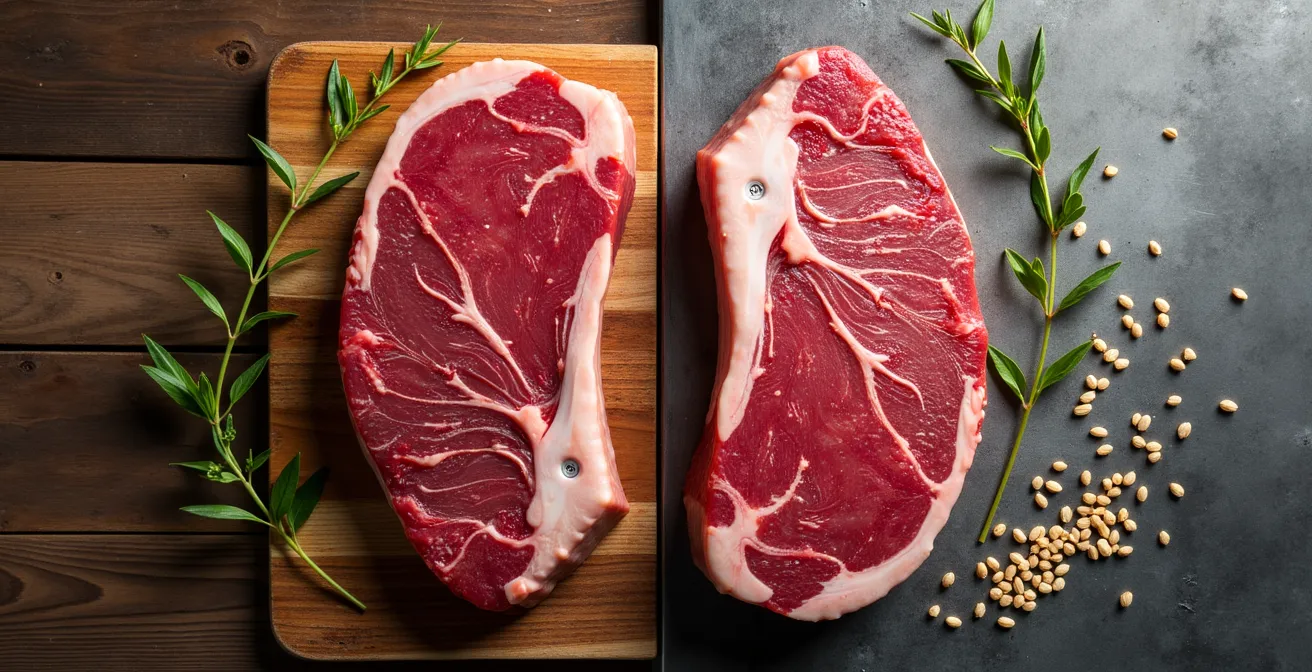
The high price of grass-fed beef is not always justified; true paleo cost-effectiveness comes from strategic budget reallocation toward nutritional density, not blanket premiums.
- Focus on high-impact, low-cost alternatives like organ meats, which offer superior nutritional ROI compared to expensive steaks.
- Avoid the “health halo trap” of expensive, processed “paleo-friendly” snacks that offer poor nutritional and financial value.
Recommendation: Analyze your food choices through a “cost-per-nutrient” lens rather than being guided solely by the “grass-fed vs. grain-fed” label.
The scene is a familiar one for any health-conscious consumer: standing at the butcher counter, weighing the desire for high-quality, ancestrally-aligned protein against a budget that strains under the weight of “grass-fed” price tags. The prevailing wisdom in paleo circles often presents this as a simple choice—pay the premium for superior nutrition. But is this binary choice the most economically sound approach to health? As a nutritional economist, the question isn’t just whether grass-fed is better, but *how much* better, and at what cost?
Most discussions stall on the benefits of higher Omega-3s and Conjugated Linoleic Acid (CLA) in grass-fed meats. While valid, this narrow focus misses the larger financial picture. A truly strategic approach to a paleo diet isn’t about universally paying more. It’s about a sophisticated reallocation of your food budget based on a principle of maximum nutritional return on investment (ROI). This involves identifying nutritional powerhouses that are undervalued by the market and sidestepping “healthy” products where the price is inflated far beyond the nutritional benefit.
This analysis moves beyond the simple “grass-fed is better” mantra. We will deconstruct the economic and nutritional arguments to build a smarter framework for your food spending. We will explore how to leverage undervalued assets like organ meats, identify the hidden metabolic costs in seemingly safe products, and apply principles of strategic sourcing to your diet—proving that a nutritionally optimal paleo lifestyle can be financially sustainable.
This article will provide a detailed breakdown of this economic approach to ancestral eating. By examining specific food categories and strategies, you will gain the tools to make informed financial decisions that support both your health goals and your wallet.
Summary: A Financial and Scientific Analysis of Paleo Eating
- Organ Meats: The Cheap Superfood Most Paleo Eaters Ignore
- Why That “Paleo Cookie” Is Just as Bad as a Regular Cookie?
- Ghee vs Butter: Why Clarifying Makes Dairy Paleo-Friendly?
- The Sunday Roast Strategy: How to Cook Once for 5 Paleo Lunches?
- Does a Paleo Diet Provide Enough Iodine Without Iodized Salt?
- Why Your “Safe” Salad Dressing Is Actually Kicking You Out of Ketosis?
- Bamboo vs Local Pine: Which “Eco” Floor Actually Has a Lower Footprint?
- Why Eating Tropical Fruit in Winter Might Weaken Your Immunity?
Organ Meats: The Cheap Superfood Most Paleo Eaters Ignore
From a nutritional economist’s perspective, the most significant flaw in the modern paleo movement is the overemphasis on expensive muscle meats at the expense of organ meats. This represents a fundamental miscalculation of nutritional ROI. While a grass-fed steak offers quality protein and fats, its cost-per-nutrient profile is vastly inferior to that of organs like liver, heart, or kidney. These are the true superfoods of the animal kingdom, delivering an unmatched density of essential vitamins and minerals for a fraction of the price.
For instance, a detailed nutritional analysis shows that beef liver provides over 500% of the daily value for copper, vitamin A, and vitamin B12 in a single 100g serving. No steak can compete with this level of micronutrient concentration. By ignoring organ meats, consumers are paying a premium for a nutritionally less potent product. Integrating these foods into a diet is the single most effective strategy for reducing costs while dramatically increasing nutrient intake.
The following table provides a clear cost-benefit analysis, comparing the price of common organ meats to their nutritional payload. It demonstrates the stark financial and nutritional inefficiency of prioritizing muscle meat exclusively. The data underscores that achieving nutritional excellence on a budget is not only possible but is the logical outcome of a data-driven approach to food selection.
| Product | Price per lb (USD) | Key Nutrients | % Daily Value per 100g |
|---|---|---|---|
| Grass-fed Beef Liver | $13.34 | Vitamin B12, A, Copper | 500%+ |
| Grass-fed Steak | $25-35 | Protein, Iron, Zinc | 20-30% |
| Beef Kidney | $8.99 | B vitamins, Iron, Selenium | 150-300% |
| Beef Heart | $9.38 | CoQ10, B vitamins, Iron | 100-200% |
This isn’t about deprivation; it’s about intelligent dietary arbitrage—swapping a high-cost, moderate-yield asset (steak) for a low-cost, high-yield one (liver). It’s the cornerstone of a financially sustainable ancestral diet.
Why That “Paleo Cookie” Is Just as Bad as a Regular Cookie?
The second major financial pitfall for the budget-conscious paleo eater is the “health halo” trap. This occurs when a product is marketed with a buzzword like “paleo,” “keto,” or “grain-free,” commanding a premium price while offering little to no superior nutritional value. The paleo cookie is the archetypal example of this phenomenon. Made with expensive almond flour, maple syrup, and coconut oil, it is often calorically identical to a conventional cookie and carries a similar glycemic load. The high price tag is for an ingredient swap, not a health upgrade.
From an economic standpoint, these products represent the worst possible nutritional ROI. Consumers pay a 200-300% markup for a product that still triggers the same metabolic responses as its cheaper, conventional counterpart. The label creates an illusion of virtue, encouraging consumption of a treat food under the guise of health, while simultaneously draining the food budget that could be allocated toward nutrient-dense whole foods like vegetables or the aforementioned organ meats. A savvy nutritional economist views these products not as assets, but as significant financial liabilities in a dietary portfolio.

The visual comparison above highlights the textural differences, but the economic story is in the raw ingredient costs. Almond flour can cost four times as much as wheat flour, and maple syrup significantly more than refined sugar. This price inflation does not translate into a metabolically “free” indulgence. It’s a marketing triumph and a nutritional and financial compromise for the consumer.
Ultimately, a cookie is a cookie. Paying a premium for a “paleo” version is a financially unsound decision that diverts capital away from foods that genuinely contribute to well-being.
Ghee vs Butter: Why Clarifying Makes Dairy Paleo-Friendly?
The case of ghee versus butter offers a more nuanced look at food processing and value. While the paleo diet typically excludes dairy, many adherents make an exception for ghee. This isn’t arbitrary; it’s based on a specific, value-adding processing step: clarification. The process of making ghee involves simmering butter to separate the milk solids (casein and lactose) and water from the pure butterfat. For individuals sensitive to these dairy components, this process removes the problematic elements, rendering the fat source tolerable.
Here, the processing step justifies a price premium because it adds a tangible benefit—it transforms a non-compliant food into a compliant one. This stands in stark contrast to the paleo cookie, where processing merely swaps ingredients without fundamentally altering the food’s metabolic impact. Furthermore, when the source is high-quality, the benefits are amplified. As the experts at Paleo Leap note, the source material is critical.
Grass-fed butter contains significantly more vitamin K2, which is important for heart health and bone health: it helps get calcium into your bones and not into your arteries.
– Paleo Leap Editorial Team, The Importance of Grass-fed Beef
Choosing ghee made from grass-fed butter, therefore, is a sound economic decision. You are paying for both the removal of potential irritants (casein, lactose) and the concentration of beneficial nutrients like vitamin K2 and butyrate found in the fat from pasture-raised animals. This is a clear example of a justified premium, where the extra cost directly correlates with increased tolerability and nutritional value.
It’s a strategic investment in a high-quality cooking fat, not just an expensive indulgence.
The Sunday Roast Strategy: How to Cook Once for 5 Paleo Lunches?
A cornerstone of financial solvency in any domain is maximizing the utility of high-value assets. In a paleo diet, a large, high-quality cut of meat like a chuck roast or a whole chicken is a significant investment. The “Sunday Roast Strategy” is an economic model for maximizing the return on this investment. Instead of viewing it as a single meal, it should be treated as the raw material for a week’s worth of lunches. This approach drastically reduces the cost-per-meal and minimizes food waste, two critical components of a budget-conscious lifestyle.
The strategy hinges on batch cooking and creative repurposing. By cooking a single large roast on the weekend, you create a supply of cooked protein that can be deployed in various forms throughout the week. This not only saves time but also prevents the impulse purchases of expensive, less-healthy convenience lunches. It transforms a one-time, high-cost purchase into a stream of five or more low-cost, high-quality meals. The final step—using the bones to make a nutrient-rich broth—extracts every last bit of nutritional and financial value from the initial purchase.
This is not merely “meal prep”; it’s a strategic approach to asset management within your kitchen. It applies the industrial principle of “full utilization” to a household setting. The following plan provides a concrete template for putting this strategy into practice.
Your 5-Day Meal Prep Action Plan: The Sunday Roast Strategy
- Day 1: The Foundation. Serve slices of the fresh roast with steamed vegetables for a classic, protein-packed meal.
- Day 2: The Salad. Shred leftover cold roast and combine it with mixed greens, avocado, and a simple vinaigrette for a quick and satisfying salad.
- Day 3: The Wrap. Use large lettuce leaves as wraps and fill them with shredded meat, salsa, and chopped onions for “taco” style meal.
- Day 4: The Sauté. Dice the remaining roast and quickly stir-fry it with leftover vegetables and coconut aminos for a new flavor profile.
- Day 5: The Broth. Simmer the bones and any remaining scraps for several hours to create a deeply nourishing bone broth, which can be drunk on its own or used as a base for a future soup.
This method demonstrates that financial discipline and a paleo lifestyle are not mutually exclusive; they are, in fact, highly compatible when a strategic framework is applied.
Does a Paleo Diet Provide Enough Iodine Without Iodized Salt?
A strict paleo diet, by eliminating processed foods and iodized table salt, introduces a potential nutritional liability: iodine deficiency. Iodine is a critical mineral for thyroid function and metabolism. While conventional diets supply it through fortified salt, a paleo eater must engage in strategic sourcing to meet their needs. This presents another opportunity for the nutritional economist to find high-ROI solutions. Relying on unfortified salts like Himalayan pink salt or sea salt is a common but critical error, as they are not reliable sources of this nutrient.
In fact, mineral analysis reveals that sea salt and Himalayan salt contain less than 1% of the iodine found in their iodized counterparts. The solution, therefore, is not to find a “paleo salt” but to source iodine from whole foods where it occurs naturally and abundantly. This is both nutritionally superior and often highly cost-effective.

Foods like seaweed (kombu, nori), wild-caught fish (especially cod), and pastured eggs are excellent sources of iodine. Seaweed, in particular, is a nutritional powerhouse. A single gram of dried kombu can provide over 2000% of the recommended daily intake. From a cost-per-nutrient perspective, a package of dried seaweed is an incredibly wise investment, offering a massive dose of a crucial mineral for a very low price. This is a perfect example of strategic sourcing to cover a nutritional gap created by a dietary shift, without resorting to expensive, isolated supplements.
It’s about being proactive in your nutritional accounting, ensuring all essential mineral “accounts” are balanced through intelligent, low-cost food choices.
Why Your “Safe” Salad Dressing Is Actually Kicking You Out of Ketosis?
For those combining paleo with a ketogenic approach, vigilance against hidden costs becomes even more critical. Here, the cost is not just financial but metabolic. Commercial salad dressings, even those marketed as “light” or “healthy,” are often laden with hidden sugars, starches, and industrial seed oils that can halt ketosis and undermine the diet’s goals. This represents a hidden metabolic cost that sabotages the body’s fat-burning state.
Analysis of product labels frequently reveals this deception. For example, label analysis shows that many ‘light’ commercial dressings contain 2-3g of hidden sugars per 2 tablespoon serving, often disguised as maltodextrin, corn syrup solids, or fruit juice concentrate. While this may seem small, it can be enough to exceed the strict carbohydrate limits of a ketogenic diet, effectively “kicking you out” of ketosis and negating its benefits. Paying a premium for a salad, only to negate its health benefits with a poor dressing choice, is a classic example of nutritional-economic inefficiency.
The solution is simple and financially prudent: create your own dressings from high-quality, compliant ingredients. A simple mix of extra virgin olive oil, vinegar, and seasonings has zero carbohydrates and is far cheaper than any pre-bottled “keto-friendly” alternative. This comparison table illustrates the stark difference in metabolic liability between commercial and homemade options.
| Dressing Type | Carbs per 2 Tbsp | Hidden Ingredients | Keto Status |
|---|---|---|---|
| Commercial Ranch | 2-4g | Maltodextrin, sugar | Not keto |
| Olive Oil & Vinegar | 0g | None | Keto-friendly |
| ‘Healthy’ Balsamic | 3-5g | Balsamic glaze, fruit purees | Not keto |
| Homemade Caesar | 1g | None if made properly | Keto-friendly |
It is a crucial step in ensuring that your dietary investments are not being silently eroded by seemingly insignificant choices.
Bamboo vs Local Pine: Which “Eco” Floor Actually Has a Lower Footprint?
While seemingly out of place in a nutritional discussion, this question about flooring provides a powerful metaphor for strategic food sourcing. Consumers often choose bamboo flooring, believing it to be the “greener” choice because bamboo is a fast-growing grass. However, when you factor in the energy costs of processing and shipping it from Asia to North America, a floor made from slower-growing but locally harvested pine often has a much lower total environmental footprint. The sticker price and a single “eco” attribute don’t tell the whole story.
This exact logic applies to our food choices, especially within the paleo framework. We can become fixated on a single attribute—like “grass-fed” beef from New Zealand or “organic” quinoa from Bolivia—without considering the true cost of bringing that food to our table. This “true cost” includes the financial expense of long-distance shipping, the nutritional degradation that occurs during transport, and the metabolic dissonance of eating foods that are out of sync with our local climate and season.
A nutritional economist argues that a truly optimal diet prioritizes local and seasonal foods whenever possible. A conventionally grown apple from a local orchard in the fall may be a superior choice—financially, nutritionally, and ecologically—to a certified “organic” apple that has been shipped thousands of miles and stored for months. The “local pine” of our diet is the food grown in our own region. Embracing it requires moving beyond simplistic labels and adopting a more holistic, systems-based view of our food supply.
It challenges us to apply the same critical thinking to our grocery cart that a conscientious builder applies to their materials, prioritizing local, sustainable, and truly efficient options.
Key takeaways
- Organ meats offer the highest nutritional ROI, providing unmatched nutrient density for a fraction of the cost of muscle meats.
- “Paleo” labels on processed foods like cookies are often a “health halo” cost trap, offering no significant health benefit over conventional treats.
- Seasonality and locality can be more important indicators of nutritional value and true cost than a single attribute like “grass-fed” or “organic.”
Why Eating Tropical Fruit in Winter Might Weaken Your Immunity?
The principle of strategic sourcing, as illustrated by the flooring analogy, finds its most direct nutritional application in the consumption of fruit. Eating a pineapple in Canada in January is a modern marvel of logistics, but it is a metabolically and economically questionable choice. From a paleo perspective, our bodies are adapted to thrive on foods available in our local environment and current season. Consuming foods that are wildly out of season can create a metabolic dissonance.
There is a tangible nutritional cost to this practice. As nutritional studies indicate, tropical fruits can lose up to 30% of their vitamin C content during the long-distance shipping and storage required to get them to a winter market. You are paying a premium price for a nutritionally-depleted product. In contrast, a locally stored winter squash or apple, while perhaps less exotic, retains more of its nutrients and is better aligned with what our ancestors would have eaten during that season.
This alignment with seasonal cycles is a core tenet of many ancestral health models, as it provides the specific micronutrients needed for that climate. As Dr. Sarah Ballantyne, a leading voice in the paleo community, explains:
Consuming local, seasonal produce provides micronutrients and fibers that support the gut microbiome for that specific climate and time of year.
– Dr. Sarah Ballantyne, The Paleo Mom Blog
Therefore, choosing local and seasonal produce is not a romantic or dogmatic notion; it is a sound economic strategy to maximize your nutritional ROI, ensuring you get the most potent nutrients for the lowest possible true cost.