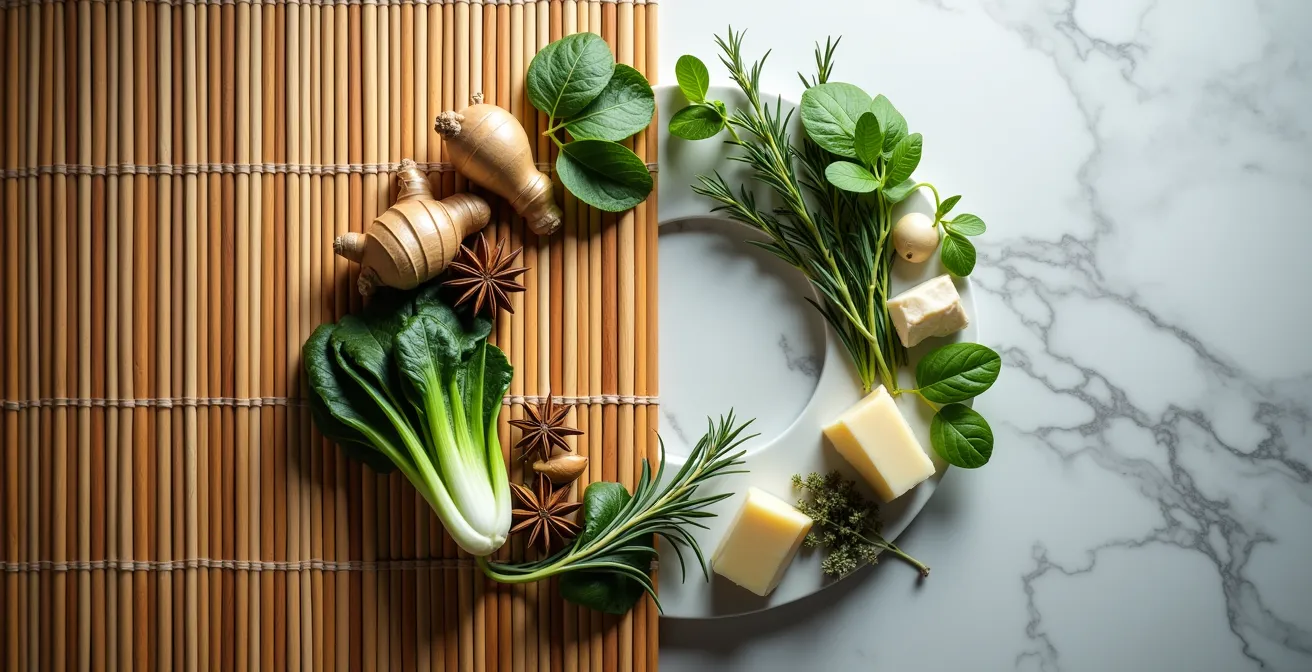
Successful fusion cooking isn’t random mixing; it’s a disciplined art based on understanding the universal “grammar” of flavor.
- Great fusion respects the structural pillars (acid, fat, heat) of each cuisine, rather than just combining popular ingredients.
- Authenticity comes from ingredient integrity and giving proper, specific credit to the original culinary sources and techniques.
Recommendation: Before your next fusion experiment, analyze the core flavor profile and techniques of each cuisine separately. Master the rules before you break them.
You’ve tasted kimchi tacos and spicy tuna on crispy rice, and inspiration strikes. You grab some gochujang from the supermarket, some tortillas, and leftover carnitas. What emerges from your kitchen, however, isn’t a brilliant fusion but a confusing, unbalanced mess. This experience is common for ambitious home cooks. Many believe fusion cuisine is simply about creative freedom, about mashing up two cultures on a plate. They’re told to “be creative” and “don’t be afraid to fail,” but this advice often ignores the craft and respect required.
The internet is filled with recipes that treat deep-rooted culinary traditions as a grab-bag of exotic flavors. But what if the secret to brilliant fusion isn’t found in a chaotic clash of ingredients, but in a disciplined, respectful understanding of them? What if there’s a “flavor grammar” that governs why certain combinations sing while others screech? True fusion is an act of translation, not theft. It requires you to become a student of multiple culinary languages before you can write your own poetry.
This guide moves beyond the platitudes. We will not just tell you to be creative; we will give you the technical framework to channel that creativity effectively. We will deconstruct the science of flavor pairing, guide you on sourcing ingredients with integrity, and provide a clear methodology for honoring your inspiration. Prepare to move from confusion to confident, delicious fusion.
text
This article will guide you through the essential techniques and philosophies that separate thoughtful fusion from culinary chaos. Below is a summary of the key areas we will explore to elevate your cooking.
Summary: The Chef’s Framework for Successful Fusion Cuisine
- Acid, Fat, Heat: The Ratios That Make “Weird” Combinations Work?
- Supermarket vs Specialty Store: Where to Buy Gochujang That Actually Tastes Good?
- Inspiration vs Theft: How to Credit Traditional Recipes on Social Media?
- No Yuzu? The Lemon-Lime Mix That Mimics the Flavor Perfectly
- Riesling or Beer: What to Drink with Kimchi Tacos?
- When to Join Expat Clubs: The Timing Strategy for Faster Integration
- Wok Hei at Home: Can You Get “Breath of the Wok” on an Electric Stove?
- MSG Myths: Why the “Fifth Taste” Is Essential for Authentic Asian Cooking?
Acid, Fat, Heat: The Ratios That Make “Weird” Combinations Work?
The single biggest mistake in fusion cooking is focusing on ingredients before principles. A successful dish, regardless of its origin, is built on structural pillars: acid, fat, salt, and heat. Fusion doesn’t change these rules; it simply widens the palette you use to fulfill them. Think of it as a universal “flavor grammar.” You can swap a French verb for a Japanese one, but the sentence still needs a verb to make sense. Similarly, you can swap lime juice (acid) for kimchi (fermented acid and spice), but the dish still needs that acidic element to cut through richness (fat).
Before combining cuisines, analyze them through this lens. What is the primary source of fat in Mexican cuisine? Lard, cheese, avocado. In Korean? Sesame oil, fatty pork. How is heat delivered? Through the sharp, fresh heat of jalapeños or the deep, fermented heat of gochujang? Understanding these roles is crucial. A dish fails when you layer fat on fat without enough acid to balance it, or when competing types of heat create a muddled, aggressive flavor instead of a complex one. The goal is harmony, not a shouting match on the plate.
Case Study: Roy Choi’s Flavor Grammar
Chef Roy Choi’s legendary Kogi BBQ taco is a masterclass in this principle. He didn’t just throw Korean meat into a tortilla. He understood the grammar of a taco: a rich, fatty protein (Korean short rib) balanced by sharp acidity and crunch (slaw, pickles) and a spicy, savory sauce. As noted in a profile on his work, Choi’s take on Korean-meets-Mexican fusion created what was dubbed “America’s first viral eatery.” His success wasn’t random; it was a technically sound application of flavor grammar, using ingredients from two different lexicons to build a perfectly structured “sentence.”
Master this by deconstructing dishes you love. Identify the role each component plays. Once you see these patterns, you can start making intelligent, effective substitutions, which is the true heart of innovative fusion.
Supermarket vs Specialty Store: Where to Buy Gochujang That Actually Tastes Good?
Your fusion dish is only as good as your worst ingredient. When you’re borrowing from another cuisine, using a mass-market, “dumbed-down” version of a key component is a recipe for failure. This is especially true for fermented products like gochujang (Korean chili paste). The bright red squeeze bottle you find in the international aisle of a major supermarket is often loaded with corn syrup and lacks the funky, umami depth of its traditional counterpart. It delivers sweetness and one-dimensional heat, but misses the complex, fermented soul of the ingredient.
This is where ingredient integrity becomes paramount. For a successful fusion, you need the real deal. This often means skipping the supermarket and seeking out a specialty store—a Korean H-Mart, a Japanese grocer, or a trusted online retailer. When you’re shopping, look for clues. A long ingredient list isn’t always bad; in this case, it can indicate a traditional fermentation process involving various grains and powders. A “Made in Korea” label is a good sign. The use of rice syrup instead of high-fructose corn syrup points to higher quality.
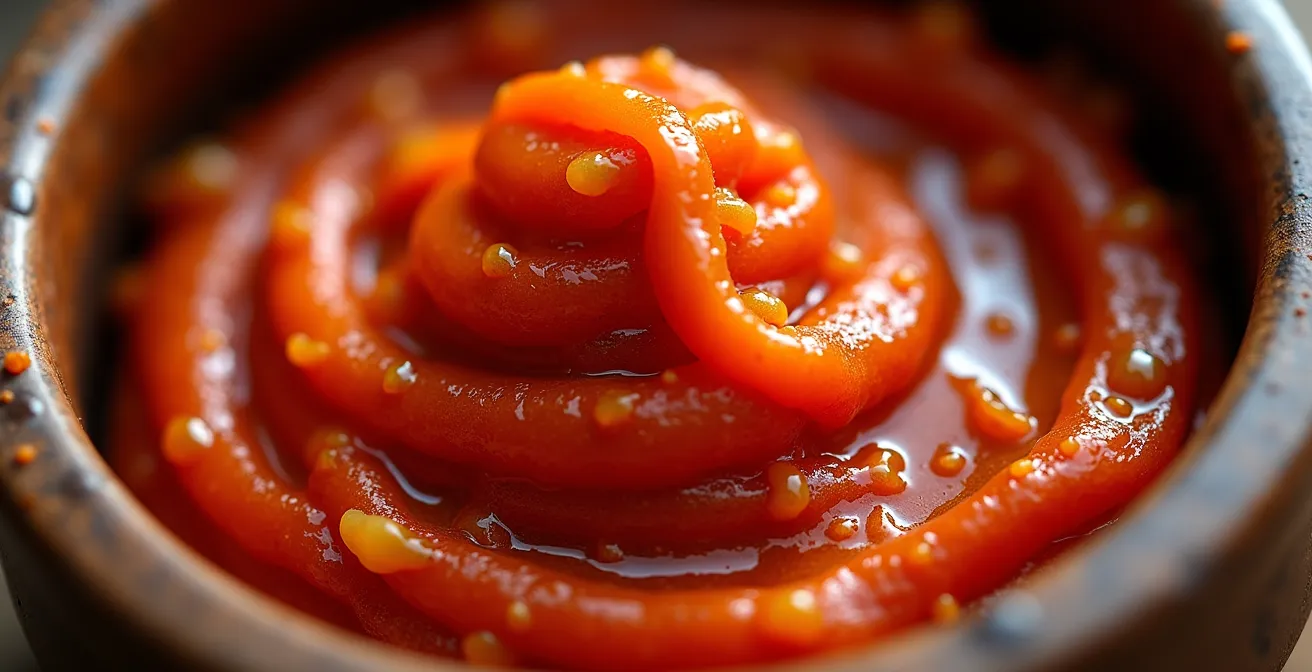
The texture seen here, a deep, glossy paste with visible graininess, is what you’re looking for. It signifies a product made with care, one that will bring a universe of flavor to your dish, not just a splash of color and heat. Investing the time to find quality ingredients is a fundamental sign of respect for the cuisine you’re borrowing from.
This table offers a starting point for sourcing high-quality gochujang in several key countries, based on a general understanding of fusion ingredient sourcing.
| Location | Best Sources | What to Look For |
|---|---|---|
| USA | H-Mart (online & stores), Korean markets in Los Angeles | ‘Made in Korea’ label, sun-dried chili percentage listed |
| Canada | Korean communities in Toronto, Vancouver Korean markets | Fermented soybean powder in ingredients, rice syrup (not corn syrup) |
| UK | New Malden Korean shops (London), online specialty retailers | Longer ingredient list indicating traditional fermentation |
Inspiration vs Theft: How to Credit Traditional Recipes on Social Media?
In the age of viral food content, the line between inspiration and appropriation is dangerously thin. As a chef, I believe this is the most important—and most often ignored—aspect of fusion cooking. Flavor doesn’t exist in a vacuum; it is born from culture, history, and generations of technique. When you use a flavor or a method, you are tapping into that legacy. To do so without acknowledgment isn’t just poor form; it’s a form of theft. As one culinary expert puts it, true culinary status is built on respect for your sources.
Proper credit goes beyond ingredients to include technique and narrative.
– Fusion cooking philosophy
Saying your dish is “Asian-inspired” is lazy and erases specificity. Asia is a continent of dozens of countries and thousands of distinct culinary traditions. Are you inspired by the Szechuan use of numbing peppercorns, the Japanese art of aging fish, or the Thai balance of sweet, sour, salty, and spicy? Be specific. Naming the dish, the technique, the region, or even the chef who inspired you shows respect and educates your audience. It elevates your work from a simple copy to a thoughtful conversation between cultures.
This doesn’t mean you can’t be creative. It means you must frame your creativity with context. Acknowledging your sources doesn’t diminish your originality; it strengthens it by showing that you’ve done the work, you understand the foundation you’re building upon, and you respect the giants on whose shoulders you stand. Use this checklist to guide how you credit your work.
Your Action Plan: The Ethical Crediting Checklist
- Direct Adaptation: Clearly state your source. Use phrasing like “My take on the classic [Dish Name] from [Region/Country], with the original recipe by [Original Chef/Source].”
- Inspired Creation: Define both elements. Use phrasing like “Flavors inspired by Vietnamese [Dish Name], fused with a classic French [Technique/Dish].”
- Conceptual Echo: Credit the technique or philosophy. Use phrasing like “A dish using the [Technique, e.g., ‘dry-frying’] from Szechuan cooking applied to [New Ingredient].”
- Ingredient Spotlight: If a single ingredient is the star, name its origin. For example, “A dessert built around the unique flavor of Japanese yuzu.”
- Narrative Honesty: If you learned about a dish from a specific blog, book, or trip, share that story. It adds authenticity and gives credit naturally.
No Yuzu? The Lemon-Lime Mix That Mimics the Flavor Perfectly
One of the practical challenges of fusion cooking, especially in the US, Canada, and the UK, is sourcing rare ingredients. A recipe might call for fresh yuzu, a Japanese citrus with an incredibly floral, aromatic flavor profile that’s a cross between a grapefruit and a mandarin orange. However, finding fresh yuzu outside of Japan or specific high-end markets in major cities is nearly impossible and prohibitively expensive. This is where a chef’s technical skill in flavor mimicry and substitution becomes critical.
Giving up is not an option. The goal is to replicate the *effect* of the ingredient, not necessarily the ingredient itself. Yuzu provides a powerful, high-toned floral acidity. A simple 1:1 mix of fresh lemon and lime juice is the most common quick fix, but it misses the floral notes. To get closer, you can use the juice of a Meyer lemon (which is less acidic and more floral than a standard lemon) and add a bit of fresh grapefruit zest to the mix. The oils in the zest will contribute some of the complex aromatic compounds you’re missing.
For an even more advanced substitution, consider local options. In the UK, the intensely fragrant peel of a Bergamot orange can provide a similar floral punch. In North America, steeping a few bruised Makrut lime leaves in your lemon/lime juice for 30 minutes will impart a beautiful, complex citrus-floral aroma that does an excellent job of standing in for yuzu. Understanding *why* an ingredient works allows you to find creative and effective solutions when it’s unavailable.
The scarcity and high cost of fresh yuzu in Western countries, as compared to a market like China, is a key reason why substitution techniques are so valuable, as shown in analyses of global ingredient availability.
| Country | Availability | Where to Find | Price Range |
|---|---|---|---|
| USA | Limited seasonal | Japanese markets in NYC, LA | High ($5-8 per fruit) |
| Canada | Very limited | Vancouver Japanese specialty stores | Very high ($6-10 per fruit) |
| UK | Rare | Select London Japanese grocers | Premium ($7-12 per fruit) |
| China | Widely available | Local markets, online platforms | Affordable ($1-3 per fruit) |
Riesling or Beer: What to Drink with Kimchi Tacos?
Pairing a beverage with a fusion dish like kimchi tacos presents a fascinating challenge. The standard Western approach might steer you toward a high-acid white wine like an off-dry Riesling to balance the spice, or a crisp lager to cut through the fat. These are not wrong—they work based on the principles of flavor pairing—but they can feel like a missed opportunity. A truly great fusion experience extends beyond the plate and into the glass. The beverage should be part of the conversation, not just a bystander.
Instead of defaulting to wine or beer, consider a “cultural bridge” beverage. Since the dominant, defining flavor of the dish is Korean kimchi, why not look to Korean drinks for the pairing? A simple cocktail made with Soju, a clean, neutral Korean spirit, mixed with pear juice would complement the fermented notes of the kimchi beautifully. Even better is Makgeolli, a lightly sparkling, unfiltered Korean rice wine. It has a natural sweetness, a gentle tang, and probiotic qualities that echo the kimchi itself, creating a holistic and deeply resonant pairing.
For those seeking non-alcoholic options, the same principle applies. Rather than reaching for soda, explore the world of artisanal teas. A cold-brewed roasted barley tea (boricha) has a nutty, savory quality that can stand up to the richness of the taco. A sparkling cold-brewed oolong or green tea offers effervescence and astringency that cleanses the palate between bites. These choices show a deeper level of thought and create a more memorable, cohesive dining experience that honors all aspects of the dish’s inspiration.
When to Join Expat Clubs: The Timing Strategy for Faster Integration
This section title may seem out of place, but let’s reframe it for the kitchen: when should a cook “integrate” into a new culinary world? The answer is: before you start inventing. The path to great fusion begins with humility and a willingness to learn. Before you can respectfully adapt a cuisine, you must first understand it on its own terms. This means joining “culinary communities”—whether they are online forums, local cooking classes, or simply the kitchens of friends who grew up in that tradition.
The goal of this initial integration is not to take, but to listen and learn. Watch how a grandmother makes her family’s kimchi. Read food blogs written by native cooks. Understand the context of a dish: is it for a celebration, a quick weekday meal, a comforting sick-day soup? This cultural knowledge is as vital as any recipe. It prevents you from making clumsy mistakes, like applying a complex, ceremonial technique to a casual dish. True integration is about absorbing the “why” behind every “how.”
The best time to join culinary communities is when you’re ready to listen, not just take.
– Fusion cooking philosophy
Join these communities when your goal is to be a student. Ask questions. Be humble. Master a few classic, traditional dishes exactly as they are meant to be made. Only after you have built this foundation of knowledge and respect can you earn the right to start experimenting. This period of integration is your most important investment. It’s the difference between being a tourist who snaps a photo and a traveler who learns the language.

Wok Hei at Home: Can You Get “Breath of the Wok” on an Electric Stove?
One of the most sought-after yet misunderstood elements of Chinese and other Asian cuisines is *wok hei*—literally, the “breath of the wok.” It’s that elusive, smoky, savory aroma that clings to a perfectly executed stir-fry. Many home cooks believe it’s impossible to achieve without a restaurant-grade, jet-engine gas burner. They are partially right about the heat requirement, but wrong about the source. Wok hei is a chemical reaction, not a flavor imparted by gas.
The magic happens when tiny droplets of oil and particles of food are thrown against the superheated sides of the wok, vaporize, and combust. This requires incredibly high temperatures. As some culinary science shows, professional wok hei requires temperatures between 650-750°F. While a standard home electric stove struggles, a powerful induction stovetop or a modern electric wok can come very close. As legendary chef Martin Yan states, the heat can come from any source: “You could use nuclear fusion, as long as you can create that intense heat.” The key is the pan and the reaction, not the fuel.
So how can a home cook on an electric stove get close?
- Get the Wok Smoking Hot: Heat your carbon steel wok until it is literally smoking before you add cold oil. Swirl and immediately add your ingredients. This initial sear is crucial.
- Don’t Crowd the Pan: This is the most common mistake. Cook in small, single-layer batches. Overcrowding drops the temperature instantly, resulting in steamed, soggy food instead of a seared, smoky stir-fry.
- The “Cheater’s” Blowtorch: For the dedicated, a small kitchen blowtorch passed quickly over the food just before serving can add a touch of that charred, smoky flavor.
- Flavor Illusion: A drop of high-quality toasted sesame oil or a sprinkle of a specific “wok hei” seasoning blend at the very end can create a powerful aromatic illusion of true wok hei.
While you may never perfectly replicate the inferno of a restaurant kitchen, by understanding the science and using these techniques, you can absolutely achieve a delicious, smoky result that honors the spirit of wok hei at home.
Key Takeaways
- True fusion is guided by the universal “flavor grammar” of acid, fat, and heat, not random combinations.
- Ingredient integrity is non-negotiable; seek out authentic, high-quality components from specialty sources.
- Respectful cooking requires specific attribution; crediting the cuisine, dish, or technique is as vital as the flavor itself.
MSG Myths: Why the “Fifth Taste” Is Essential for Authentic Asian Cooking?
For decades, monosodium glutamate (MSG) has been unfairly vilified in Western cooking, largely due to the debunked myth of “Chinese Restaurant Syndrome.” For any home cook serious about fusion—especially involving East and Southeast Asian cuisines—it’s time to let go of this fear and embrace MSG for what it is: a pure form of umami, the fifth taste. To omit it from certain dishes out of misplaced fear is like trying to make a cake without sugar. You’re removing a foundational building block of flavor.
Umami is the savory, meaty, brothy taste found naturally in ingredients like parmesan cheese, mushrooms, tomatoes, and soy sauce. MSG is simply the sodium salt of glutamic acid, one of the most abundant amino acids in nature. Decades of rigorous, double-blind scientific studies have disproven any link between MSG and the alleged symptoms. In fact, major international food safety organizations, including the FDA, have placed MSG in the safest category of food ingredients, alongside salt and vinegar.
In the kitchen, MSG is a powerful tool. It doesn’t just add saltiness; it amplifies and rounds out other flavors, adding a depth and “moreishness” that is impossible to replicate. It’s the secret to that craveable quality in a great bowl of ramen or a perfectly seasoned stir-fry. Some research has even suggested that using umami-rich broths can help regulate appetite. A study on the physiological functions of glutamate found that consuming an MSG-enhanced broth before a meal can decrease appetite and reduce the intake of less healthy fats. By rejecting MSG, you are not only making your food less delicious, but you are also ignoring a tool used by chefs and home cooks across Asia for over a century.
Start small. Add a tiny pinch to your next soup, marinade, or stir-fry sauce along with salt. Taste the difference. You’ll discover a new depth and balance. Embracing MSG is a key step in truly understanding and authentically executing many of the world’s most delicious cuisines.
Now that you are equipped with the principles of flavor grammar and respectful creation, it’s time to apply them. Start your next culinary experiment not with a random idea, but with a question: what flavor grammar do I want to explore, and how can I do so with knowledge and respect? Your journey from confusion to masterful fusion begins now.