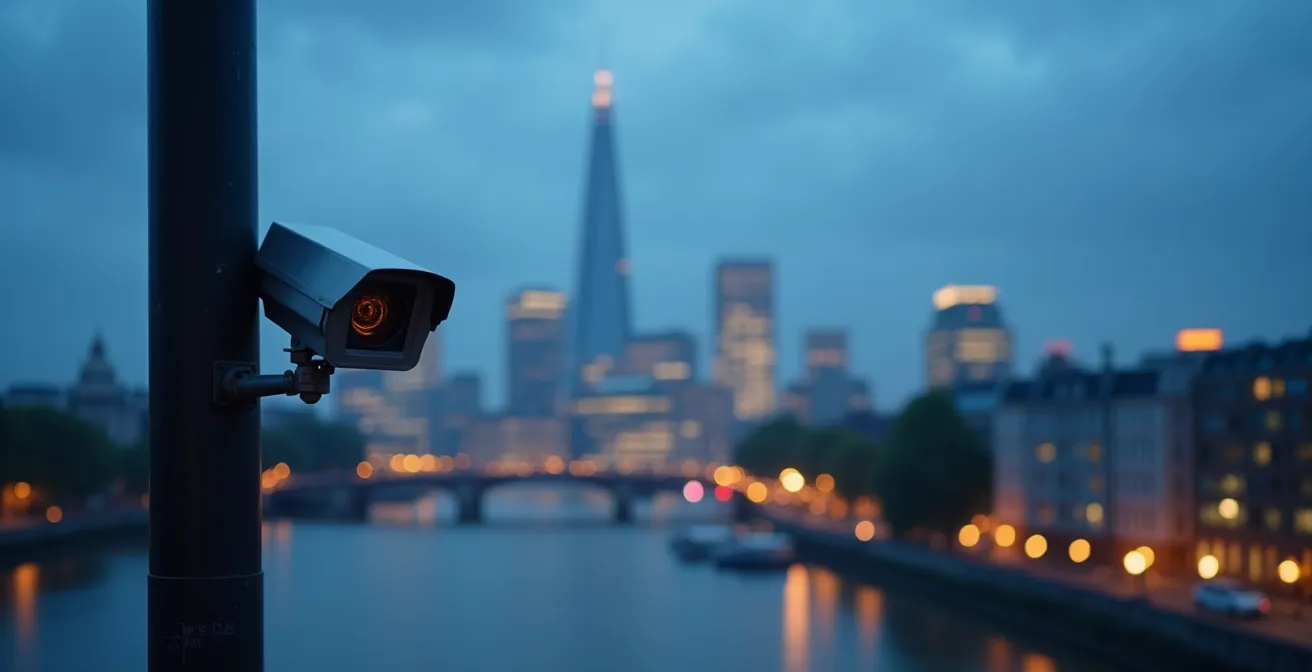
The promise of a safer, more efficient London hides a vast data marketplace built on your daily habits, where convenience is the fee and your privacy is the currency.
- Surveillance is not just CCTV; it’s embedded in your smart meter, transit app, and the very property data of your neighbourhood, creating invisible digital tripwires.
- Convenience features, like public Wi-Fi and app integrations, often come with invasive permissions that serve commercial interests, not just your security.
Recommendation: Achieve digital autonomy by actively auditing app permissions, questioning every data request, and understanding the economic incentives behind the smart city infrastructure you use daily.
Walking through London, the feeling is palpable. You are being watched. The official narrative tells you this is for your protection, a necessary trade-off for security in a sprawling metropolis. We are told that the ubiquitous CCTV cameras, the smart transit systems, and the connected public services create a shield against crime and chaos. This security-versus-privacy debate is the most common platitude, a tired binary that deliberately obscures a more unsettling truth.
The conversation rarely moves beyond the sheer number of cameras to question the system’s purpose. What if the primary function of this vast network isn’t just security, but commerce? What if the smart city isn’t just a safer city, but a highly efficient data marketplace where your movements, preferences, and behaviours are the most valuable commodities? The real threat isn’t just being seen; it’s being sorted, scored, and sold. The convenience of tapping your phone to ride the Tube or connecting to free Wi-Fi at a station comes at a cost, but the price tag is written in the fine print of a privacy policy you’ve never read.
This isn’t about rejecting technology. It’s about understanding its true cost. This article moves beyond the surface-level debate to expose the specific digital tripwires you cross every day in London. We will dissect the mechanisms that turn your daily life into a stream of monetisable data, from the energy you consume to the routes you travel. By understanding the ‘why’ behind the ‘what’, you can begin to navigate this environment not as a passive subject of surveillance, but as an informed resident reclaiming a measure of your digital autonomy.
This guide breaks down the hidden data transactions embedded in London’s urban fabric. The following sections will equip you with the critical knowledge needed to see the city’s smart infrastructure for what it truly is.
Summary: The Hidden Cost of a Connected London
- Why Your Smart Meter Might Be Overestimating Usage by 15%
- How to Use City Data Portals to Predict Neighborhood Gentrification?
- The Cybersecurity Gap in Public Wi-Fi That Exposes Commuters to Identity Theft
- Smart District vs Historic Zone: Which Offers Better Long-Term Property Value?
- When Will Drone Deliveries Replace Couriers in High-Density Zones?
- Why Does Your Transit App Need Access to Your Photos and Contacts?
- Deepfake or Real: How to Spot AI-Generated Images in News Feeds?
- The Cybersecurity Gap in Public Wi-Fi That Exposes Commuters to Identity Theft
Why Your Smart Meter Might Be Overestimating Usage by 15%
Your smart meter is presented as a tool for empowerment, giving you real-time data to manage energy consumption. However, its primary function is to create a high-frequency data stream for the utility provider. The 15% overestimation figure, while a documented concern in some early-generation devices, points to a broader, more systemic vulnerability: the unquestioning faith in automated data collection. These systems are not infallible. Just as London’s ULEZ cameras have been shown to incorrectly issue fines due to cloning or system errors, the complex software in smart meters is susceptible to glitches, bugs, and calibration drift.
The real issue is not just the potential for inaccurate billing, but the nature of the data being collected. Your energy usage patterns are a powerful form of proxy data. They can reveal when you wake up, when you go to sleep, when you’re on holiday, and even how many people live in your home. This information is a goldmine for advertisers, insurers, and data brokers. While utility companies are regulated, the ecosystem of third-party “energy management” apps and services that connect to this data often operates with far less oversight.
The core problem is information asymmetry. You are given a simplified dashboard, while the provider gains a granular, 24/7 insight into your life. The promise of “smarter” living masks a transaction where you trade intimate details of your household’s rhythm for a vague promise of efficiency. Questioning the accuracy of the meter is the first step; questioning the necessity of such granular data collection is the crucial next one.
How to Use City Data Portals to Predict Neighborhood Gentrification?
Public data portals like the London Datastore are promoted as beacons of transparency. They offer vast datasets on everything from crime rates to planning applications. Yet, for those who can read between the lines, they are also powerful predictive engines for urban change, particularly gentrification. By cross-referencing datasets, you can spot the leading indicators of a neighborhood on the cusp of economic transformation long before the first artisanal coffee shop opens its doors.
Look for a confluence of signals: a sudden spike in planning applications for converting commercial properties to residential, an increase in licenses for cafes and restaurants, and a dip in the recorded income levels of existing residents, soon followed by a sharp rise. This pattern indicates that capital is flowing in, preparing for a demographic shift. For instance, Trust for London research shows an 11% average income increase in gentrifying areas, a clear metric of displacement. By monitoring these data points, you are not just observing the city; you are witnessing the mechanics of the data marketplace reshaping the urban landscape.
Case Study: The Reshaping of East London
An analysis of census data between 2011 and 2021 provides a stark illustration of this phenomenon. Areas like Stratford, Walthamstow, Deptford, and Greenwich show the formation of new “radial corridors of affluence” extending from the city center. The property price data per square metre in these North East and South East boroughs now mirrors patterns previously exclusive to West London, revealing a clear, data-traceable path of gentrification and displacement driven by major redevelopment projects.
This macro-level data visualization helps contextualize the raw numbers, showing how investment and demographic shifts physically manifest across the city.

The ability to perform this analysis isn’t a flaw in the system; from a market perspective, it’s a feature. It allows investors, developers, and real estate speculators to identify undervalued areas and capitalize on future growth. For the privacy-conscious resident, it’s a double-edged sword: a tool for foresight, but also a confirmation that your neighborhood’s future is being modeled and traded as a dataset.
The Cybersecurity Gap in Public Wi-Fi That Exposes Commuters to Identity Theft
While you’re acutely aware of the 15,516 CCTV cameras in the London Underground watching your physical movements, a far less visible but more immediate threat exists in the very Wi-Fi networks you use to pass the time. Public Wi-Fi, especially in transient locations like Tube stations, is a notorious weak point in personal cybersecurity. The convenience of “free” internet access is a powerful lure, but it creates a perfect hunting ground for malicious actors.
The primary threat is the “Man-in-the-Middle” (MitM) attack. An attacker can easily set up a rogue Wi-Fi hotspot with a convincing name like “TfL_WiFi_Free”. Once you connect, all your internet traffic—passwords, emails, bank details—is routed through their device. You are handing them the keys to your digital life. Even on legitimate networks, if the connection is not properly encrypted (look for the padlock symbol), your data is broadcast “in the clear,” making it trivial for anyone on the same network to intercept.
slight_pause
This isn’t a theoretical risk. It’s a fundamental design flaw of how we approach public amenities. The focus is on providing access, with security often being an afterthought. This gap is a crucial digital tripwire. It exploits our desire for constant connectivity, turning a moment of boredom on a platform into a high-risk activity. The perceived safety of a busy, camera-filled station offers no protection against this invisible form of theft. Your physical security might be monitored, but your digital identity is left exposed.
Smart District vs Historic Zone: Which Offers Better Long-Term Property Value?
The choice between living in a hyper-connected “smart district” like Canary Wharf or a historically protected area like Greenwich is often framed as a lifestyle decision: modern convenience versus traditional charm. However, from a data privacy and long-term value perspective, the distinction is far more significant. Smart districts are, by design, environments of intense infrastructural surveillance. The efficiency they promise is powered by a dense network of sensors, cameras, and data collection points.
The City of London, for example, is one of the most surveilled places on earth. Research reveals a staggering density of cameras that goes far beyond simple security. While this data can optimize traffic flow or waste management, it also creates an unparalleled record of public life. This constant monitoring has an unquantified but real impact on the “value” of living there. For a growing number of people, the psychological cost of pervasive surveillance detracts from the appeal, potentially creating a ceiling for property value in the long term.

Conversely, historic zones, with their building restrictions and protected status, are inherently more resistant to the installation of such dense sensor networks. Their value is tied to scarcity, character, and a sense of permanence. As awareness of the data marketplace grows, the perceived “privacy premium” of living in a less-monitored area could become a significant driver of property value. The question is no longer just about architecture and amenities, but about digital autonomy. Which is a better long-term bet: a district optimized for machine efficiency or one preserved for human experience?
When Will Drone Deliveries Replace Couriers in High-Density Zones?
The vision of automated drones zipping through London’s skies to deliver packages is a staple of smart city speculation. While technologically feasible, the biggest hurdles are not engineering challenges but regulatory and social ones, rooted deeply in the city’s existing surveillance infrastructure. London is already saturated with an estimated 942,562 security cameras, and the introduction of a fleet of autonomous flying delivery vehicles would add another pervasive layer of mobile data collection.
Each delivery drone would be a flying sensor package, equipped with cameras for navigation and GPS for routing. This creates a host of privacy issues. Who owns the “incidental” footage the drone captures as it flies past a residential window? How is this data stored, and who has access to it? The regulatory framework is simply not prepared for this escalation. The debate around a previous attempt to govern surveillance gives us a clue to the difficulties ahead.
Case Study: The Surveillance Camera Code of Practice
The UK Home Office’s 2013 Surveillance Camera Code of Practice was an attempt to establish guidelines for CCTV and ANPR systems used by public authorities. However, its impact was limited by a crucial fact: the vast majority of cameras are privately operated, with some estimates suggesting a 70-to-1 ratio of private to public cameras. This creates massive regulatory gaps. A similar challenge would face drone deliveries, which would likely be operated by private corporations, falling outside the direct purview of existing public surveillance laws and creating yet another unregulated data marketplace.
Therefore, the question is not “when” drones will arrive, but “under what terms.” Without a robust legal framework that prioritizes citizen privacy over corporate data-gathering, the rollout of drone deliveries would represent a significant expansion of the surveillance state, traded for the marginal convenience of faster takeaway.
Why Does Your Transit App Need Access to Your Photos and Contacts?
When you download a transit app, you expect it to need your location to function. But when it asks for access to your photos, contacts, and microphone, a red flag should go up. This is a classic example of “permission overreach,” a key mechanism in the urban data marketplace. While developers may offer benign justifications—access to photos for personalizing your profile, or to contacts for sharing your ETA—the real value lies in data aggregation. An app that can cross-reference your location data with your social graph (contacts) and personal media (photos) is exponentially more valuable to data brokers.
This occurs in a city where, according to research, the average Londoner is already captured on CCTV an estimated 70 times per day. Your physical movements are tracked, and your transit app adds a rich layer of digital and social context to that tracking. The industry justifies this pervasive monitoring under the banner of safety, as highlighted by security firms.
CCTV cameras installed at Underground stations, bus stops, and taxis provide security protection for commuters.
– Surrey Security, The Impact of CCTV Monitoring on Crime Prevention in London
Yet, this argument conveniently ignores the fact that your app’s request for contact list access has nothing to do with preventing crime on a bus. It’s a commercial transaction disguised as a feature. Reclaiming your digital autonomy begins with treating every permission request with skepticism and denying anything that isn’t essential for the app’s core function.
Your Action Plan: Privacy Protection for London Transit
- Review app permissions in your phone’s Settings immediately after installation and deny any that are not essential.
- Deny photo and contact access by default; a transit app’s core function is navigation, not social networking.
- Use anonymous or unregistered Oyster cards for travel where possible to avoid linking your journeys to your personal identity.
- Disable location sharing for the app when you are not actively using it for navigation to prevent background tracking.
- Regularly check TfL’s privacy policy to understand their data retention periods and how your information is used.
Deepfake or Real: How to Spot AI-Generated Images in News Feeds?
The smart city’s data collection apparatus is built on the premise that the data, once captured, is an authentic record of reality. But the rise of generative AI and deepfakes shatters this assumption. We are rapidly entering an era where distinguishing between a real photograph from a London protest and an AI-generated image designed to inflame tensions is becoming nearly impossible for the human eye. This erodes the very foundation of trust in the information we see.
This challenge of data *integrity* echoes an earlier debate about data *access*. The controversy surrounding government surveillance powers highlighted the fundamental tension between security and privacy. Citizens were concerned about the state having a truthful record of their lives. Now, the problem is inverted: we are faced with the pollution of the information ecosystem with convincing falsehoods. This is no longer about a government agency tracking you, but about any actor being able to fabricate “evidence” that you were somewhere you weren’t.
Case Study: The Investigatory Powers Bill Debate
In the wake of the Edward Snowden revelations, the UK’s 2016 Investigatory Powers Bill (dubbed the “Snooper’s Charter”) sought to formalize mass surveillance practices. The heated debate centered on the state’s right to collect mass metadata without judicial oversight. Critics warned of the chilling effects on civil liberties, while the government argued it was essential for counter-terrorism. This entire debate was predicated on the assumption that the data being collected was *real*. Deepfake technology adds a terrifying new dimension, where the argument could shift to justifying surveillance as a tool to *verify* reality.
How can you spot these fakes? Look for the tell-tale signs of current AI models: flawlessly uniform textures, strange physics in the background, unnatural patterns, and hands with the wrong number of fingers. Use reverse image search to trace a picture’s origin. But these are temporary solutions. The ultimate defence is a vigilant, skeptical mindset: treat all startling or emotionally charged imagery as potentially manipulated until proven otherwise. In the new data war, your critical thinking is your last line of defence.
Key Takeaways
- Data collection is infrastructural and often invisible, embedded in the very services you use for convenience.
- The smart city operates as a data marketplace where your privacy is frequently traded for access, often without your explicit, informed consent.
- You can reclaim a degree of digital autonomy by being skeptical of defaults, auditing permissions, and understanding the economic motives behind data collection.
The Cybersecurity Gap in Public Wi-Fi That Exposes Commuters to Identity Theft
We’ve established the specific risk of public Wi-Fi, but it’s crucial to see this not as an isolated issue, but as a symptom of a systemic philosophy. The cybersecurity gap on the Tube is the perfect metaphor for the entire smart city proposition: a surface-level benefit (free internet) masking a deep, structural vulnerability. This same logic applies to the transit app demanding your contacts, the smart meter tracking your sleep schedule, and the data portal predicting your neighborhood’s displacement. Convenience is the universal justification, and the end-user’s security and privacy are consistently the first items to be compromised.
The problem is that these digital tripwires are not seen as interconnected. A resident might be wary of CCTV but think nothing of using public Wi-Fi. They might deny an app access to their photos but accept the data collection of a smart meter as non-negotiable. This fragmented view is what the data marketplace thrives on. By presenting each data transaction as a separate, minor trade-off, the cumulative effect of total surveillance is obscured.
Achieving genuine digital autonomy requires a holistic approach. It means understanding that the same commercial incentive that drives a developer to over-request app permissions is at play in the provision of insecure public networks. It’s all part of the same ecosystem designed to extract maximum value with minimum friction. The solution, therefore, is not just to use a VPN, but to cultivate a mindset of universal skepticism towards any “free” or “smart” service that demands your data as payment.
Your first step towards digital autonomy is to question the defaults and challenge the veneer of convenience. Start today by reviewing the permissions on your most-used city app and ask a simple, powerful question: why?