
The primary risk of urban e-scooting is not simply collision, but the constant, unforeseen liability exposure that comes from operating a vehicle within an infrastructure not designed for it.
- Private e-scooters remain illegal on UK public roads, exposing unknowing owners to significant fines and license points.
- Effective security requires a multi-layered strategy beyond a simple lock, as professional theft rates are skyrocketing.
Recommendation: Before purchasing, conduct a personal risk audit covering your specific route’s legal status, security weak points, and true usage costs to understand your actual liability.
For the modern urban commuter in London or New York, the “last mile” problem is a daily frustration. Public transport gets you close, but the final leg of the journey can be a tedious walk or a frustrating wait for a connecting bus. The electric scooter presents itself as a sleek, efficient solution. It promises to transform a 20-minute walk into a 5-minute breeze. But while the benefits are clear, the risks are often dangerously underestimated. The common advice—wear a helmet, watch for cars—barely scratches the surface of the complex legal and practical hazards involved.
The convenience of an e-scooter is seductive, but this convenience comes with a hidden cost: a significant transfer of risk onto the rider. This isn’t just about physical safety. It’s about your legal standing, your financial liability, and the daily logistical challenges of securing and maintaining your vehicle. The core issue is a systemic mismatch: a 15-mph personal vehicle operating in an environment designed primarily for 2-ton cars and 3-mph pedestrians, with few provisions in between.
To truly understand if an e-scooter is right for you, we must move beyond simple pros and cons. The real key is to adopt a mindset of continuous navigational due diligence. This is the active, ongoing process of assessing the legal, infrastructural, and security risks of your specific journey. This article is not a simple buyer’s guide; it is a framework for conducting that due diligence. We will analyze the specific legal exposures in the UK, dissect effective security protocols, evaluate the true cost of ownership, and examine the infrastructural blind spots that create hazards long before you even turn the key.
For those who prefer a visual summary, the following video profiles a rider’s experience, offering a glimpse into the daily reality of integrating an e-scooter into an urban commute.
This guide provides a structured analysis of the critical factors you must consider. By breaking down the risks into distinct categories, you can build a complete picture of what e-scooter ownership truly entails, allowing you to make an informed, responsible decision.
Summary: A Commuter’s Guide to E-Scooter Risk Assessment
- Why Your E-Scooter Might Be Illegal on UK Public Roads?
- The Locking Strategy That Deters 90% of Bike Thieves in Major Cities
- How to Preserve E-Bike Battery Life During a Canadian Winter?
- Buy or Rent: At What Usage Level Does a Personal Scooter Pay Off?
- The Folding Bike Mistake That Makes Rush Hour Trains a Nightmare
- The Pediatrician Gap That Plagues 60% of New Suburban Developments
- The Design Flaw That Makes Self-Driving Pods Unusable for Wheelchair Users
- Why Your E-Scooter Might Be Illegal on UK Public Roads?
Why Your E-Scooter Might Be Illegal on UK Public Roads?
For commuters in London and other major UK cities, the most significant risk associated with personal e-scooters is not physical but legal. There is a profound and often misunderstood distinction between government-approved rental scooters and privately owned ones. Under current UK law, private e-scooters are classified as Personal Light Electric Vehicles (PLEVs), which means they are subject to the same legal requirements as cars and motorcycles, including insurance, taxes, and licensing. Since they do not meet these standards, their use is strictly prohibited on public roads, cycle lanes, and pavements.
The only legal way to ride an e-scooter on public land in the UK is to use a rental device within one of the designated trial areas. These government-sanctioned trials are currently set to continue for some time, with trial areas extended until May 31, 2026, according to official guidance. This creates a confusing landscape where a rider on a Voi or Lime scooter is compliant with the law, while a person on their identical-looking private scooter is committing an offense. This legal gray area represents a significant liability exposure for uninformed buyers.
The penalties for illegal use are substantial, including a £300 fine and up to six penalty points on your driving license. To navigate this complex legal framework, it’s crucial to understand precisely where and how you are permitted to ride. The following table breaks down the legal status based on scooter type and location.
This stark legal contrast between rental and private scooters is detailed in a clear legal analysis available for UK residents.
| E-Scooter Type | Legal Status | Requirements | Penalties if Violated |
|---|---|---|---|
| Rental E-Scooters (Trial Zones) | Legal | Provisional/Full UK license, 18+ years, Max 15.5 mph | Fines for misuse |
| Private E-Scooters (Public Roads) | Illegal | N/A – Prohibited | £300 fine, 6 points on license |
| Private E-Scooters (Private Land) | Legal | Landowner permission | N/A |
Your Pre-Ride Legal Checklist: UK Trial Zones
- Verify you are physically within a government-approved trial area (e.g., specific boroughs in London, Birmingham, Manchester).
- Use only rental e-scooters from officially approved operators like Lime, Voi, Tier, or Dott.
- Confirm you hold at least a provisional UK driving license that includes the ‘Q’ category.
- Ride exclusively on roads and in cycle lanes; riding on pavements is strictly forbidden.
- Adhere to the mandatory 15.5 mph maximum speed limit imposed on all trial scooters.
The Locking Strategy That Deters 90% of Bike Thieves in Major Cities
Once you navigate the legal hurdles, the next immediate risk is theft. E-scooters are high-value, portable targets, and theft is not a minor concern; it’s a rapidly growing criminal enterprise. The convenience that makes them appealing to commuters also makes them appealing to thieves. Recent data reveals an alarming 481% increase in e-scooter theft in recent years, highlighting a critical need for robust operational security. A casual cable lock is an invitation for disaster and provides a false sense of security.
Effective deterrence is not about a single, “best” lock. It’s about a layered strategy designed to make your scooter a less attractive target than the one next to it. The core principle is to use two different types of high-quality locks. This forces a thief to carry two different types of tools, increasing their risk and the time required for the theft. The primary lock should be a hardened steel U-lock (or D-lock) securing the frame to an immovable object. The secondary lock should be a heavy-duty chain or folding lock, used to secure the wheels or provide an additional anchor point.

This two-lock method, as illustrated, creates a significant visual and physical deterrent. The choice of lock quality is paramount. A study on bicycle theft sheds light on common owner mistakes that apply directly to scooters. In a survey of over 5,000 theft victims, it was found that 80% used unrated locks and 70% had spent less than $41 on their security. This underscores a critical failure in personal risk assessment: underinvesting in the protection of a high-value asset.
Case Study: The False Economy of Cheap Locks
An analysis of over 5,000 bike theft victims in Canada provided by a bike security analysis platform revealed critical patterns in user behavior. A staggering 70% of victims spent less than $41 on their lock, with nearly a third spending under $20. This gross underinvestment in security, especially in cities like Toronto which recorded nearly 3,000 thefts in a single year, demonstrates a common but costly mistake. The lesson for e-scooter owners is clear: a $600+ scooter protected by a $20 lock is not a secure asset; it is a high-risk gamble. Your security budget should be proportional to the asset’s value, typically around 10%.
How to Preserve E-Bike Battery Life During a Canadian Winter?
While the title mentions e-bikes, the underlying science of lithium-ion battery preservation in cold weather is identical for e-scooters, presenting a significant operational risk for commuters in colder climates like Canada or the northern US. The battery is the heart and the most expensive component of your scooter. Exposing it to extreme cold without proper precautions can lead to a temporary range reduction of 30-50% and, more critically, permanent capacity loss. This is a maintenance issue that directly impacts the vehicle’s financial viability and reliability.
The fundamental principle of cold-weather battery care is temperature management. Lithium-ion batteries perform optimally at room temperature (around 20°C or 68°F). When temperatures drop, the electrochemical reactions inside the battery slow down, reducing its ability to deliver power. Charging a frozen battery is especially damaging and can cause irreversible plating on the anode, permanently reducing its capacity. Therefore, your “navigational due diligence” must extend to environmental management of the scooter’s core component.
For riders in cities like Toronto or Montreal, a winter riding protocol is not optional; it is essential for protecting your investment. This involves managing both storage and charging cycles with careful attention to temperature.
- Indoor Acclimatization: When temperatures fall below -10°C (14°F), always bring the battery indoors. Crucially, let it acclimatize to room temperature for at least 30 minutes before plugging it in to charge.
- Storage Charge Level: If you are storing the scooter for an extended period during the winter, do not leave the battery fully charged or fully depleted. Maintain a charge level between 40-60% to minimize degradation.
- Active Insulation: For those who ride throughout the winter, installing a DIY neoprene insulation wrap around the battery compartment can help retain some of the heat generated during use, mitigating the worst effects of the cold.
- Power Mode Discipline: While it may seem counterintuitive, avoid using eco or low-power modes on icy or challenging surfaces where you might need a burst of power for safety and stability. Reserve lower power modes for clear, dry roads.
- Avoid Unheated Storage: Never leave your scooter for more than a day in an unheated garage where temperatures can plummet. Always bring the battery inside.
Buy or Rent: At What Usage Level Does a Personal Scooter Pay Off?
The financial aspect of “navigational due diligence” requires a sober analysis of buying versus renting. The allure of ownership is strong, promising freedom from per-minute charges. However, the total cost of ownership (TCO) extends far beyond the initial purchase price. It must include maintenance, charging costs, insurance (where applicable), and crucially, security hardware. A comprehensive analysis is required to determine the break-even point where a personal scooter becomes more economical than using rental services like Lime, Bird, or Voi.
Case Study: The High-Frequency User Advantage
An analysis of rental costs across major UK trial cities reveals significant variation, making a one-size-fits-all conclusion impossible. In London, rental rates average £1 to unlock plus 15-20p per minute. In contrast, some smaller cities offer daily passes for £10-£15. The study found that for high-frequency users—those taking 20 or more trips per month—personal ownership can lead to savings of 60-70% over renting. This calculation, however, is contingent on factoring in the total costs of ownership, including insurance, maintenance, and electricity, which can average around £25 per month combined.
The decision hinges almost entirely on your usage frequency. For the occasional joyrider or someone needing to bridge a last-mile gap once or twice a week, the high upfront cost and associated responsibilities of ownership are unlikely to be worthwhile. For the daily commuter, the equation changes dramatically. The following table provides a model for calculating this break-even point based on typical usage patterns and costs.
A recent comparative analysis provides a clear financial model for prospective buyers, showing that the break-even point is often further away than many assume.
| Usage Frequency | Monthly Rental Cost (Lime/Bird) | Personal Scooter TCO | Break-Even Point |
|---|---|---|---|
| Daily Commute (20 days/month) | $120-180 | $40/month (amortized) | 4-6 months |
| 3x per week | $60-90 | $40/month | 8-12 months |
| Weekend only | $30-40 | $40/month | 18+ months |
| *Based on £1 unlock + 15p/minute rental rates, $600 scooter purchase price | |||
The Folding Bike Mistake That Makes Rush Hour Trains a Nightmare
The concept of “systemic mismatch” is nowhere more apparent than in the integration of micro-mobility with mass transit. While folding bikes have carved out a niche, e-scooters face a much tougher reality, particularly on services like the London Underground. The core mistake commuters make is assuming their device will be welcome. This is a failure of due diligence regarding transit operator policies. The ability to fold is often not the deciding factor; it is the perceived fire risk from lithium-ion batteries and the physical bulk of the device.
Transport for London (TfL) has taken a clear and uncompromising stance on this issue, which serves as a critical data point for any London-based commuter considering a purchase. Their policy is not ambiguous and is rooted in safety assessments.
E-scooters hired under the rental e-scooters trial have always been banned from TfL services because they cannot be folded
– Transport for London, TfL E-scooter Policy Statement
This ban extends to private e-scooters as well, creating a major logistical barrier for multi-modal commutes. The dream of scooting to the station and carrying your device onto the train is, in many major cities, simply not a reality. This highlights an infrastructural blind spot in urban planning: the lack of a seamless interface between different modes of transport. For a folding scooter to be practical, the entire process must be swift and efficient, especially during the chaos of rush hour.
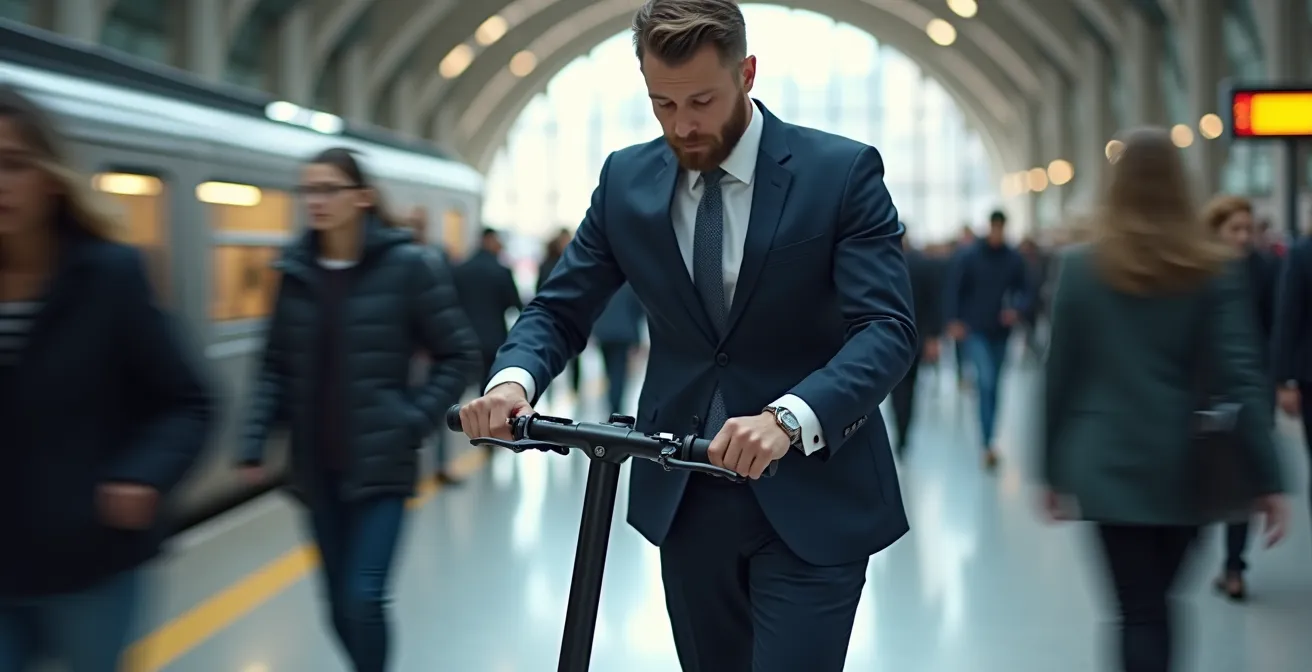
Even where allowed, the etiquette and practicality of managing a scooter on a crowded platform are significant. A slow, clumsy folding mechanism can create bottlenecks and frustration for fellow commuters. A prospective buyer must research the specific policies of every transit authority on their route and realistically assess their ability to manage the device in a high-pressure environment.
The Pediatrician Gap That Plagues 60% of New Suburban Developments
While seemingly unrelated, the concept of a “pediatrician gap” in new suburban developments serves as a powerful metaphor for the hidden risks of e-scooter use outside of dense urban cores. This “gap” refers to a well-documented phenomenon where new housing is built far faster than essential social infrastructure like schools and healthcare facilities. It is a classic example of an infrastructural blind spot born from car-centric planning. The same planning philosophy that overlooks the need for a local doctor also overlooks the need for safe, alternative modes of transport.
For an e-scooter rider, this translates into a hostile environment. Imagine a commuter in a new suburban development trying to reach a train station two miles away. They are likely faced with a four-lane arterial road with a 45-mph speed limit, no bike lanes, and fragmented sidewalks that end abruptly. This is the micro-mobility equivalent of the pediatrician gap. The infrastructure assumes every journey will be made by car, leaving scooter riders dangerously exposed. The city has, in effect, failed in its duty of care to provide safe passage for all residents.
In this context, the rider’s personal “navigational due diligence” must be heightened to an extreme degree. You are operating in an environment that was not designed for you and is inherently unforgiving. You must scout your route in advance, identifying choke points, unsafe crossings, and stretches of road with no shoulder or escape path. The risk is not just from traffic, but from the very design of the landscape—poorly maintained surfaces, lack of curb cuts, and intersections designed solely for vehicle throughput. The “pediatrician gap” is a symptom of a system that prioritizes development over liveability, a system that creates profound risks for anyone daring to travel outside of a metal box.
The Design Flaw That Makes Self-Driving Pods Unusable for Wheelchair Users
Looking toward the future of urban mobility, the challenges faced by emerging technologies like self-driving pods offer a crucial lesson for today’s e-scooter riders. When a next-generation transit solution—designed from the ground up—fails to account for a fundamental need like wheelchair accessibility, it reveals a deep-seated flaw in design philosophy. It shows that even with a blank slate, designers and planners can perpetuate a lack of universal design, creating systems that cater to a narrow definition of the “average” user.
This is not a niche accessibility issue; it is a cautionary tale about the dangers of assuming infrastructure will be fit for purpose. If a futuristic, multi-million-dollar pod system has such a glaring design flaw, what does that say about the current state of our centuries-old sidewalks, curb cuts, and road surfaces? For the e-scooter rider, the lesson is stark: you cannot trust that the path ahead is safe. The same broken pavement or absent curb ramp that makes a route impassable for a wheelchair user is a serious accident risk for a scooter with small wheels and limited suspension.
This reinforces the core theme of navigational due diligence. The rider must become an active scanner of their environment, proactively identifying hazards that are invisible to a car driver and overlooked by city planners. These “design flaws” in the urban fabric include:
- Cobblestone streets or historic paving that are treacherous for small-wheeled vehicles.
- Poorly lit underpasses or cycle paths that conceal potholes and debris.
- Drainage grates with bars aligned in the direction of travel, creating a trap for scooter wheels.
- Intersections where bike lanes disappear, forcing riders to merge unexpectedly with high-speed traffic.
The failure of future tech to solve for accessibility is a powerful reminder that current infrastructure is likely riddled with similar oversights. The responsibility for navigating these flaws falls squarely on the rider.
Key Takeaways
- Legal ambiguity is a major financial risk, especially in the UK where private e-scooter use on public roads remains illegal, exposing owners to significant fines.
- The cost-effectiveness of owning vs. renting an e-scooter is highly dependent on daily usage, and breaking even can take over a year for casual users.
- Environmental factors, such as winter cold impacting battery life and high urban theft rates, are not minor inconveniences but significant operational risks that must be factored into any purchase decision.
Why Your E-Scooter Might Be Illegal on UK Public Roads?
We return to the foundational question of legality, but this time with a broader perspective. The specific rules governing rental versus private scooters in the UK are not arbitrary red tape; they are the result of a fundamental conflict between innovation and public liability. The reason your private scooter is illegal on public roads is that there is currently no established legal framework to ensure it is safe, to hold the rider accountable, or to provide for victims in case of an accident. It exists in a state of legal limbo.
Rental schemes solve this problem through a closed-loop system. The operators are required to carry insurance, the vehicles are speed-limited and geofenced, and the users are identifiable via their driver’s licenses and payment information. This creates a chain of accountability that is completely absent with private ownership. The government’s reluctance to legalize private scooters wholesale stems from these unresolved questions of insurance, rider standards, and vehicle safety compliance.
For the prospective buyer, this means you are not just purchasing a product; you are assuming a significant, undefined legal risk. The future of legislation is uncertain. While many hope for a new PLEV classification that would legalize and regulate private scooters, the timeline is unknown. Until that day, every ride on a public road is a gamble against a £300 fine and six license points. This is the ultimate expression of the “systemic mismatch”: owning a vehicle for which no legal or insurable place exists in the public right-of-way. This is the most critical component of your personal liability exposure.
To make an informed decision, your next step should not be a purchase, but a thorough assessment of these risks against your specific commute. Evaluate your route, your local laws, and your budget through the lens of navigational due diligence.
Frequently Asked Questions on E-Scooters
What happens to lithium batteries at -20°C?
Permanent capacity loss can occur if charged while frozen. Always warm batteries to at least 5°C before charging.
How much range do I lose in Canadian winter?
Expect 30-50% range reduction at -10°C compared to room temperature performance.
Can I leave my e-scooter in an unheated garage?
Only if the battery is removed and stored indoors, or if garage temperature stays above -5°C.